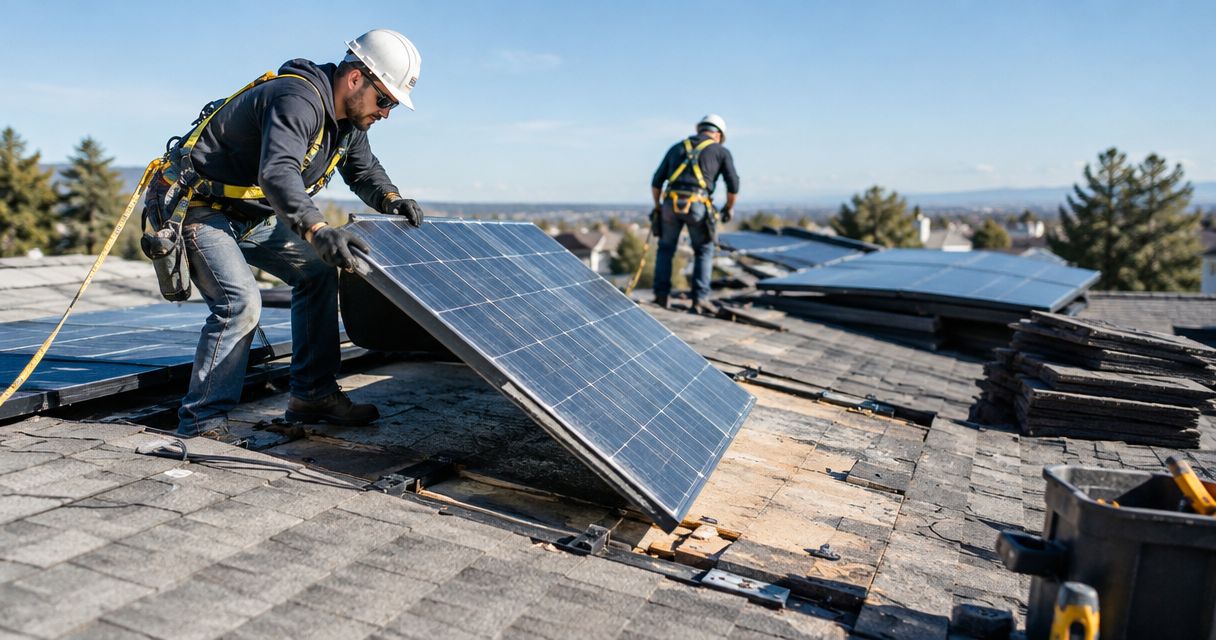
Instead of coordinating solar removal and roofing as separate jobs, use one written sequence: qualified solar professionals disconnect and remove the array, the roofer replaces the roof, and the solar team reinstalls and checks the system. This 2026 solar panel removal roof replacement workflow keeps responsibilities clear before anyone opens the roof.
- Solar panel removal roof replacement needs a written handoff between the roofer and qualified solar professionals.
- Prescott Roofing serves Southern New Hampshire homeowners planning homeowner-paid residential roof replacement.
- Confirm ownership, removal authorization, mounting requirements, and storage responsibility before scheduling tear-off.
- Finish roof inspection and attachment planning before solar reinstallation; verify operation afterward.
Why this matters
Solar panels hide roofing that must be accessible during replacement. Mounts also connect the array to the building, so removing modules alone does not resolve every attachment or flashing detail. Flashing is the material that directs water away from a roof penetration or intersection.
Prescott Roofing is best for Southern New Hampshire homeowners seeking residential roof replacement. For a house with an existing array, evaluate the roofing scope alongside the separate solar removal and reinstallation scope. The broader roof replacement guide for homes with solar panels covers that planning context.
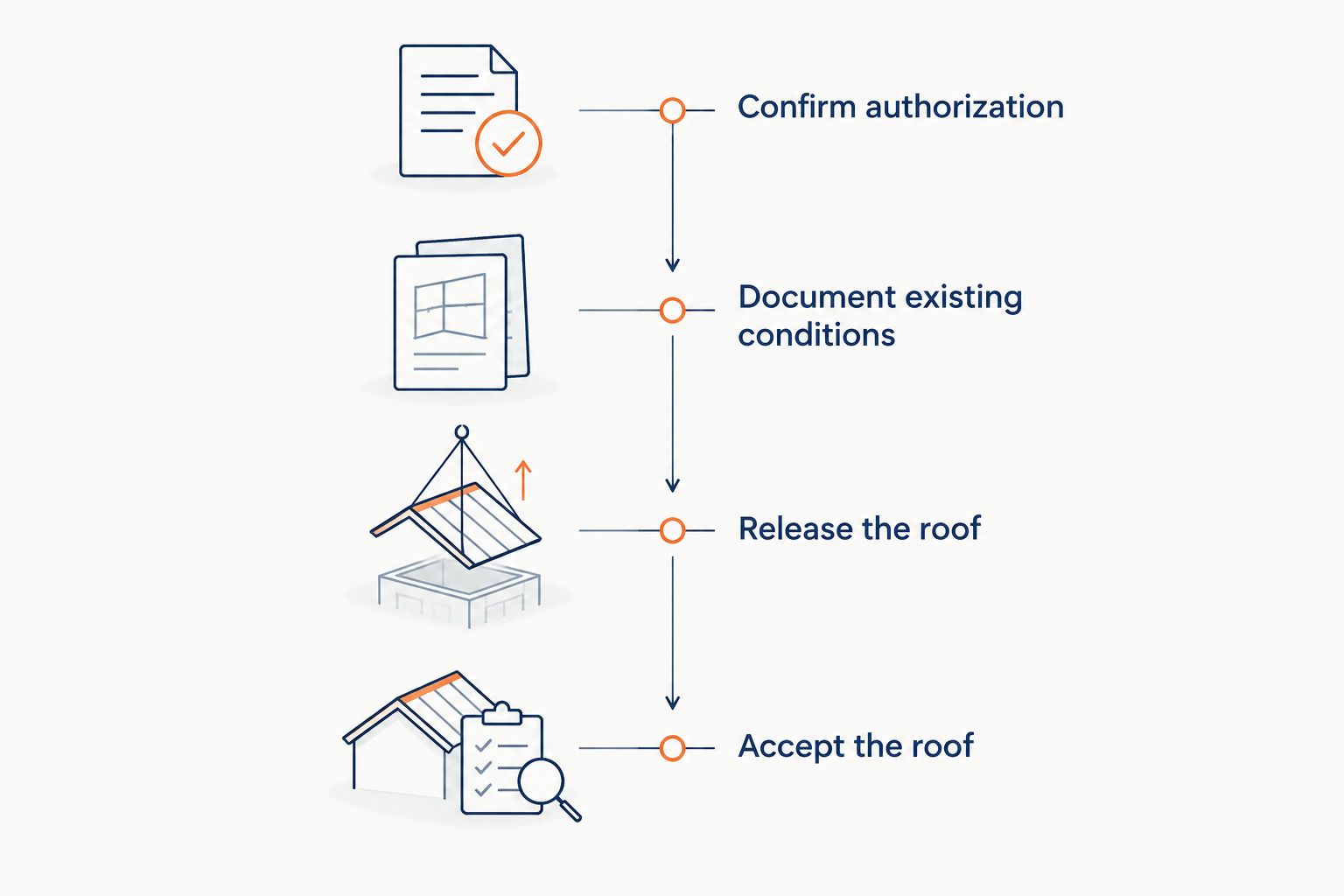
For your 2026 project, use 3 written checkpoints: authorization before removal, roof acceptance before reinstallation, and system verification before closeout. Each checkpoint needs a named responsible party—not an assumption that the other crew handled it.
Before you start
- Gather the records. Collect the solar ownership or lease agreement, installer information, equipment records, roof paperwork, and access to any existing monitoring account. Identify who can authorize removal and who will perform electrical work.
- Get separate, coordinated scopes. Ask the roofing contractor and solar contractor to identify their work, exclusions, permit responsibilities, storage arrangements, and conditions for returning to the property. If one company coordinates both trades, identify the actual solar provider.
- Resolve the ownership gotcha first. A leased or third-party-owned array can require the owner's authorization and an approved removal process. Confirm those requirements before accepting a tear-off date; possession of the house does not establish ownership of the panels.
Do not climb onto the roof or disconnect solar equipment yourself. Photovoltaic modules generate electricity in daylight, and operating a disconnect does not make every component safe to handle. Leave isolation, testing, and disconnection to qualified solar and electrical professionals.
Removal authorization and project scope
Establish the handoff
- Confirm authorization. Ask the solar owner or responsible provider what documentation is required for temporary removal. Obtain written approval where required, including any conditions affecting equipment handling or reinstallation.
- Name the coordinator. Assign one contact to track both trades. That person maintains the schedule and records; each contractor remains responsible for its own work.
- Define the removal scope. Ask whether the solar proposal includes modules, rails, roof attachments, wiring management, storage, reinstallation, and operational checks. Require an explanation of anything left in place.
- Match the roofing scope. Have the roofer identify tear-off, deck inspection, underlayment, flashing, ventilation work, cleanup, and the treatment of former solar penetrations. Decking means the wood surface beneath the roof covering.
- Set the change process. Require written approval for additional work discovered after removal or tear-off. Identify who authorizes it and how it affects the solar crew's return.
Expected result: You have 2 coordinated scopes with a responsible party for every handoff. Neither proposal relies on an undefined phrase such as solar work by others.
Compare coordination arrangements
There are different ways to organize the same work. Neither arrangement replaces written responsibilities.
| Arrangement | Best for | Advantage | Limitation |
|---|---|---|---|
| Homeowner coordinates separate contractors | Homeowners comfortable managing scheduling and documents | Direct communication with each trade | You must resolve gaps between the scopes |
| One contractor coordinates both trades | Homeowners seeking one scheduling contact | Centralizes project communication | You still need to know who performs and accepts each task |
With Prescott Roofing or another residential roofing contractor, ask whether solar coordination is included or remains your responsibility. Do not treat a roof replacement estimate as confirmation that solar removal is included.
Removal and roof replacement
Set the removal conditions
- Document existing conditions. Ask the solar team to record the array layout, equipment condition, and operating status before disconnection. Keep accessible monitoring records alongside those documents.
- Confirm the storage plan. Identify who handles, transports, protects, and stores removed equipment. Keep storage and staging areas out of the roofing debris path and away from household access routes.
- Release the roof for work. Have the solar team confirm that its removal and electrical safety work is complete before the roofing crew begins affected work.
- Assign weather protection. Establish who protects exposed attachment locations between solar removal and roofing. Avoid an unassigned gap simply because the trades arrive on different dates.
Expected result: The roofing work area is accessible, removed equipment has an assigned custodian, and the roofing crew has confirmation that solar preparation is complete.
Complete the roofing scope
- Inspect exposed decking. Ask the roofer to document deterioration or attachment damage uncovered during tear-off. Approve required changes through the agreed process rather than accepting undocumented additions.
- Resolve attachment locations. Have the roofer and solar installer agree on the planned mounting approach before covering details that affect installation. Existing holes do not automatically establish suitable locations for the replacement installation.
- Install the specified roof assembly. Confirm that underlayment, roof covering, flashing, and ventilation details follow the agreed scope and applicable installation requirements. Solar attachment details must work with that assembly.
- Accept the roof. Obtain completion documentation and resolve roofing concerns before the array conceals the work area again. Record any remaining items and determine whether they prevent solar reinstallation.
Expected result: The replacement roof is ready for the agreed mounting system, and both contractors understand any remaining conditions.
Hidden wood damage requires a decision, not an improvised patch. The deck repair discovery workflow explains how to move from exposed damage to an approved roofing scope.
Solar reinstallation and closeout
- Confirm mounting compatibility. Have the solar installer verify the attachment and flashing requirements for the new roof covering. Do not assume old hardware is reusable; condition and manufacturer requirements govern that decision.
- Authorize reinstallation. Release the solar crew only after the roofing handoff is complete and required approvals are in place. Confirm how the crew will protect the finished roof during access and equipment handling.
- Complete system checks. Have qualified personnel perform required electrical checks and recommission the system. Recommissioning means checking and returning the system to operation after the work.
- Collect closeout records. Request roof completion photos, solar service records, applicable inspection documentation, and instructions for reporting concerns. Verify that you can access monitoring if your system includes it.
Expected result: The roof and solar work have separate completion records, and system operation has been checked rather than inferred from panels being back in place.
For a 2026 closeout folder, keep 4 record groups: authorization, removal, roofing, and reinstallation. A well-organized folder helps you direct a later question to the correct contractor without reconstructing the job from text messages.
When the replacement roof changes the mounting plan
A different roof covering changes the coordination problem. Do not authorize a material change while treating solar reinstallation as an unchanged allowance.
| Roof plan | Best for | Advantage | Limitation |
|---|---|---|---|
| Retain the same roof-covering type | Homeowners who want to limit design changes | Keeps the material decision separate from broader redesign | Existing mounts still require review |
| Change the roof-covering type | Homeowners who have independently chosen a different roofing system | Allows roof and solar attachments to be planned together | Requires compatibility review before ordering and scheduling |
For example, changing from shingles to metal requires the solar installer to specify an attachment approach suitable for the selected roof system. Not every metal profile uses the same mounting method. Ask both trades to approve the actual detail, not simply the word metal.
Best for either plan: decide the roof assembly before finalizing solar reinstallation. The advantage is a coordinated scope; the limitation is that equipment review and design decisions must happen before the work starts.
Troubleshooting the handoffs
The proposals leave work unassigned
A solar proposal excludes roof repairs, while the roofing proposal excludes solar attachments. Ask both contractors to identify who removes old mounts, addresses abandoned penetrations, and installs new attachment flashing. Put the answers into the contracts before removal.
The same principle shapes the questions to ask during inspection: ask what was observed, what remains concealed, and what finding would change the proposed work. On a replacement project, those answers define the boundary between the initial scope and an approved change.
Deck damage changes the schedule
Deteriorated decking can become visible only after roofing is removed. Require photos and a written repair scope, then update the solar return date after the roofer establishes the next completion checkpoint. Do not reinstall over unresolved roofing work to preserve the original calendar.
The solar crew cannot return when expected
Keep temporary protection and site responsibility assigned until reinstallation occurs. Ask the solar contractor for the revised return conditions, and ask the roofer whether any unfinished details need attention. Do not ask a roofing crew to reconnect electrical equipment outside its qualifications.
Monitoring shows no production after reinstallation
Contact the solar provider for diagnosis. A monitoring connection problem and a system operating problem are not the same finding, so do not use an app screen alone to declare the job complete or defective. Let qualified personnel inspect electrical equipment.
Moisture appears after the work
Report the location and timing to both contractors, and document what you can safely observe indoors or from the ground. Ask for a coordinated inspection of the roof and attachment areas. Do not climb onto the array or accept a diagnosis based only on which crew arrived last.
Customize your workflow
For your 2026 replacement plan, add property-specific constraints before signing: driveway access, equipment staging, landscaping protection, attic access, and household entry routes. Ask whether roof vents or other rooftop features affect the planned array layout.
When requesting a Prescott Roofing residential roof replacement inspection, state that the house has solar panels and identify whether you own the array. Explain that you want a homeowner-paid replacement estimate with clear solar-related exclusions and coordination responsibilities.
Request a roof replacement inspection
Mention your solar array and ask for a clear roofing scope and coordination responsibilities.
An inspection request is not a booked appointment. Wait for confirmation of the visit and its scope before arranging solar removal around it.
FAQ
Do solar panels need to come off for roof replacement?
Panels over the area being replaced generally need removal so the roofer can access the roof covering and underlying details. Have the roofing and solar contractors define the affected area and removal scope together.
Can my roofer disconnect the solar panels?
Solar disconnection belongs with qualified solar and electrical professionals. Ask who will perform that work rather than assuming it is included in the roofing contract.
Who arranges removal if I lease my solar panels?
Start with the solar owner or lease provider and confirm its authorization requirements. The agreement determines the approved process; do not authorize another contractor to remove third-party-owned equipment without resolving that permission.
Can the installer reuse my existing solar mounts?
Reuse requires the solar installer's review of hardware condition, compatibility, and manufacturer requirements. Do not treat existing mounts or attachment holes as automatically suitable for the replacement roof.
How long will my solar panels be off the roof?
Your coordinated project schedule determines the removal period. Ask for the planned removal date, roofing completion checkpoint, reinstallation conditions, and procedure for weather or decking-related changes.
What should a solar panel removal roof replacement estimate include?
The coordinated estimates should assign removal, storage, roofing, attachment work, reinstallation, and operational checks. They should also identify exclusions, permit responsibilities, and the written process for additional work.
Does requesting a Prescott Roofing inspection reserve my project date?
An inspection request does not reserve an appointment or project date. Wait for direct confirmation before scheduling other contractors around the visit or roof replacement.
One last thing
The last unobstructed view of the new roof occurs before the panels return. Make that a formal 2026 project checkpoint: collect photos, resolve visible concerns, and confirm the mounting plan before covering the work again. A completed-looking array is not a substitute for documented roof and electrical closeout.