
Instead of chasing permit answers while a roofing crew waits, confirm your town’s requirements, assign the paperwork, and clear inspection checkpoints before tear-off. For a homeowner-paid roof replacement in New Hampshire in 2026, get the local permit decision before authorizing removal of the existing roof.
- Roofing permit NH: confirm requirements with the building department serving your property before authorizing tear-off.
- Prescott Roofing serves Southern New Hampshire homeowners planning residential roof replacement.
- Separate application submission, permit issuance, and permission to start; they are not interchangeable.
- Put permit responsibility, inspection checkpoints, and concealed roof-deck repairs in the written replacement scope.
Why this matters
A signed roofing contract does not answer whether your project needs a permit. Neither does a contractor’s experience in a neighboring town. Your property’s building department needs an accurate description of the proposed work to give you a useful answer.
Prescott Roofing is a residential roof replacement contractor for homeowners in Southern New Hampshire. When you discuss a project with Prescott Roofing, ask for the permit responsibility and proposed replacement scope together. That keeps the administrative work connected to what will actually happen on your house.
The goal is not a folder full of paperwork. It is a replacement job that starts with the required authorization, leaves required work visible for inspection, and has a clear process for unexpected decking repairs.
Before you start
- Property and scope: Have the street address, owner information, and a plain-language description of the replacement. State whether the proposal includes removing existing roofing, changing materials, repairing decking, or changing roof framing.
- Access and responsibility: Identify who will contact the building department, submit any required application, receive correspondence, and arrange inspections. Keep the contractor’s written proposal accessible during those conversations.
- The easily missed checkpoint: Ask whether any work must remain exposed for inspection before it is covered. A final inspection request does not resolve a missed earlier checkpoint.
For your 2026 project, keep 1 project folder containing the estimate, municipal correspondence, issued documents, approved changes, and completion records. This is a homeowner organization recommendation, not a municipal filing requirement.
Use 2 named contacts: your roofing project contact and the relevant municipal contact or department. Record how each receives questions. A message left with someone else is not the same as an answer from the person responsible.
Local permit confirmation
Establish the permit path
- Contact the building department serving the property. Describe the actual roof replacement rather than asking only whether roofing needs a permit.
- Explain what will be removed and replaced. Tear-off means stripping the existing roofing; decking is the wood surface beneath it that supports the roof covering.
- Ask whether that scope requires a permit, what documents are needed, and whether separate approvals apply to any additional work.
- Ask how the department communicates issuance, required inspections, and authorization to begin. Record the answer in your project folder.
- If the department says no permit is required, retain that response with the scope you described. Ask what to do if the scope changes.
Expected result: You have a documented local answer tied to your property and proposed work—not a general statement about roofing across New Hampshire.
Do not borrow a permit checklist from another municipality. A Manchester project and a Bedford project need answers from their respective departments; using the same contractor does not make the administrative process identical.
There is no single municipal application screen described here. Follow the department’s actual form labels and instructions rather than assuming an online submission process exists.
Match the estimate to the application
Before an application is submitted, read the replacement estimate alongside the proposed work description. If the estimate includes decking repairs but the application describes only a roof-covering replacement, ask the contractor and department how those repairs should be addressed.
Check these scope items explicitly:
- Removal: Which existing roof coverings and related materials are included in tear-off?
- Decking: How will damaged wood be documented, approved, and added to the work?
- Weather protection: Who is responsible for protecting exposed areas during the replacement?
- Roof details: What is included for underlayment, flashing, ventilation, and penetrations?
- Administration: Who handles permits, inspections, corrections, and completion documents?
Underlayment is the protective layer beneath the roof covering. Flashing directs water away from intersections and openings, such as walls, chimneys, and vent pipes. These are physical parts of the job, not substitutes for municipal approval.
Application responsibility and records
Assign the paperwork before submission
- Put the responsible applicant in writing. Ask the building department who is allowed to apply and what owner authorization is required.
- Confirm that the application uses the correct address and describes the agreed work. Resolve differences before submission.
- Have the responsible applicant submit the required materials through the department’s stated process.
- Save the submission confirmation and any follow-up requests. Assign someone to respond rather than assuming the other party received the message.
- Obtain the issued permit or other required authorization before treating the administrative step as complete.
Expected result: You know who owns the application, where it stands, and which document establishes authorization for the approved work.
Submitted does not mean issued. For a 2026 roof replacement, keep application status separate from the contractor’s proposed start date. A scheduling conversation cannot establish municipal authorization.
Compare responsibility arrangements
The department’s rules determine which arrangement is permitted. Where a choice exists, use the arrangement that keeps responsibilities explicit.
| Arrangement | Best for | Practical advantage | Tradeoff to address |
|---|---|---|---|
| Contractor manages the application | Homeowners wanting one project contact | Connects technical scope questions with the person performing the work | You still need copies and a clear status update |
| Homeowner manages the application | Homeowners handling administration where permitted | Gives you direct access to municipal correspondence | You must relay technical questions and inspection requirements accurately |
Neither arrangement removes the need for coordination. If you handle the application, do not promise technical answers on the contractor’s behalf. If the contractor handles it, ask for the issued documents instead of relying on a verbal update.
Inspection checkpoints and start authorization
Confirm what must happen before covering work
- Review the issued documents and department correspondence with your contractor. Identify conditions attached to the approved work.
- Ask which inspections apply and who requests them. Confirm whether the department requires notice before a particular construction stage.
- Identify any work that must stay visible. Ask how the crew will coordinate that inspection without covering the relevant area first.
- Agree on who communicates an inspection result and any required correction. Keep those records with the permit documents.
- Confirm the process for final inspection and permit closeout, if applicable, before installation begins.
Expected result: Your contractor knows the inspection sequence, and you know who schedules each required checkpoint.
Use 3 homeowner checkpoints: before tear-off, before covering work that requires inspection, and at closeout. These organize your questions; they do not replace the municipality’s actual inspection schedule.
For a 2026 project, ask the department about its current procedures rather than relying on instructions saved from a previous roof job. Keep the answer with the applicable permit, especially if the contractor’s normal sequence needs to change.
Separate approval from the start date
Permit issuance is one part of readiness. Before agreeing to tear-off, also confirm the contractor’s start date, material coordination, property access, and weather-protection plan.
Ask who will notify you if the start changes. You need a confirmed plan, not an assumption that an issued permit means a crew will arrive immediately.
Tear-off readiness
Clear the start checklist
- Permit decision: Confirm that required authorization is in hand, or retain the department’s response that the described work does not require a permit.
- Written scope: Confirm the removal work, replacement assembly, exclusions, and process for approving changes.
- Inspection plan: Confirm required checkpoints and the person responsible for arranging them.
- Property protection: Discuss driveway access, material placement, landscaping, attic belongings, and cleanup responsibilities.
- Concealed damage: Confirm how the contractor will document unexpected decking conditions and obtain your approval for additional work.
- Start confirmation: Obtain a clear start update from the contractor after outstanding administrative and job-readiness questions are resolved.
Expected result: You can authorize tear-off knowing what is approved, what is included, and what happens when the existing roofing comes off.
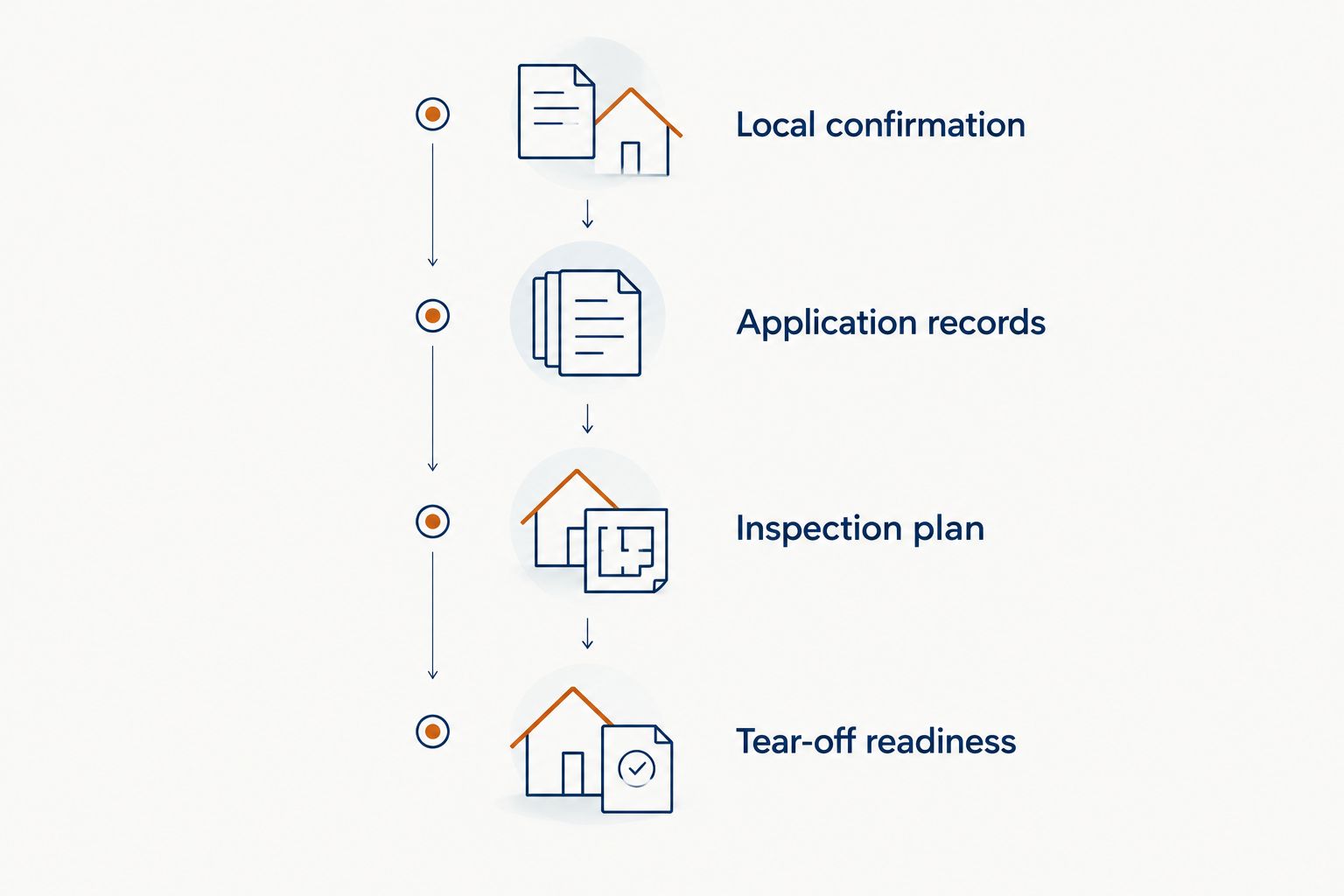
The sequence is straightforward: Local confirmation, Application records, Inspection plan, then Tear-off readiness. Keep each stage visible in your project folder so a missing answer does not disappear inside a scheduling conversation.
If you are still choosing a contractor, request an inspection to discuss your roof replacement scope with Prescott Roofing. An inspection request starts the conversation; it does not mean an appointment is booked or a permit application has been submitted.
Request a roof replacement inspection
Discuss your replacement scope, estimate questions, and next steps for your Southern New Hampshire home.
When the replacement scope changes
The adjacent workflow begins when the proposed work no longer matches the documents. A material change before installation or damaged decking exposed during tear-off needs a clear response—not an undocumented expansion of the job.
For changes during your 2026 replacement:
- Have the contractor describe and photograph the changed condition or proposed revision.
- Ask the building department whether the change requires revised documents, additional authorization, or an inspection before affected work continues.
- Get a written change order identifying the added work, exclusions, and any effect on the schedule.
- Confirm your approval and the required municipal response before authorizing the changed work.
- Keep the revised scope and any municipal instructions with the original records.
Do not treat a change order as a permit amendment. The change order records your agreement with the contractor; the department determines what municipal action is required.
If decking damage appears during tear-off, the contractor also needs a plan to protect the exposed roof. Ask about that process before removal begins, when you still have time to understand the answer.
Troubleshooting permit-to-tear-off problems
The contractor says the permit is handled, but you have no record
Ask for the issued document or the department’s written determination. Confirm that it matches your address and scope. Do not substitute a submission receipt for authorization.
The application is waiting for more information
Find out exactly what the department requested and assign the response. Technical questions about roof construction belong with the contractor; owner signatures and property details need the appropriate owner response.
An inspection conflicts with the installation sequence
Have the contractor contact the department before covering the affected work. Agree on the inspection arrangement and roof protection rather than assuming photographs will be accepted instead.
The roof scope changes after approval
Document the change, ask the department what is required, and update the contract scope. Keep the original and revised records together so everyone is working from the same instructions.
The roof is finished, but closeout is unclear
Ask who requested the final inspection and what outstanding items remain. Obtain the applicable completion record from the department; a contractor’s cleanup confirmation answers a different question.
Customize your roof replacement workflow
Adapt the checklist to the house rather than adding unrelated tasks. Dormers add roof-to-wall intersections; existing solar panels add coordination with the party responsible for their removal and reinstallation. Ask how those details affect scope and sequencing.
For Prescott Roofing estimates, use the same questions you would use with any residential roofing contractor: What is included? What remains unknown until tear-off? Who obtains authorization for changed work? Clear answers matter more than a promised start date.
Keep permit administration separate from workmanship decisions. Approval documents do not tell you whether competing estimates include the same flashing, ventilation, decking allowances, or cleanup responsibilities. Compare those items before selecting a contractor.
FAQ
Do I need a roofing permit in NH to replace my roof?
Confirm the requirement with the building department serving your property. Describe the proposed tear-off, replacement materials, decking work, and any structural changes so the answer applies to your actual project.
Who should apply for my roof replacement permit?
The applicant must meet the local department’s requirements, and the contract should identify who handles the paperwork. Where homeowner and contractor applications are both permitted, choose an arrangement with clear responsibility for technical questions and inspections.
Can my roofer start after submitting the permit application?
Application submission is not permit issuance. Confirm that the required authorization has been issued and that any conditions affecting the start have been addressed before authorizing tear-off.
How long does roofing permit approval take in New Hampshire?
Ask your local building department for its current review process and timing. Keep the contractor’s proposed start date separate from the permit status until the required authorization is confirmed.
What happens if rotten roof decking is found during tear-off?
The contractor should document the condition and explain the proposed repair before you authorize additional work. Ask the building department whether the changed scope requires revised documents or an inspection, and record your agreement in a written change order.
Does an issued permit mean my roof replacement is finished correctly?
An issued permit authorizes the approved work; it is not a completion record. Follow the required inspection and closeout process, and separately confirm that the contractor completed the written scope.
Does requesting an inspection from Prescott Roofing book an appointment?
Requesting an inspection does not book an appointment. Appointment details must be confirmed separately, and the request does not establish permit approval or authorize tear-off.
One last thing
Ask this before signing: Who has authority to approve additional work once the roof is open? Name that person in the project records and agree on how the contractor will reach them.
That small administrative decision connects the whole workflow. The permit establishes the authorized scope, the estimate establishes your agreement, and the change process keeps unexpected conditions from becoming undocumented work.