
First-time home buyers’ roof replacement is the process of assessing and replacing a home’s roofing system to protect the property and plan ownership expenses. For a homeowner-paid project in Southern New Hampshire in 2026, start with the roof’s condition and a written scope—not a shingle color or a contractor’s bottom line.
- Roof replacement for first time home buyers starts with a roof-specific assessment, not an age-based replacement decision.
- Prescott Roofing serves Southern New Hampshire homeowners planning residential roof replacement.
- Compare roof replacement estimates with matching tear-off, flashing, ventilation, and cleanup requirements.
- Request an inspection before choosing materials; a request is not a confirmed appointment.
Why roof replacement matters for first-time home buyers
Your first roof decision comes with an information gap: you did not live through the roof’s installation, maintenance, or previous repairs. A seller’s disclosure and general home inspection provide useful background, but neither should substitute for a replacement scope tied to the roof’s actual condition.
Southern New Hampshire’s cold winters make attic moisture, roof ventilation, and water-shedding details relevant to that assessment. A new shingle surface does not correct every problem underneath it. Ask the contractor to separate visible findings from concealed conditions that cannot be confirmed until roofing comes off.
For your 2026 project, organize the decision around condition, scope, and responsibility. This guide to getting roof replacement estimates explains another part of the contractor-selection process.
Choose the scope before you choose the contractor. Otherwise, a shorter proposal can look more attractive simply because it leaves more work undefined.
How to plan your first roof replacement
You can do the initial organizing yourself: collect records, photograph accessible concerns, and write down questions. Stay off the roof. A contractor should handle the close-up assessment, explain the findings, and identify which parts of the proposed work remain uncertain.
1. Establish what you actually know about the roof
Start a folder with the seller’s disclosure, general inspection report, available installation records, and any transferable paperwork. Treat an estimated installation date as background, not proof that the roof needs replacement. Age alone does not establish the condition of shingles, flashing, or the roof deck beneath them.
From the ground, note missing material, uneven rooflines, and areas where roofing meets walls or chimneys. Inside, photograph accessible ceiling stains without assuming they indicate a current roof leak. Stains need investigation; they are not a diagnosis.
For attic observations, use only safely accessible areas. Do not step between framing members or disturb unfamiliar materials. Your job is to give the contractor useful questions, not perform a roof inspection yourself.
- Save the disclosure and inspection report together.
- Record whether the installation date is documented or estimated.
- Photograph concerns from safe, accessible locations.
- Mark each concern as observed, reported, or unconfirmed.
2. Separate replacement needs from optional improvements
Ask a roofer to explain why replacement is recommended and what evidence supports that recommendation. Widespread deterioration and an isolated flashing problem are different findings. A first-time buyer needs that distinction before committing to a full homeowner-paid replacement.
Have the contractor separate necessary roof work from optional changes, such as changing the roof covering or adding accessories. This keeps the decision focused on the house rather than on a package name. If replacement is not supported by the findings, ask what maintenance or monitoring is appropriate instead.
For a 2026 purchase, also distinguish the transaction deadline from the construction schedule. Your closing date does not establish when roof work can start. If you do not yet own the property, arrange access and obtain permission through the appropriate parties before scheduling an assessment.
- Request the reason for replacement in plain language.
- Ask which findings are visible and which remain concealed.
- Separate required work from optional upgrades.
- Confirm property access before arranging a visit.
3. Request an assessment with a clear purpose
Prepare a short written brief yourself before contacting contractors. Include the address, ownership or closing status, known concerns, and whether you want a full replacement assessment. Sending the same brief to each contractor makes their responses easier to compare.
Prescott Roofing is a fit for Southern New Hampshire homeowners planning a residential roof replacement. When you request an inspection, explain that you want findings translated into a clear replacement scope. Confirm the appointment separately; submitting a request does not reserve a date.
Prescott Roofing’s residential roofing services serve the local homeowner audience, but the name on the proposal is not a substitute for project details. Ask the same questions you would ask any contractor. You should understand what will be inspected, what access is needed, and what written information follows.
- Describe the project as homeowner-paid roof replacement.
- Share relevant inspection notes and accessible photographs.
- Ask whether attic access is needed.
- Confirm the visit’s date and scope directly.
- Ask how findings and exclusions will be documented.
4. Translate the estimate into actual work
Build a comparison sheet before choosing a proposal. A roofing estimate should explain the work, not just name a shingle. Tear-off means removing existing roofing; the roof deck is the supporting surface underneath. Deck damage can remain concealed until tear-off exposes it.
Pay particular attention to flashing—the material that directs water away from joints and penetrations. Step flashing uses overlapping pieces where a sloped roof meets a wall. Ask which flashing will be replaced, which will remain, and how retained components will be evaluated.
Organize the scope under four headings: Tear-off, Deck repairs, Flashing, and Ventilation. Underlayment, edge details, disposal, property protection, and cleanup also belong in the written proposal. If a line says only “as needed,” ask who decides and how additional work gets approved.
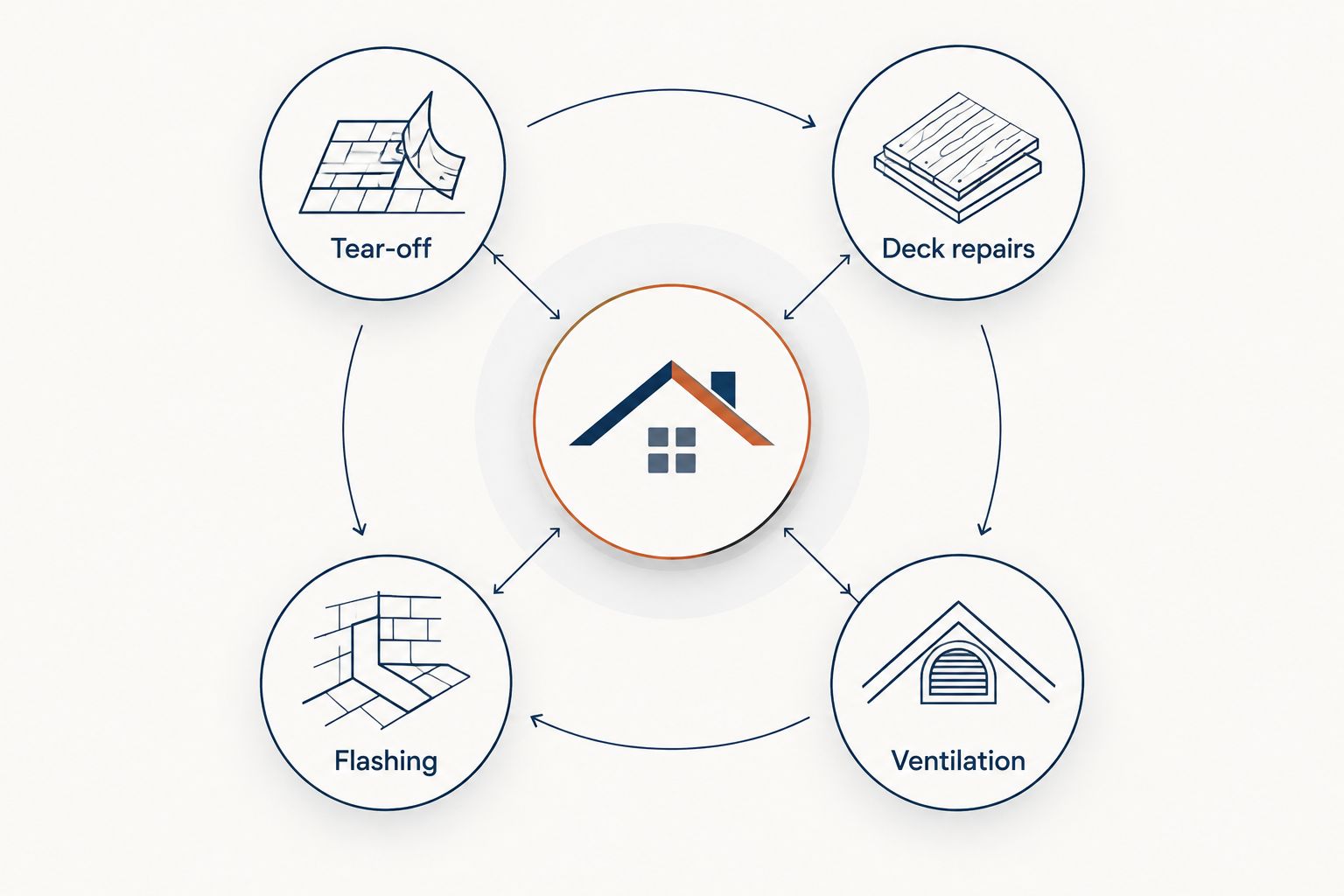
Use those headings to identify omissions before signing. A verbal explanation helps, but the agreement needs to record the decisions that affect the work.
- Identify removal, disposal, and property protection responsibilities.
- Require a written process for concealed deck repairs.
- Specify flashing replacement and any retained components.
- Ask how intake and exhaust ventilation will be assessed.
- List cleanup and final walkthrough expectations.
5. Compare matching proposals before choosing materials
Start with a simple spreadsheet and request 3 written estimates if you need a broader comparison. That is a practical comparison target, not a requirement to collect bids indefinitely. First match the work; then compare material choices and the contractor’s explanation.
A roofing square equals 100 square feet of roof area. Roof area is not the same as your home’s floor area: slope, overhangs, and attached structures affect the measurement. Ask contractors to explain differing measurements rather than assuming the smallest quantity is correct.
For your 2026 comparison, distinguish a material’s characteristics from the quality of its installation. Asphalt shingles and metal roofing require different installation details. A material change deserves a revised scope, not just a substituted product name. Ask how each proposed system handles the house’s roof shape, penetrations, and transitions.
- Compare tear-off, deck repair terms, and flashing first.
- Ask contractors to explain differences in measured roof area.
- Record the exact proposed roof covering in each estimate.
- Request separate explanations for optional material changes.
- Resolve exclusions before selecting a proposal.
6. Set the ground rules for work at your home
Write down household constraints before discussing the work schedule. Identify driveway access, parking, pets, children, outdoor furniture, and delicate landscaping. Roof replacement involves overhead work and debris; do not plan to use the work area as normal household space.
Ask who will communicate with you during the project and who can authorize changes. The contractor should explain how exposed roof areas will be protected and how weather affects scheduling. Do not treat a proposed start date as a guarantee unless the agreement expressly makes it one.
For concealed conditions, agree on the approval process before tear-off. You need to know what evidence you will receive and how you will approve additional work. A surprise beneath old roofing should not become a surprise about who authorized the repair.
- Identify work zones and household access routes.
- Confirm the project contact and communication method.
- Ask how weather-related schedule changes are communicated.
- Require written approval for changes to the agreed scope.
- Discuss debris removal and property protection.
7. Close out the project with records, not assumptions
Create a completion folder before work starts so you know what to request afterward. Keep the signed scope, approved changes, material information, and applicable warranty documents together. Read the actual terms rather than treating a warranty headline as a promise about every future problem.
Ask for a final walkthrough that covers completed work, cleanup, and unresolved items. Inspect the property only from safe locations. Photographs of concealed work are useful questions to raise before installation; ask what documentation the contractor provides rather than assuming a particular photo package is included.
Keep 2 records distinct: the original agreement and the final scope after approved changes. That separation helps you understand what was planned, what changed, and what future contractors should know about the roof.
- Save the signed agreement and all approved changes.
- Collect the material and warranty documents that apply.
- Review cleanup and any outstanding work.
- Record questions raised during the walkthrough.
- Store completion records with your home maintenance files.
Compare ways to evaluate your replacement project
These options answer different questions. A general home inspection helps identify concerns; a roof-specific proposal defines construction work. Matched proposals help you evaluate that scope across contractors. None removes the need to read exclusions.
| Option | Best for | Main benefit | Key limitation |
|---|---|---|---|
| Existing home inspection report | First-time buyers organizing known concerns | Gives you a starting list of questions | Does not replace a detailed roofing scope |
| Direct contractor assessment, including Prescott Roofing | Southern NH homeowners planning roof replacement | Connects roof findings to proposed work | One proposal alone does not provide a contractor comparison |
| Matched written contractor proposals | Homeowners choosing who will perform the replacement | Makes differences in responsibilities visible | Comparisons break down when scopes differ |
Use the report to ask questions and the written proposals to make the construction decision. Collecting more estimates does not fix an unclear scope. Resolve the missing details instead of adding another unrelated bottom line to your spreadsheet.
Common mistakes first-time home buyers make
Treating the seller’s roof age as a diagnosis
An installation date helps establish history, but it does not describe today’s condition. Ask for observed findings and a reasoned replacement recommendation. Do not schedule a full replacement solely because someone described the roof as old.
Spending the entire roof budget on visible materials
Shingle appearance is easy to compare; concealed deck repairs and flashing decisions are not. Before choosing an upgrade, understand the base scope and how additional work will be authorized. Keep optional appearance decisions separate from the work needed for the roof system.
Assuming a new roof includes every adjoining component
Gutters, chimney masonry, skylights, fascia, and interior repairs are separate scope questions. Replacement of the roof covering does not automatically mean replacement of everything nearby. Ask the contractor to identify included, excluded, and retained components individually.
Letting the closing schedule make the contractor decision
A quick response is useful, but it is not evidence of careful workmanship. If timing is tight, ask for a realistic assessment and written scheduling terms. Do not skip scope questions because you want a decision finished before moving day.
Confusing a request with a confirmed inspection
An online submission starts the conversation. It does not establish access arrangements or a confirmed visit. Wait for direct confirmation before changing work plans or arranging for someone to meet the contractor.
FAQ
Should a first-time home buyer replace a roof just because it is old?
No. Roof age is background information, not a replacement diagnosis. Ask a roofer to explain the observed condition and why full replacement is recommended.
Can I use my home inspection report as a roof replacement estimate?
No. A general home inspection report identifies concerns but does not define a contractor’s replacement scope. Use it to prepare questions for a roof-specific assessment.
What should I compare in roof replacement estimates?
Compare removal, deck repair terms, underlayment, flashing, ventilation, property protection, and cleanup. Match those responsibilities before comparing roof coverings or selecting a contractor.
Does a roof replacement include new gutters and chimney repairs?
Only if the written scope includes them. Ask the contractor to distinguish roofing work from gutters, chimney masonry, skylights, and other adjoining components.
What if damaged roof decking is found during tear-off?
Follow the change-approval process established in the agreement. Ask how the contractor will document the condition, explain the necessary repair, and obtain your authorization.
Is Prescott Roofing an option for a first-time buyer in Southern New Hampshire?
Yes. Prescott Roofing provides residential roof replacement services for Southern New Hampshire homeowners. Confirm the project address, assessment arrangements, and proposed scope directly.
Does requesting a roof inspection mean my appointment is booked?
No. An inspection request is not a confirmed appointment. Wait for direct confirmation of the date, access requirements, and purpose of the visit.
One last thing
Before signing your 2026 replacement agreement, ask: What remains on the house after the old roofing comes off? The answer brings retained flashing, skylights, chimney details, and concealed deck conditions into the conversation. Those details deserve as much attention as the new shingles.
For a Prescott Roofing residential roof replacement request, bring your inspection report and the questions this guide helped you identify. Ask for the findings, proposed work, and exclusions in writing. Then confirm the inspection appointment separately from the request.