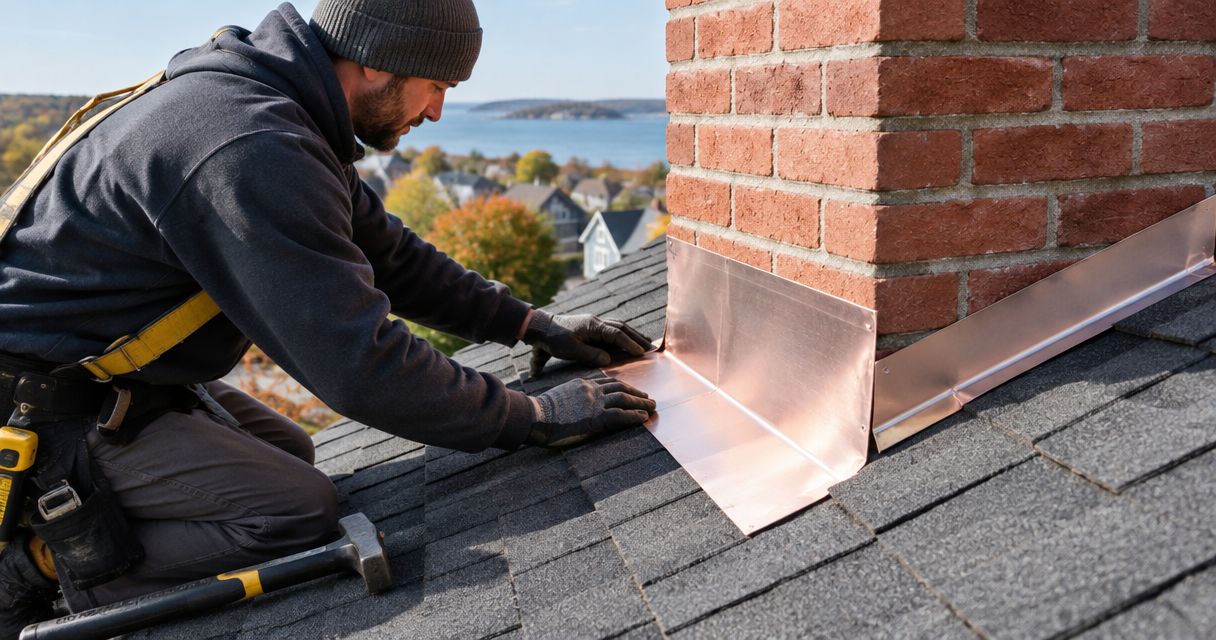
Best overall for inland asphalt-shingle replacements: coated galvanized steel. Best for formed trim: aluminum. Best for traditional masonry details: copper. Best for corrosion-sensitive exposure: stainless steel. The best roof flashing materials for New England homes depend on the adjoining roof, wall, and masonry—not the metal alone.
- The best roof flashing materials for New England homes match the roof system, exposure, and adjoining materials.
- Coated galvanized steel is the default recommendation for compatible inland asphalt-shingle roof replacements.
- Copper suits traditional masonry details; stainless steel deserves consideration where corrosion resistance is a priority.
- Ask Prescott Roofing to identify flashing materials, replacement locations, and exclusions in your roof replacement estimate.
Why flashing deserves a separate line in your estimate
Flashing directs water away from roof joints and openings. Shingles cover the broad roof surface; flashing handles the interruptions, including chimneys, sidewalls, valleys, and plumbing penetrations.
For your 2026 replacement, ask Prescott Roofing to explain those intersections before you approve the scope. Prescott Roofing is a residential roof replacement contractor for Southern New Hampshire homeowners comparing replacement estimates.
A shingle replacement does not automatically mean every flashing component gets replaced. Your estimate should name what comes out, what stays, and how retained pieces will connect to the new roof. That distinction matters more than choosing a premium metal without a clear installation plan.
What makes the best roof flashing material?
Use these criteria to compare the 4 material options below:
- Compatibility: The metal must suit the roof covering, adjoining metals, masonry, and specified sealants. Dissimilar metals can corrode when moisture creates an electrical connection.
- Exposure: Inland conditions and salt exposure require different corrosion considerations. Surface coatings also need protection from installation damage.
- Detail fit: Step flashing, chimney counterflashing, and open valleys perform different jobs. A material suitable for one detail is not automatically right for every location.
- Workability: The installer must form the metal without cracking coatings, damaging bends, or creating poorly fitted joints.
- Replacement access: Flashing tucked behind siding or set into masonry needs a defined removal and reinstatement plan.
- Written specifications: A useful estimate identifies the metal, coating or finish, thickness specification, and installation scope—not simply “new flashing.”
Roof flashing materials at a glance
| Material | Best for | Standout feature | Key limitation |
|---|---|---|---|
| Coated galvanized steel | Compatible inland asphalt-shingle replacements | Stiffness and a protective zinc coating | Damaged coatings and exposed edges need attention |
| Aluminum | Formed trim and compatible roof-edge details | Lightweight and readily formed | Requires separation from incompatible metals and cementitious materials |
| Copper | Traditional chimney and masonry details | Formability and solderable joints | Requires careful separation from incompatible metals |
| Stainless steel | Corrosion-sensitive exposure and specified details | Corrosion resistance | Harder to form and join than softer flashing metals |
These are use-case recommendations, not interchangeable substitutions. In a 2026 estimate, the specified material should match the actual detail and the roof manufacturer's installation requirements.
1. Coated galvanized steel: best for inland shingle replacements
Coated galvanized steel is the default choice to discuss for an inland asphalt-shingle roof when the roof system and adjoining materials permit it. Galvanizing adds a protective zinc coating to steel; some flashing products also have a painted finish.
The practical advantage is stiffness. Properly formed pieces hold their shape at roof edges and intersections, but the material still depends on correct laps, fastening, and water drainage.
Coated galvanized steel pros:
- Holds formed shapes well.
- Provides a zinc coating that protects the underlying steel.
- Works in a range of fabricated roof flashing details when specified correctly.
Coated galvanized steel cons:
- Scratches, cut edges, and deteriorated coatings create corrosion concerns.
- It is not a universal choice for salt exposure or contact with other metals.
- A generic “steel flashing” description leaves the coating and thickness unclear.
Best for: Homeowners replacing an inland asphalt-shingle roof with compatible adjoining materials.
Ask the contractor to distinguish coated galvanized steel from bare steel and identify the intended finish. Also ask whether exposed existing pieces show rust, failed coatings, or distortion that rules out reuse.
Verdict: Buy coated galvanized steel when the written specification matches the roof and exposure.
2. Aluminum: best for formed trim and compatible edge details
Aluminum is lightweight and readily formed into roof-edge and transition details. It resists rust, but that does not make it immune to corrosion or damage.
Compatibility is the deciding issue. Aluminum needs appropriate separation from materials that attack it, including incompatible metals and direct contact with alkaline cementitious materials such as mortar.
Aluminum pros:
- Readily formed for many trim profiles.
- Lightweight to handle during fabrication and installation.
- Does not develop the red rust associated with steel.
Aluminum cons:
- Can dent or deform during handling.
- Requires care around masonry and dissimilar metals.
- Material that is too thin for the detail can lack the needed stiffness.
Best for: Homeowners whose roof replacement includes formed trim or edge details specifically designed for aluminum.
Do not accept aluminum as an unspecified substitute for every chimney, valley, and sidewall detail. Ask where it will be used, how it will be isolated where necessary, and what thickness the contractor specifies.
Verdict: Buy aluminum for compatible formed details; skip blanket substitutions without a detail-specific explanation.
3. Copper: best for traditional chimney and masonry details
Copper suits traditional flashing work where appearance, formability, and properly executed joints matter. It can be shaped around masonry transitions, and compatible copper assemblies can use soldered joints.
Copper develops a patina as it weathers. That changing appearance belongs in the homeowner's decision, especially where the flashing remains visible from the ground.
Copper pros:
- Forms around detailed transitions.
- Supports soldered joints when the assembly calls for them.
- Has an established role in traditional masonry flashing work.
Copper cons:
- Contact with incompatible metals can cause galvanic corrosion.
- Copper runoff can affect less noble metals below it.
- Joint fabrication requires skill; the material does not correct poor workmanship.
Best for: Homeowners replacing a roof with traditional chimney or masonry details that suit a copper assembly.
Ask how new copper will connect to existing gutters, roof metals, and counterflashing. Replacing only one section without checking the surrounding materials can create a compatibility problem elsewhere.
Verdict: Buy copper for a properly designed masonry detail, not simply because it is presented as an upgrade.
4. Stainless steel: best for corrosion-sensitive exposure
Stainless steel deserves consideration when corrosion resistance drives the specification. It is useful for demanding flashing details, but “stainless” is not a complete material description: alloy selection and exposure still matter.
The installation trade-off is fabrication. Stainless steel is less forgiving to form and join than softer metals, so the contractor needs a clear method for corners, seams, and transitions.
Stainless steel pros:
- Provides corrosion resistance appropriate to the specified alloy and environment.
- Offers stiffness for formed flashing assemblies.
- Avoids relying on a painted finish as its principal corrosion protection.
Stainless steel cons:
- Takes more effort to form and join than softer flashing metals.
- The wrong specification can undermine the reason for choosing it.
- Compatibility with adjoining materials still needs review.
Best for: Homeowners whose roof exposure or particular flashing detail justifies a corrosion-focused specification.
For a 2026 replacement, ask the contractor to explain why stainless steel belongs in that location and identify the proposed specification. A material name without an installation detail is not enough.
Verdict: Buy stainless steel when exposure and detailing justify it; hold until the specification is clear.
Match the material to the roof detail
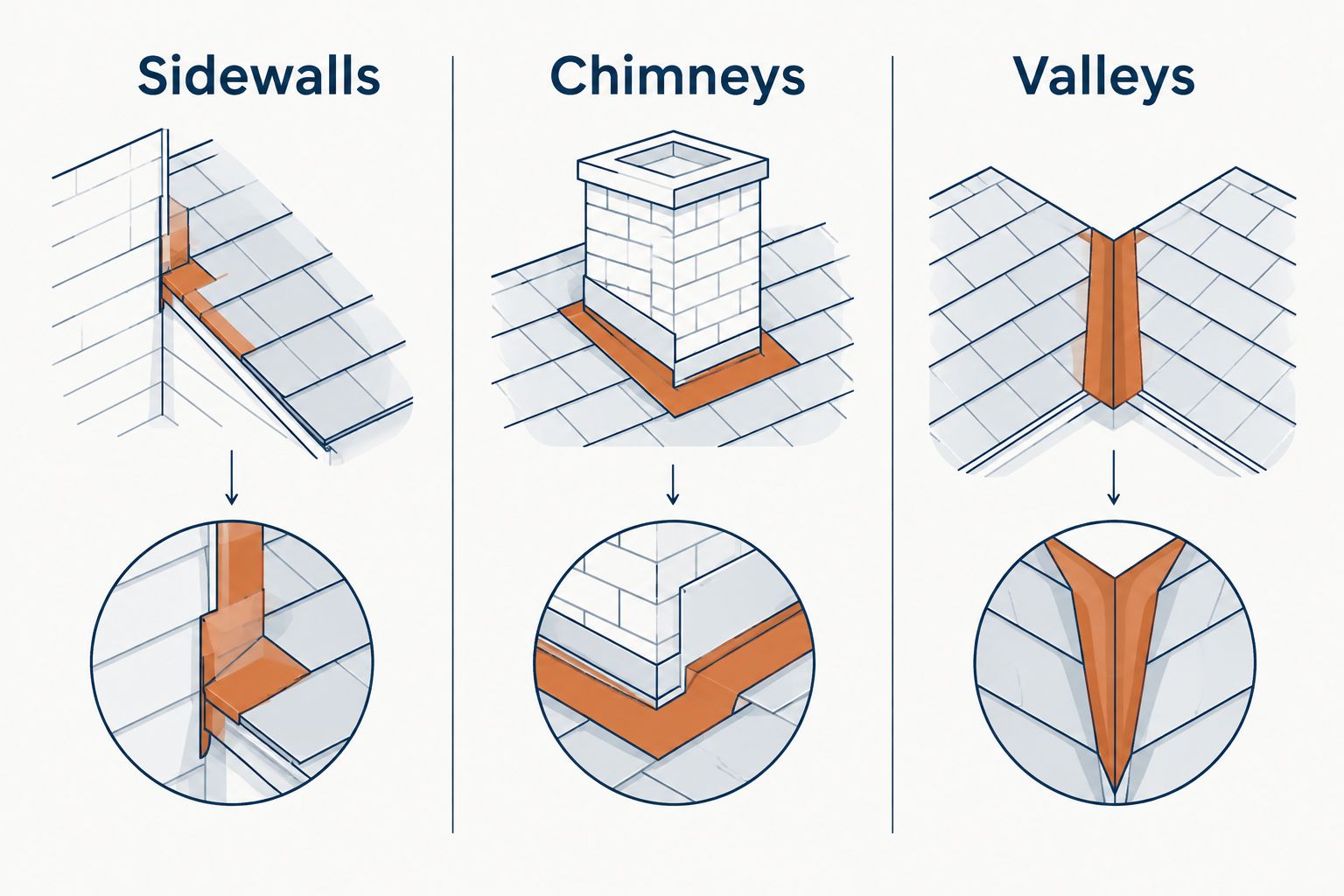
Material selection comes after identifying how the junction sheds water. Compare these 3 roof areas during your estimate review: sidewalls, chimneys, and valleys.
Sidewalls
Step flashing uses individual overlapping pieces woven into successive shingle courses where a sloped roof meets a wall. Counterflashing or the wall's water-shedding layers cover the upper portion of that assembly.
Ask how siding will be handled if access is necessary. A new visible metal strip is not proof that concealed step flashing has been replaced correctly.
Chimneys
Base flashing connects the roof surface to the chimney; counterflashing protects the upper edge of the base flashing. At masonry, the connection needs a defined detail rather than an exposed bead of sealant standing in for the assembly.
Ask whether the estimate includes base flashing, counterflashing, or both. Masonry repairs are a separate scope question and should not disappear inside the phrase “chimney flashing.”
Valleys
Valleys concentrate runoff where roof slopes meet. Open metal valleys and shingle-covered valley systems use different assemblies, so the metal choice must follow the selected roof system.
Ask the contractor to name the valley method and explain the underlayment beneath it. Do not compare a metal-valley estimate with a shingle-covered valley estimate as though their scopes are identical.
What your roof replacement estimate should include
For your 2026 project, compare flashing scope separately from shingle selection. Read each estimate against the same checklist:
- Removal: Which existing flashings will be removed during tear-off?
- Replacement: Which locations receive new metal, and what material is specified?
- Reuse: Which pieces stay, and what condition makes reuse acceptable?
- Access: Does the work include removing and reinstalling siding or opening masonry joints?
- Concealed damage: How will deteriorated decking or inaccessible conditions be documented and authorized?
- Completion: What photographs or explanations will confirm the concealed details before they are covered?
An allowance is not the same as a fully defined scope. Ask what triggers additional work and how you approve it before the work proceeds.
Ask Prescott Roofing to separate included flashing work from conditional work in your residential roof replacement estimate. This gives you a clearer basis for comparing proposals without assuming every contractor has included the same assembly.
Request a roof replacement inspection
Discuss flashing details and replacement scope. An inspection request is not a confirmed appointment.
How these materials were ranked
The ranking prioritizes compatibility, exposure, detail fit, workability, replacement access, and written specifications. Coated galvanized steel takes the default inland shingle-roof slot; aluminum, copper, and stainless steel earn separate recommendations for distinct applications.
No metal wins every location. Choose the complete water-shedding detail before choosing the metal's appearance.
Which flashing material should you choose?
For a typical inland Southern New Hampshire asphalt-shingle replacement, start by asking about coated galvanized steel. Move to another material when the adjoining materials, exposure, or fabrication requirements support that choice.
Your 2026 decision should end with a written specification—not a verbal promise to “take care of the flashing.” Choose the contractor who can explain the connection, identify exclusions, and document what will be replaced.
FAQ
What's the best roof flashing material for a New England home?
Coated galvanized steel is a practical default for compatible inland asphalt-shingle replacements. Copper, aluminum, and stainless steel suit different details, so the final choice depends on exposure and adjoining materials.
Is copper flashing better than aluminum?
Copper is better suited to some traditional masonry details, while aluminum suits compatible formed trim and edge applications. Neither is a universal substitute for the other, and both require attention to adjoining materials.
Should all flashing be replaced with a new roof?
A roof replacement needs an explicit flashing assessment, not an automatic assumption that every piece stays or goes. Your estimate should identify replacement locations and explain the condition and integration of anything retained.
Can roof sealant replace metal flashing?
Sealant is not a substitute for a properly designed flashing assembly. Some specified joints use compatible sealants, but the assembly must still direct water onto the roof's drainage surface.
Does a roof replacement estimate include chimney flashing?
The written scope determines whether chimney flashing is included. Ask separately about base flashing, counterflashing, masonry access, and any excluded repairs.
Is stainless steel flashing right for every coastal home?
Stainless steel deserves consideration where corrosion resistance is a priority, but alloy selection and the complete detail still matter. Ask the contractor to specify the material for the actual exposure rather than relying on the word stainless.
What should I ask Prescott Roofing during an inspection?
Ask Prescott Roofing which flashing components need replacement, which can remain, and how each will connect to the new roof. Request a written explanation of materials, access work, and exclusions before approving the replacement.
One last thing
The most useful flashing photograph is often taken before the shingles cover it. Ask how concealed step flashing and other covered details will be documented during replacement, not after cleanup.
You do not need to climb onto the roof to evaluate that answer. You need a contractor who can explain the work clearly and show what will disappear beneath the finished surface.