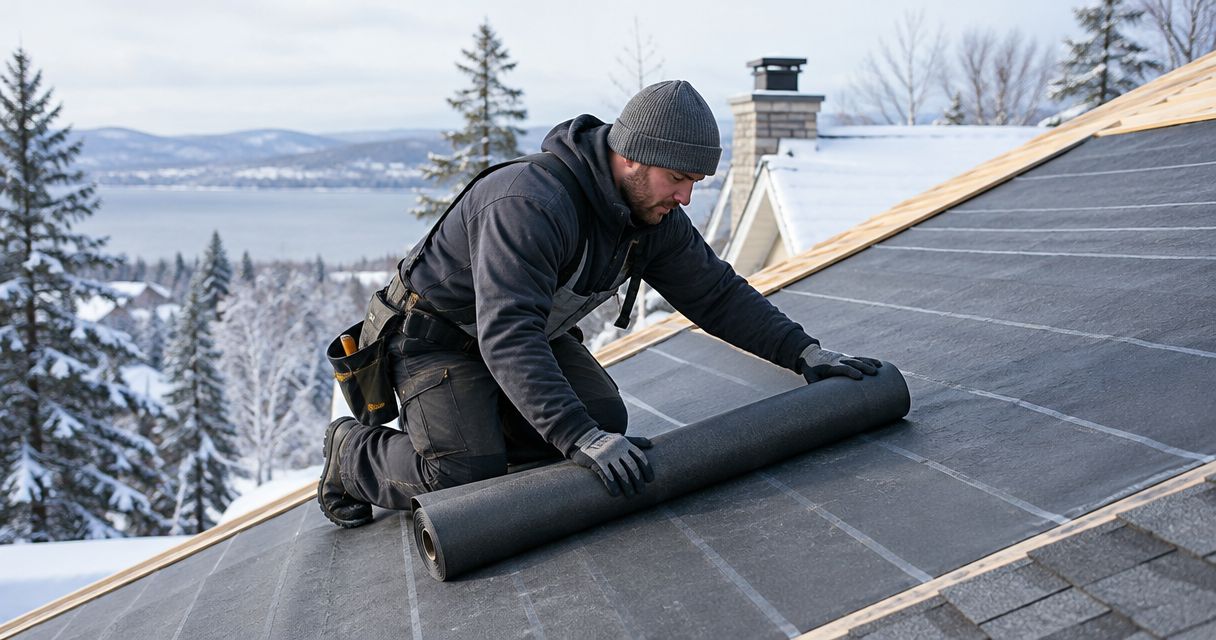
Best overall for the main roof area: mechanically fastened synthetic underlayment. Best for locations requiring an ice barrier: a qualifying self-adhered, synthetic-surfaced membrane. Best for an assembly designed to dry outward: vapor-permeable synthetic underlayment. For a homeowner-paid roof replacement in 2026, choose the underlayment that fits the roof assembly and installation conditions—not the strongest-looking sample.
- The best synthetic roofing underlayment for cold winters depends on roof slope, assembly design, and installation requirements.
- Mechanically fastened synthetic underlayment is the default field-layer choice; it does not replace a required ice barrier.
- Choose self-adhered membranes by their documented ice-barrier approval, substrate requirements, and installation temperature limits.
- Ask Prescottroofingnh to identify the proposed underlayment and its installation requirements in your roof replacement estimate.
Why this matters
Underlayment is the secondary layer between your roof deck and roof covering. It helps manage water that reaches beneath the shingles, but it does not replace properly installed shingles, flashing, or a sound deck.
For homeowners comparing residential replacement work through Prescottroofingnh, the useful question is not simply whether synthetic material beats felt. Ask which material goes where, what conditions it requires, and how that work appears in the estimate.
Cold New England weather makes those distinctions important. A membrane's ability to function after installation is different from its ability to bond correctly during installation. Neither a thick sheet nor a recognizable name resolves that difference.
What makes the best synthetic roofing underlayment?
Use these criteria before comparing any proposed product:
- Assembly compatibility: The underlayment must suit the roof covering, roof slope, deck, and applicable installation instructions.
- Cold-weather installation requirements: Check permitted application conditions, substrate preparation, and any primer requirements.
- Water-management role: Distinguish ordinary field underlayment from a membrane qualified for required ice-barrier locations.
- Attachment and laps: The estimate should account for specified fasteners, overlap dimensions, and transitions—not just rolls of material.
- Drying strategy: Vapor permeability must fit the roof assembly. More permeability is not automatically better.
- Documentation: Get the exact manufacturer and product designation before approving the replacement contract.
The best underlayment is the one your contractor can specify and install correctly for your roof—not the one with the broadest winter claim.
Synthetic roofing underlayment at a glance
These are application categories, not interchangeable products. A single replacement roof can use more than one category in different locations.
| Ranked option | Best for | Standout feature | Key limitation |
|---|---|---|---|
| Mechanically fastened synthetic underlayment | Main roof areas beneath a compatible covering | A separately fastened secondary water-shedding layer | Ordinary field underlayment does not replace a required ice barrier |
| Qualifying self-adhered, synthetic-surfaced membrane | Locations requiring ice-barrier protection | Bonds to a prepared substrate when installed as specified | Bonding depends on product-specific conditions and preparation |
| Vapor-permeable synthetic underlayment | Assemblies specifically designed for outward drying | Allows more outward vapor movement than low-permeance alternatives | Requires assembly-level selection; permeability alone is not a winter advantage |
1. Mechanically fastened synthetic: best for main roof areas
Mechanically fastened synthetic underlayment is a practical default beneath compatible steep-slope roof coverings. The installer attaches it to the deck with the specified fasteners and overlaps the sheets so water sheds toward the eaves.
For a 2026 replacement estimate, require the actual product name rather than the phrase premium synthetic. That phrase does not identify attachment requirements, exposure limits, or permitted roof slopes.
Mechanically fastened synthetic underlayment pros:
- Provides a secondary water-shedding layer beneath the roof covering.
- Does not depend on a full-surface adhesive bond for attachment.
- Can be combined with qualifying self-adhered protection in specified locations.
- Has installation requirements that can be checked against the written scope.
Mechanically fastened synthetic underlayment cons:
- Ordinary field products are not substitutes for required ice-barrier membranes.
- Incorrect fastening and poorly arranged laps undermine the intended protection.
- Product-specific exposure limits still apply before the roof covering is installed.
Best for: Homeowners replacing a compatible steep-slope roof who need a clearly specified field underlayment.
Ask how the contractor will attach the material and handle transitions into other membranes. An answer that stops at the material's tear resistance leaves the installation question unanswered.
Verdict: Buy as the field-layer choice when the named product fits the roof covering and installation requirements.
2. Self-adhered synthetic-surfaced membrane: best for ice barriers
A qualifying self-adhered membrane serves a different purpose from ordinary mechanically fastened underlayment. Its adhesive bonds the membrane to a suitable substrate, and qualifying products provide the protection required at designated ice-barrier locations.
Do not assume every peel-and-stick roofing product qualifies. The contractor must identify the particular membrane and confirm that its documented uses meet the project requirements.
Self-adhered synthetic-surfaced membrane pros:
- Provides bonded protection where the assembly requires it.
- Qualifying products address the specific role of an ice barrier.
- Can protect designated locations without requiring the same material across the entire roof.
- Makes substrate preparation and application conditions explicit parts of the specification.
Self-adhered synthetic-surfaced membrane cons:
- Cold, moisture, or an unsuitable substrate can interfere with adhesion.
- Primer requirements and application limits vary by product.
- Broad coverage can change the assembly's drying behavior and needs deliberate planning.
Best for: Locations where the applicable code, roof design, or covering instructions require a qualifying ice barrier.
For a Southern New Hampshire replacement, ask the contractor to show the proposed membrane coverage on a roof sketch. The sketch should identify the relevant eaves, valleys, and transitions rather than promise an unspecified amount of protection.
Verdict: Buy for required locations after the contractor confirms product qualification, coverage, and installation conditions.
3. Vapor-permeable synthetic: best for a specified drying assembly
Vapor-permeable synthetic underlayment allows water vapor to move through the sheet. That characteristic matters when the roof assembly has been designed to dry outward through compatible layers.
It is not a cure for a damp attic. Air leakage, insulation, ventilation, deck condition, and the roof covering all affect moisture behavior; selecting a permeable sheet does not resolve those issues by itself.
Vapor-permeable synthetic underlayment pros:
- Supports outward vapor movement where the complete assembly permits it.
- Gives the designer a documented material characteristic to evaluate.
- Offers an alternative when low-permeance underlayment conflicts with the intended drying strategy.
Vapor-permeable synthetic underlayment cons:
- Does not automatically improve every residential roof assembly.
- Requires compatibility with the covering and other roof layers.
- Does not replace required ice-barrier protection or correct attic moisture sources.
Best for: A replacement project with a documented assembly-level reason to use vapor-permeable underlayment.
If a proposal recommends this category, ask what moisture pathway it addresses and how the remaining roof layers support that pathway. The answer should describe your house, not repeat the product brochure.
Verdict: Hold until the contractor explains the assembly-specific reason for choosing it.
What your replacement estimate should include
A useful 2026 estimate connects the underlayment to the rest of the replacement work. Ask Prescottroofingnh to separate material selection from preparation, installation, and concealed-condition allowances so you can evaluate the scope clearly.
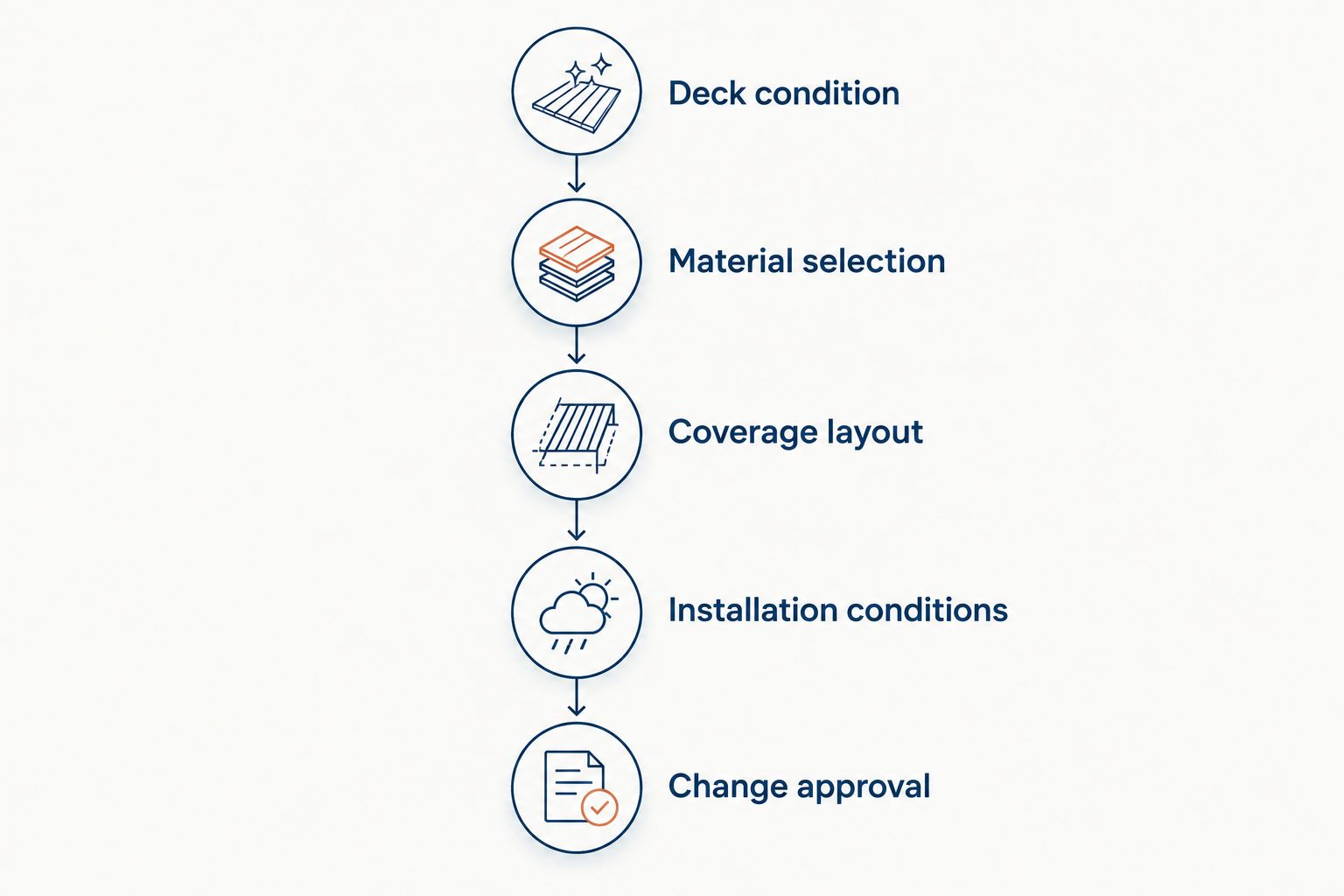
Use this sequence when reviewing a proposal:
- Deck condition: Establish whether the scope includes tear-off to expose the deck and how damaged decking will be handled.
- Material selection: Identify the exact field underlayment and any separate self-adhered membrane.
- Coverage layout: Show where each material goes and how adjoining layers overlap.
- Installation conditions: State how the crew will follow temperature, moisture, fastening, and preparation requirements.
- Change approval: Explain how additional work will be documented and authorized before it proceeds.
Compare 3 written estimates using the same checklist. Different totals do not establish different value when one proposal includes deck preparation and another leaves it undefined.
Also identify exclusions. Ask whether flashing replacement, ventilation changes, disposal, permits, and deck repairs are included, excluded, or addressed through a stated allowance or change process. Do not assume an underlayment upgrade includes those items.
Cold-weather installation: ask about the work, not just the roll
A material's service-temperature range describes conditions it can withstand in use. Its application-temperature requirements describe conditions needed during installation. Those are different specifications, particularly for adhesive-backed membranes.
For roof replacement in cold weather, the controlling questions are whether the deck is suitable, the material can be installed within its instructions, and the crew can protect unfinished work. Scheduling a winter job does not remove those requirements.
That distinction also explains why roof replacement in cold weather requires a plan for each installed layer rather than a general promise that roofing can proceed. Shingles, underlayment, adhesives, and sealants do not necessarily share the same application conditions.
Before approving a winter installation in 2026, ask these 4 questions:
- What are the named membrane's application requirements?
- How will the crew confirm the deck is ready for that membrane?
- What happens if conditions fall outside the product instructions?
- How will unfinished roof areas be protected if work pauses?
A clear answer describes the installation process and the stopping point. A vague answer about using a better grade of material does neither.
Check the details that underlayment cannot fix
Step flashing consists of individual flashing pieces integrated with shingles where a sloped roof meets a wall. Underlayment beneath that intersection does not eliminate the need to handle the flashing correctly.
The same principle applies around penetrations and at roof edges. Water-management layers must connect in the correct order; a sheet installed beneath an incorrectly detailed transition is not a complete repair strategy.
Request photographs of 3 detail types before they are concealed: membrane transitions, roof-to-wall flashing, and penetration flashing. Where a detail does not exist on your roof, substitute another relevant transition identified during the inspection.
Photos do not prove every installation requirement was met. They do give you a record of work that becomes difficult to inspect after the shingles cover it.
How these options are ranked
This ranking prioritizes application fit, required water protection, installation conditions, and clarity in the replacement estimate. It ranks material categories by their jobs rather than claiming an unsupported winner among branded products.
Mechanically fastened synthetic takes the default field-layer position. Qualifying self-adhered membrane takes the required ice-barrier position. Vapor-permeable synthetic earns a place when the assembly has a specific drying requirement.
The categories complement one another. Treating them as direct substitutes is the wrong buying decision.
Which synthetic roofing underlayment should you choose?
For a typical compatible steep-slope replacement, choose a named mechanically fastened synthetic field underlayment, with qualifying self-adhered protection wherever required. Select vapor-permeable material only when the roof assembly calls for it.
For your 2026 project, request a Prescottroofingnh inspection to discuss synthetic roofing underlayment as part of the complete replacement scope. Explain any known attic moisture concerns and ask for the material names, coverage layout, and concealed-condition process in writing.
Requesting an inspection is not the same as having an appointment booked. Confirm the appointment details before making arrangements to be home.
FAQ
What's the best synthetic roofing underlayment for cold winters?
Mechanically fastened synthetic underlayment is the default field-layer choice beneath a compatible steep-slope roof covering. Pair it with qualifying self-adhered protection wherever an ice barrier is required, and follow each product's installation instructions.
Is synthetic underlayment the same as ice and water membrane?
No. Ordinary synthetic field underlayment and a qualifying ice-barrier membrane perform different roles. A synthetic surface alone does not establish that a product qualifies as an ice barrier.
Can self-adhered roofing membrane be installed in freezing weather?
The named product's installation instructions determine whether it can be applied under the conditions at your roof. Check application temperature, substrate condition, storage instructions, and any primer requirements rather than relying on a general winter-use claim.
Should my whole roof get self-adhered underlayment?
Full-roof self-adhered coverage needs an assembly-specific reason. Ask how the proposed coverage meets water-protection requirements and affects drying before approving it as an upgrade.
Is vapor-permeable underlayment better for a cold attic?
Not automatically. Vapor-permeable underlayment must fit the complete roof assembly, and it does not correct attic air leakage, insulation defects, or ventilation problems by itself.
What should a roofing estimate say about underlayment?
A roofing estimate should identify the exact products, coverage locations, installation requirements, and relevant exclusions. It should also explain how concealed deck damage and additional work will be authorized.
Can better underlayment make up for old flashing?
No. Underlayment does not replace correctly detailed flashing at walls, penetrations, and other transitions. Ask the contractor to state which flashing will be replaced and how any proposed reuse will be evaluated.
One last thing
Ask to see the underlayment packaging or product designation before installation starts. Match it to the approved estimate while a substitution is still straightforward to discuss—not after the material is beneath the shingles.
A precise specification is a homeowner protection. It turns synthetic underlayment included into work you can actually verify.