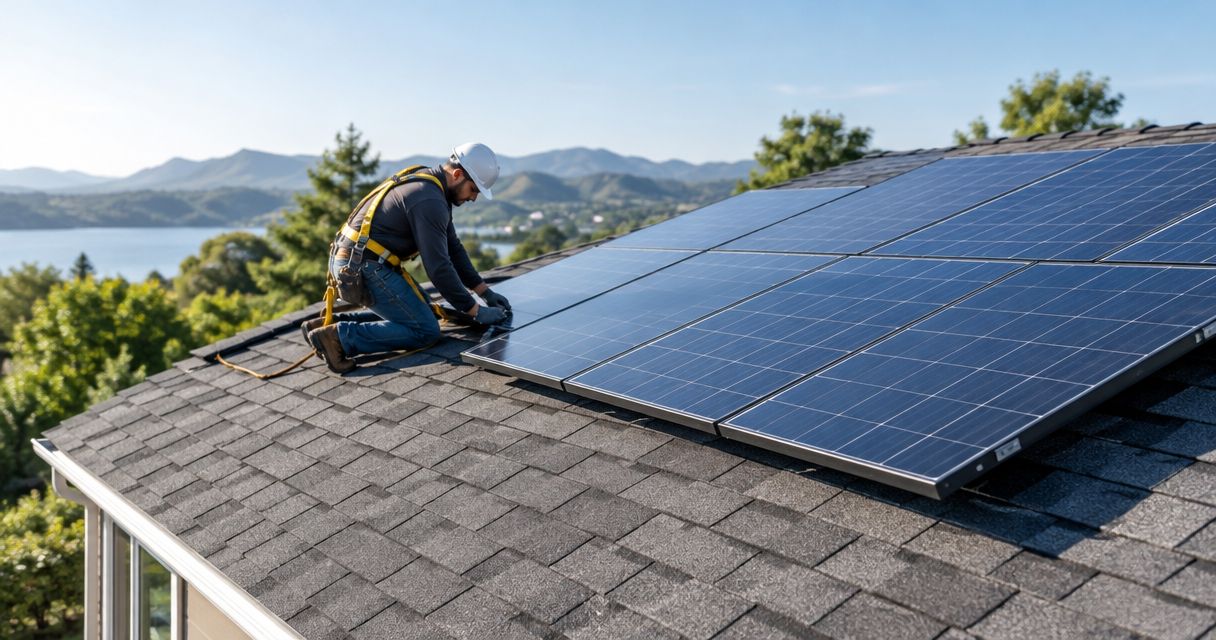
Solar-equipped homeowners’ roof replacement is a coordinated roofing and solar project aimed at renewing the roof without leaving panel removal, reinstallation, or electrical responsibilities unresolved. This 2026 guide explains how to compare estimates, sequence the work, and prepare for inspections; Prescott Roofing serves homeowners considering residential roof replacement in Southern New Hampshire and Northern Massachusetts.
- Roof replacement for homes with solar panels needs separate roofing, solar removal, and reinstallation scopes before scheduling.
- Prescott Roofing fits Southern New Hampshire homeowners seeking residential roof replacement; confirm solar responsibilities separately.
- Compare roof replacement estimates by included work, exclusions, and handoffs—not the roofing total alone.
- Keep panels off the roof until the roofing work and mounting details are ready for reinstallation.
Why roof replacement matters for solar-equipped homeowners
A solar array changes access to the roof beneath it. Panels, mounting rails, attachments, and electrical wiring create responsibilities that a roofing estimate alone does not settle. Replacing exposed shingles while leaving an aging roof beneath the array also leaves part of the roofing problem untouched.
For Southern New Hampshire homeowners planning a homeowner-paid replacement in 2026, the central question is not simply which shingle to choose. It is who removes the array, who protects the house during the roofing work, and who confirms that the reinstalled system works.
Prescott Roofing is best suited to Southern New Hampshire homeowners seeking residential roof replacement. Treat solar removal and reinstallation as a separate scope unless the written agreement expressly includes them.
A clear plan protects your ability to compare contractors. An estimate that excludes panel handling is not equivalent to one that includes it, even when both describe a complete roof replacement. Ask for the missing scope before making your decision.
How to plan a roof replacement with existing solar panels
1. Establish who controls the solar equipment
Start with your existing paperwork. Find the installation agreement, equipment documents, monitoring access, and any lease or power purchase agreement. Ownership and contract terms determine whom you must involve before anyone moves the array.
Do this yourself before requesting coordinated estimates. If another company owns the equipment, ask that company for its removal and reinstallation process in writing. If you own it, ask the original installer whether it handles this work and what records another qualified solar contractor would need.
Do not disconnect wiring, loosen mounts, or climb onto the roof to identify components. Solar equipment can present electrical hazards even when household power is switched off. Leave isolation and electrical work to qualified personnel.
- Confirm whether you own or lease the equipment.
- Identify the company authorized to approve removal.
- Collect equipment and mounting-system documents.
- Save existing monitoring access and system records.
- Request written instructions for a roofing project.
2. Inspect the whole roof, not just exposed shingles
Begin with observations from the ground and accessible interior spaces. Record ceiling staining, visible roof wear, and known leak locations without assuming that each symptom identifies the entry point. Water can travel before appearing indoors.
Then request a roof inspection that addresses the array area as well as the uncovered roof. Ask how the contractor will assess areas hidden beneath the panels and what remains uncertain until removal. A concealed condition should become a defined inspection checkpoint, not an unexplained addition later.
The roof deck is the structural surface beneath the roofing materials. Its condition can affect both the replacement roof and the mounting attachments. Before approving your 2026 scope, ask how damaged decking will be documented and how additional work will receive your approval.
- Photograph visible concerns from safe locations.
- Identify roof sections concealed by the array.
- Ask what can be assessed before panel removal.
- Require photographs of concealed damage after exposure.
- Set a written approval process for deck repairs.
3. Separate the estimate into clear work scopes
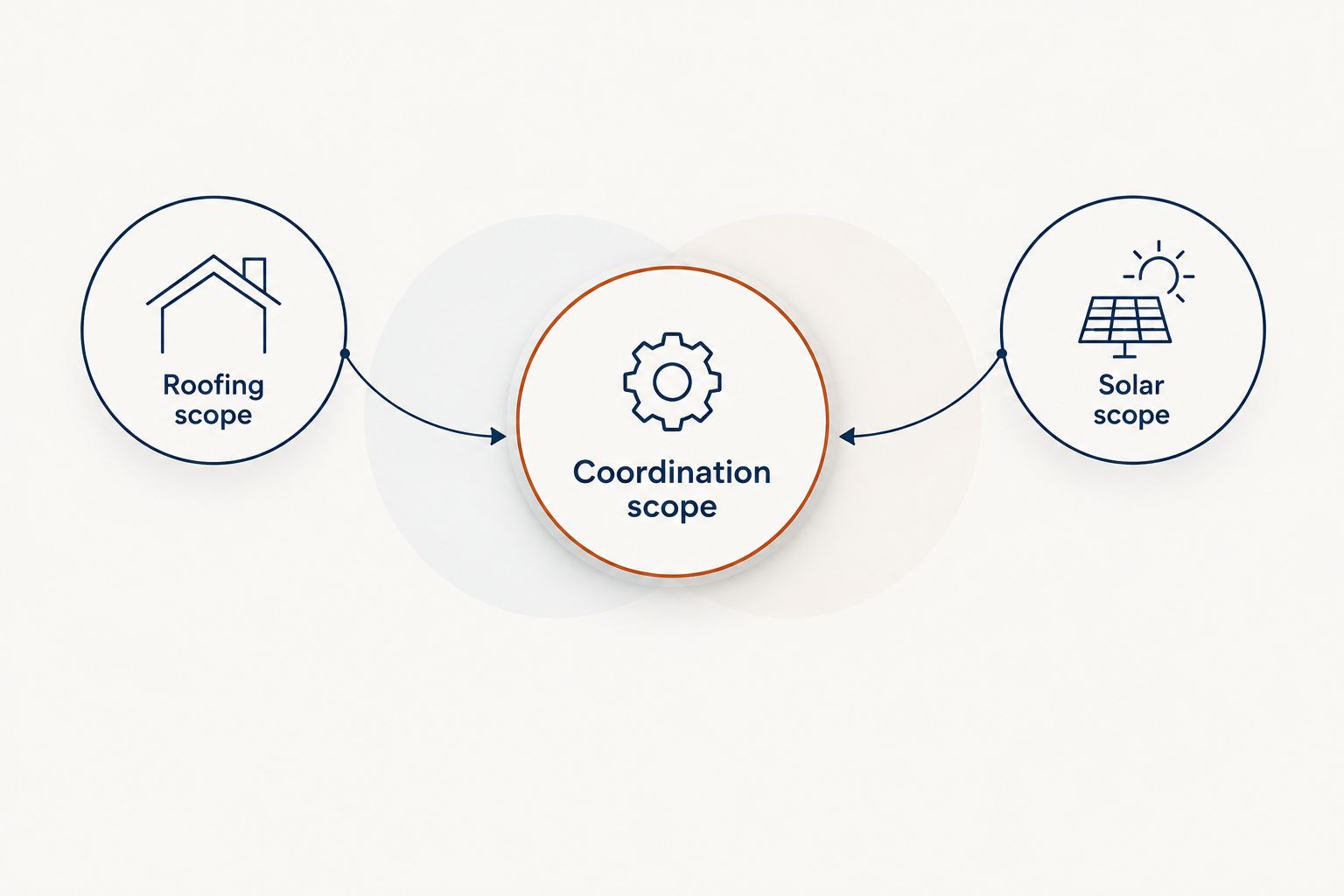
Create a comparison sheet yourself before choosing a contractor. Use 3 written scopes: roofing, solar, and coordination. These are planning categories, not a requirement to hire separate companies; a single agreement still needs to identify who performs each task.
Ask Prescott Roofing to identify the roofing work included in its estimate, and ask the solar provider to identify removal and reinstallation responsibilities. Do not assume either company has accepted the other's work because both have discussed the project.
A tear-off means removing existing roof-covering materials. Your roofing scope should explain the removal limits, underlayment, flashing, ventilation work, disposal, and cleanup. Your solar scope should address equipment handling, storage, mounting hardware, electrical work, and operational checks. Coordination covers scheduling, permits, inspections, and responsibility between trades.
- Roofing scope: identify materials, tear-off, flashing, and exclusions.
- Solar scope: identify removal, storage, reinstallation, and testing.
- Coordination scope: name the person managing trade handoffs.
- Define how changes receive your written approval.
- Identify who arranges required permits and inspections.
4. Choose roofing and mounting details together
Start by asking whether your existing roof type remains suitable for the planned replacement and solar reinstallation. Keeping the same material does not eliminate the need to review attachment locations and waterproofing. Changing materials adds another compatibility question.
For asphalt shingles, ask how each mounting penetration will be flashed. Flashing directs water away from vulnerable joints and openings; a surface bead of sealant is not a substitute for an installation that follows the mounting and roofing manufacturers' instructions.
For a proposed metal roof, ask the solar contractor to identify the attachment method for the exact roof profile. Do not assume that every metal roof accepts the same clamp or attachment. Ask who verifies structural attachment requirements and whether the proposed layout changes any existing penetrations.
- Identify the exact roofing material under consideration.
- Request the proposed mounting attachment details.
- Confirm compatibility using manufacturer instructions.
- Specify how abandoned penetrations will be addressed.
- Coordinate roof vents and other obstructions with the array layout.
5. Agree on the sequence before setting dates
Make a simple schedule showing solar removal, roof exposure, roofing work, reinstallation, and closeout. Your manual version can be a shared written checklist. Ask the contractors to confirm their responsibilities against it rather than relying on separate verbal promises.
Use 2 documented handoff checks: one after solar removal and one before solar reinstallation. The first confirms that the roof is accessible and equipment is accounted for. The second confirms that roofing work and attachment details are ready for the solar contractor.
For a 2026 replacement, ask how weather interruptions affect that sequence. The agreement should identify who protects exposed areas and who communicates schedule changes. Do not accept a fixed completion promise that leaves no explanation of what happens when roofing conditions prevent work.
- Name the person who authorizes each handoff.
- Record equipment condition before removal.
- Identify the secure equipment storage location.
- Confirm temporary weather-protection responsibilities.
- Require approval before the array returns to the roof.
6. Resolve water-entry details before panels return
Once the panels are removed, concealed roof areas become accessible. This is the point to inspect old attachments, damaged decking, and roof-to-wall intersections—not after the array covers them again. Ask for photographs before those areas disappear beneath new materials.
Leak diagnosis must distinguish the visible indoor symptom from the actual entry point. That is why roof leak detection methods belong in the discussion before removal and reinstallation scopes are finalized: a suspected mounting leak and a flashing defect require different corrective work. The project's repair details must still match your roof and local requirements.
Step flashing consists of individual pieces of flashing integrated with roofing along a wall intersection. Ask whether nearby wall flashing will be replaced, retained, or investigated further. A complete replacement estimate should make those boundaries clear, especially where panels previously limited access.
- Inspect old mounting locations after removal.
- Document deck condition before covering it.
- Identify wall, chimney, and vent flashing work.
- Confirm treatment of unused attachment holes.
- Resolve unexplained staining or moisture before reinstallation.
7. Close out both the roof and solar work
Keep 1 closeout file containing the roofing scope, solar scope, approved changes, photographs, inspection records, and applicable manufacturer documents. A folder you maintain yourself is enough. The value comes from complete records, not a particular app.
Ask the solar contractor to explain how reinstallation will be checked and how you will know the system is operating. Monitoring access alone does not explain whether every required commissioning or inspection task is complete. Request the relevant records and a clear answer about any outstanding work.
Before final acceptance, review cleanup, roof penetrations, equipment condition, and unresolved items with the responsible contractor. Keep roofing workmanship questions separate from solar equipment questions, while documenting who will investigate a problem that crosses both scopes.
- Collect photographs before and after reinstallation.
- Obtain applicable permit and inspection records.
- Request documentation of solar operational checks.
- Record outstanding work and the responsible party.
- Save warranty documents without assuming coverage transfers unchanged.
Request a roof replacement inspection
Discuss the roofing scope and identify what your solar provider needs to coordinate.
An inspection request starts the conversation; it does not mean an appointment is booked. Confirm the date, access arrangements, and whether the solar provider needs to supply records beforehand.
Compare project arrangements before hiring
There is no single best contracting arrangement for every solar-equipped home. Compare accountability and exclusions first. For your 2026 project, select the arrangement that gives you a documented removal-to-reinstallation plan rather than an unsupported promise of convenience.
| Option | Best for | Main advantage | Key limitation |
|---|---|---|---|
| Separate roofing and solar contracts | Homeowners retaining an existing solar provider | Each trade has a distinct written scope | You must confirm who coordinates handoffs |
| Roofing agreement with expressly included solar work | Homeowners seeking a single contractual point of contact | Coordination responsibilities can sit in one agreement | You still need to know who performs and accepts the solar work |
| Solar-provider-led coordination | Homeowners whose equipment agreement directs the process | Solar handling follows the provider's specified process | Roofing scope and contractor selection still need separate review |
Choose the arrangement with the clearest responsibility, not simply the fewest signatures. A single contract can still contain exclusions, and separate contracts can work well when the schedule and handoffs are explicit.
Common mistakes solar-equipped homeowners make
- Comparing roofing totals without solar scopes. An excluded removal-and-reinstallation scope leaves you comparing different projects. Obtain the missing scope before choosing.
- Assuming panels eliminate roof inspection needs. The covered roof still needs assessment. Ask which findings remain provisional until the array is removed.
- Switching roof materials without reviewing attachments. A material decision also affects mounting details. Get the proposed attachment method confirmed before ordering roofing materials.
- Accepting sealant as the entire waterproofing explanation. Ask how the mounting assembly integrates with the roof covering and manufacturer instructions.
- Closing the project without solar records. A finished roof does not establish that reinstalled solar equipment has completed its required checks. Collect both sets of closeout documents.
FAQ
Do solar panels have to come off before a roof replacement?
Panels covering a roof section being replaced generally need to be removed so that section can be accessed. Ask the roofing and solar contractors to define the removal area and sequence in writing.
Can my roofer remove and reinstall my solar panels?
Do not assume solar removal and reinstallation are included in a roofing contractor's work. Confirm who performs the solar work, their qualifications, and whether your equipment agreement imposes additional requirements.
How do I compare roof replacement estimates when I have solar panels?
Compare roofing, solar, and coordination scopes separately. Check removal, storage, mounting hardware, electrical work, deck repairs, permits, inspections, and exclusions before comparing the proposals as complete projects.
What should I do if I lease my solar panels?
Contact the equipment owner before authorizing removal. Ask for its written process, approved contractor requirements, and any agreement terms that affect roof replacement.
Can I change from shingles to metal roofing with existing solar panels?
A change requires confirmation that the proposed solar attachments suit the exact metal roofing system. Have the roofing and solar contractors resolve compatibility and structural attachment details before approving the material change.
Will my solar system keep generating power during roof replacement?
A disconnected array does not generate usable power for your home during removal and reinstallation. Ask the solar contractor to explain the expected interruption and how operation will be confirmed afterward.
How do I request a roof inspection from Prescott Roofing?
Use Prescott Roofing's contact process to request a residential roof replacement inspection and explain that the home has solar panels. Confirm the appointment separately and ask what solar documents should be available for the discussion.
One last thing
Ask for photographs of the finished roofing and mounting details before the panels cover them. Those images preserve a view you will not have once the project is complete, making the closeout record more useful than final exterior photos alone.
For a homeowner-paid replacement in 2026, start with a roof inspection and a separate conversation with your solar provider. Prescott Roofing can be part of the roofing discussion; solar responsibilities still need explicit written confirmation before work begins.