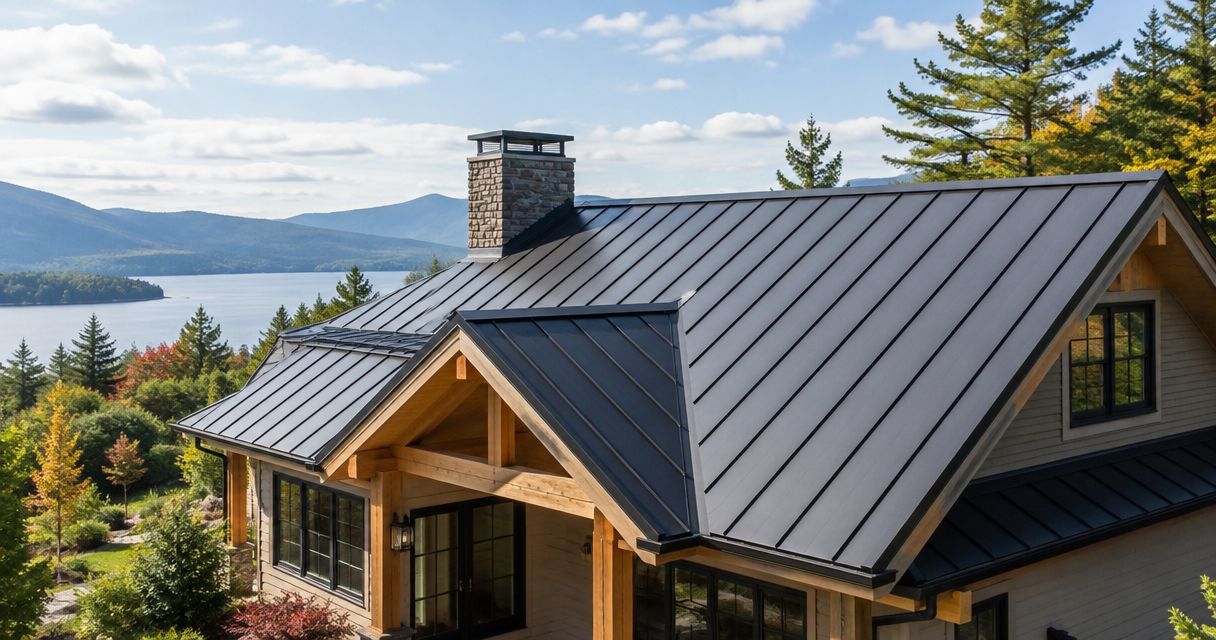
Best overall shortlist for a straightforward NH replacement: McElroy Metal. Best for comparing mechanically seamed systems: Englert. Best for architectural profile choices: ATAS International. Best for projects built around portable rollforming: Drexel Metals. This 2026 guide compares standing seam manufacturers by project fit, then explains what your contractor’s estimate must cover before you choose.
- The best standing seam metal roof brands for NH homes depend on panel selection, roof geometry, and installation details.
- McElroy Metal is the first shortlist pick for a straightforward residential standing seam replacement.
- Compare Englert for mechanically seamed systems, ATAS International for profiles, and Drexel Metals for portable rollforming.
- Prescott Roofing is best for Southern NH homeowners seeking a residential replacement inspection before choosing roofing materials.
Why this matters
A metal manufacturer supplies a roof system, not a finished roof. Your contractor still has to inspect the deck, choose an appropriate panel, and build the transitions around chimneys, walls, valleys, and roof edges.
For a homeowner-paid replacement in Manchester, Nashua, or Bedford, start with the roof you have—not a manufacturer’s color chart. Ask Prescott Roofing about a residential replacement inspection before deciding which material belongs on your estimate. Requesting an inspection does not mean an appointment is booked; confirm the date separately.
Choose the documented roof assembly before choosing the logo on the material order. A recognizable manufacturer does not settle questions about flashing, ventilation, or concealed deck repairs.
What makes the best standing seam roof brand?
Use these criteria to compare your 2026 options. Each one should connect to something the contractor can show you in writing.
- Panel suitability: The exact panel must meet its manufacturer’s requirements for your roof slope, substrate, and attachment method.
- Seam design: Snap-lock and mechanically seamed panels use different closure methods. Neither label alone proves suitability.
- Movement details: Metal expands and contracts with temperature. Attachment and flashing details must accommodate that movement.
- Complete specifications: Compare the metal substrate, thickness, finish, clips, underlayment, and trim—not just the brand name.
- Installer familiarity: Ask how the contractor forms, attaches, seams, and flashes the proposed system.
- Clear responsibility: Your estimate should distinguish material documentation from the contractor’s installation obligations.
A roof slope of 3:12 means the roof rises 3 inches over 12 inches of horizontal distance. That measurement helps identify eligible systems; it is not permission to install any standing seam panel on that roof.
Standing seam manufacturers at a glance
These are project-fit recommendations, not a laboratory performance ranking. Confirm the exact current panel documentation before signing a 2026 replacement contract.
| Manufacturer | Best for | Standout consideration | Key limitation |
|---|---|---|---|
| McElroy Metal | Straightforward residential replacements | Snap-lock and mechanically seamed panel options | Manufacturer name alone does not identify the proposed assembly |
| Englert | Comparing mechanically seamed systems | Architectural standing seam systems and rollforming equipment | Seam selection still requires slope and installation checks |
| ATAS International | Architectural profile selection | Multiple standing seam profile choices | Appearance choices do not resolve flashing or attachment requirements |
| Drexel Metals | Projects organized around portable rollforming | Metal roofing systems and portable rollforming equipment | Field fabrication still needs controlled handling and installation |
None of these manufacturers replaces the need for a qualified installer. Ask which exact system your contractor proposes, who forms the panels, and which written instructions govern the work.
1. McElroy Metal: best for straightforward home replacements
McElroy Metal offers standing seam roofing systems with different seam configurations. It is the first shortlist pick here for a homeowner comparing a conventional residential replacement, because the discussion can start with panel suitability rather than decorative extras.
Keep the selection specific. An estimate that says only McElroy Metal leaves the panel profile, seam closure, attachment, and other assembly decisions unresolved.
McElroy Metal pros:
- Snap-lock and mechanically seamed options support different project requirements.
- Named panel systems let you request system-specific installation details.
- A system-based comparison helps separate material selection from contractor scope.
McElroy Metal cons:
- Different systems under the same brand are not interchangeable.
- The manufacturer’s name does not establish the installer’s experience with your selected panel.
Best for: A homeowner with a straightforward roof who wants to compare clearly identified standing seam assemblies.
Ask the contractor to explain why the proposed panel fits your slope and roof geometry. If the answer stops at brand recognition, the recommendation is incomplete.
Verdict: Buy only after the estimate names the exact panel and installation method.
2. Englert: best for comparing mechanically seamed systems
Englert supplies architectural metal roofing systems and rollforming equipment. Include Englert when your contractor proposes a mechanically seamed standing seam roof and can explain the required closure process.
Mechanical seaming uses equipment to fold the panel seams after placement. The finished seam must follow the selected system’s requirements; simply calling a roof mechanically seamed does not establish its performance.
Englert pros:
- Architectural standing seam systems provide defined profiles to evaluate.
- Rollforming equipment supports a fabrication-focused contractor discussion.
- Mechanically seamed options let you compare closure details explicitly.
Englert cons:
- Mechanical seaming adds an installation operation that needs proper equipment and execution.
- A selected seam still needs compatible slope, substrate, and flashing details.
Best for: A homeowner whose proposed assembly calls for mechanical seaming and whose contractor can document that choice.
Ask who performs the seaming and how the installer checks the finished seams. Your contract should identify the proposed system, not leave the closure method to an undocumented field decision.
Verdict: Buy when the contractor documents the panel, seam configuration, and installation responsibilities.
3. ATAS International: best for architectural profile choices
ATAS International manufactures metal roofing systems with multiple standing seam profiles. Include ATAS International when seam appearance is a major part of your replacement decision, particularly on roof planes visible from the street.
Profile selection is more than choosing a color. Seam shape, spacing, and panel surface affect how the finished roof looks, while system instructions determine where and how that profile belongs.
ATAS International pros:
- Multiple profiles give you specific architectural choices to compare.
- Profile-based selection makes it easier to discuss the roof’s visible proportions.
- Defined systems help connect appearance preferences to technical requirements.
ATAS International cons:
- More visual choices require careful confirmation of the final specification.
- An attractive profile is not automatically appropriate for every roof plane.
Best for: A homeowner who wants to compare standing seam appearance without separating it from installation requirements.
Request a physical sample of the proposed profile and finish. Review the sample outdoors, then confirm that the written estimate identifies the same selection.
Verdict: Buy after approving both the profile sample and the assembly specification.
4. Drexel Metals: best for portable rollforming projects
Drexel Metals supplies metal roofing systems and portable rollforming equipment. Put Drexel Metals on the shortlist when the contractor’s plan centers on forming panels with portable equipment rather than treating fabrication as an unspecified supply step.
Rollforming shapes metal coil into the selected panel profile. Forming the panel is only part of the work: transport, handling, attachment, and flashing still determine whether the installation follows the intended system.
Drexel Metals pros:
- Portable rollforming supports a clearly defined fabrication approach.
- A system-and-equipment discussion helps identify who controls panel production.
- Fabrication planning brings panel dimensions and handling into the estimate conversation.
Drexel Metals cons:
- Portable equipment does not eliminate workmanship requirements.
- The contractor must plan suitable access, handling, and fabrication arrangements.
Best for: A homeowner working with a contractor who can explain and document the panel-forming process.
Ask where fabrication happens and how panels are protected before installation. Do not assume site-formed panels automatically mean fewer installation risks.
Verdict: Buy when fabrication responsibility and installation details are clear.
Compare the assembly, not just the metal
For your 2026 replacement, compare snap-lock and mechanically seamed panels as installation systems—not as competing quality labels. Snap-lock panels connect through their designed locking edges; mechanically seamed panels receive a formed seam closure during installation.
| Option | Best for | Advantage | Trade-off |
|---|---|---|---|
| Snap-lock | Roofs that meet the selected panel’s application requirements | Does not use the same field-seaming operation as a mechanically seamed system | Slope and application restrictions still apply |
| Mechanically seamed | Projects whose specifications call for a mechanically closed seam | Defined seam closure process | Requires the specified equipment and careful seaming |
Metal thickness also deserves a precise answer. If estimates specify 24-gauge and 26-gauge steel, those are different thickness designations; for steel, the lower gauge number indicates thicker material. That difference does not establish a complete roof’s quality on its own.
Ask about the finish, attachment, and flashing as well. A thicker panel does not correct a poorly built chimney transition.
What your standing seam replacement estimate must include
Prescott Roofing homeowners should use the same scope questions when comparing any residential replacement estimate. Separate what is included, what is excluded, and what requires approval after tear-off—the removal of the existing roofing.
Tear-off and decking
Ask whether the estimate includes removal of existing roofing and disposal. The contract should explain how the contractor handles deteriorated roof decking discovered after removal, including documentation and your approval process.
Do not accept an open-ended instruction to repair whatever is needed. Concealed work needs a clear decision process even when its extent cannot be confirmed beforehand.
Underlayment and flashing
Underlayment sits beneath the roof covering. Flashing directs water at vulnerable transitions, including walls, chimneys, valleys, and penetrations.
Ask which existing flashing will be removed, replaced, or retained. Step flashing uses overlapping pieces along a roof-to-wall intersection; the connection between that wall detail and the selected metal system needs a specific plan.
Attachment and ventilation
Ask how the panels attach and how the assembly accommodates thermal movement. Ventilation should also be assessed rather than treated as an automatic accessory package.
The contractor should explain the existing intake and exhaust arrangement and identify any proposed changes. Adding an exhaust vent without considering intake is not a complete ventilation plan.
Cleanup and closeout
Confirm debris removal, property protection, and the final walkthrough. Request the exact product identification and applicable written documents at closeout, so you know what was installed.
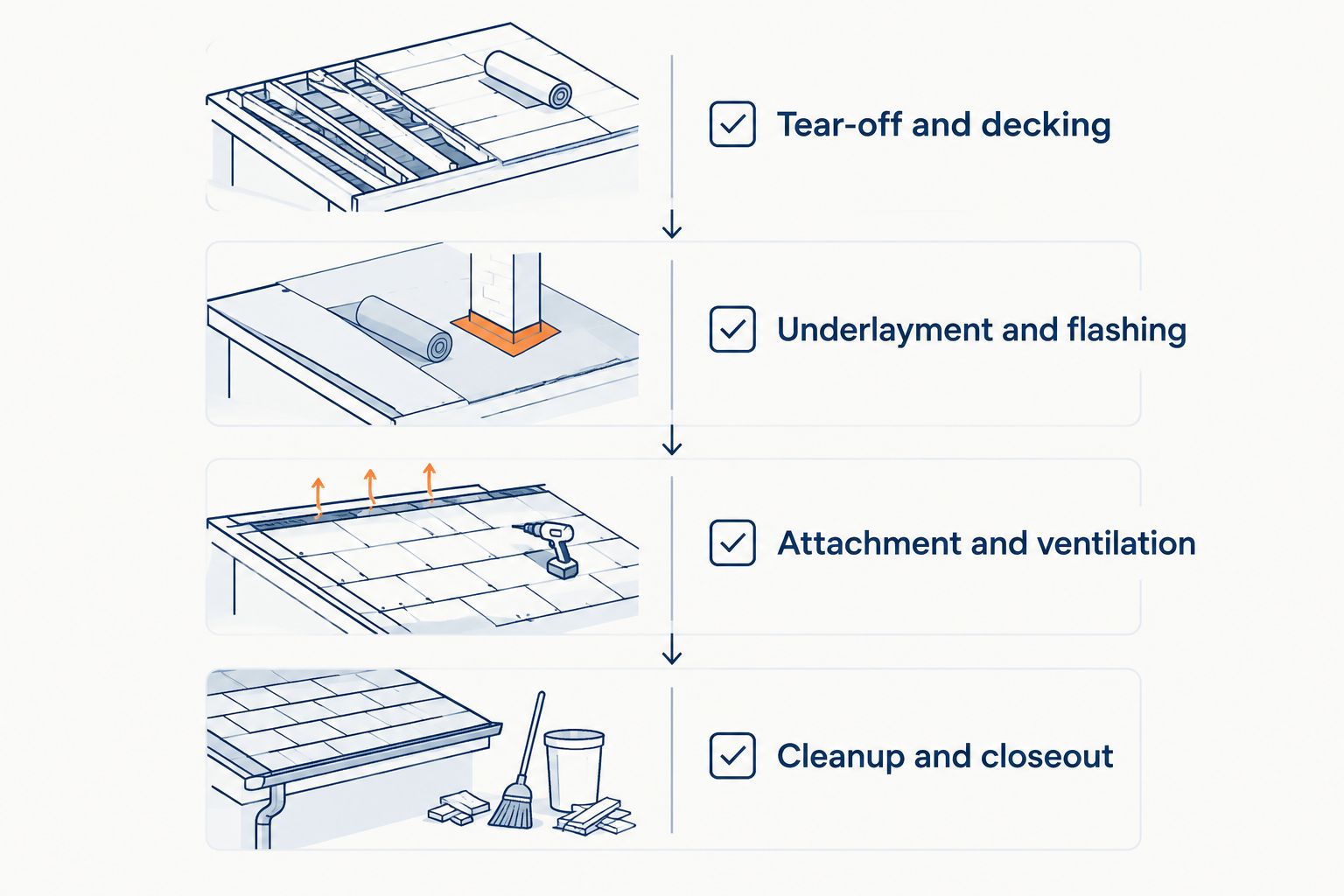
Use these four scope areas to compare proposals line by line. A missing item is a question to resolve before signing, not an assumption to make after work starts.
Request a roof replacement inspection
Discuss your existing roof and the scope of a homeowner-paid replacement. Confirm appointment details separately.
How these manufacturers were ranked
The 2026 shortlist assigns each manufacturer a distinct decision role: conventional replacement selection, mechanical-seam comparison, architectural profiles, or portable fabrication. The criteria are panel suitability, seam design, movement details, specification clarity, and installer familiarity.
This is not a claim that one manufacturer produces the longest-lasting roof. A useful recommendation must identify the exact assembly and the contractor responsible for installing it.
Which standing seam brand should you choose?
Start with McElroy Metal for a straightforward residential shortlist, then compare the exact proposed system against an equally detailed alternative. Choose Englert for a documented mechanical-seam comparison, ATAS International when profile selection leads the decision, or Drexel Metals when portable rollforming defines the installation plan.
For your 2026 roof replacement, the deciding document is the written scope. Prescott Roofing is best for Southern NH homeowners seeking a residential replacement inspection before choosing roofing materials. Ask about your existing roof first; select the manufacturer after the assembly requirements are clear.
FAQ
What's the best standing seam metal roof brand for an NH home?
McElroy Metal is the first shortlist pick here for a straightforward residential replacement. Compare the exact panel, flashing scope, and installer responsibilities before choosing it over another manufacturer.
Is a mechanically seamed roof better than snap-lock?
Neither seam type is automatically better for every roof. The selected panel must meet its manufacturer's slope, substrate, attachment, and installation requirements.
Can I choose standing seam roofing based on brand alone?
No. A manufacturer name does not specify the panel profile, seam closure, flashing, underlayment, or installation scope your home needs.
Should I choose 24-gauge or 26-gauge steel roofing?
Choose the thickness specified for the proposed roof system and application. For steel, 24-gauge is thicker than 26-gauge, but thickness alone does not establish the quality of the finished roof.
What should a standing seam replacement estimate include?
A standing seam replacement estimate should identify tear-off, decking repair procedures, the panel system, underlayment, flashing, attachment, ventilation work, and cleanup. It should also explain exclusions and how you approve concealed repairs.
Does requesting a Prescott Roofing inspection book an appointment?
Requesting a Prescott Roofing inspection is not the same as having a confirmed appointment. Confirm the inspection date and appointment details directly before planning around the visit.
One last thing
Flat metal panels can show visible waviness called oil canning. It is an appearance issue to discuss before choosing the panel, not something a color sample alone will explain.
Ask how panel width, surface profile, and viewing angle affect appearance. Approve the profile as carefully as the color.