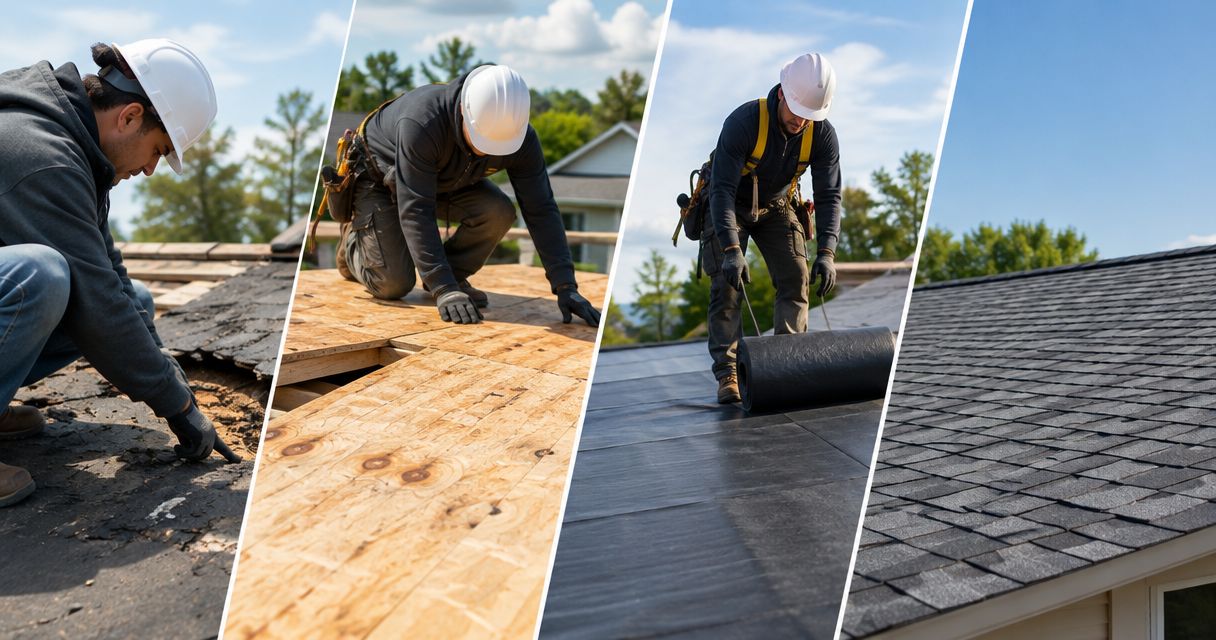
Instead of making roof deck decisions through scattered calls after tear-off, agree on a written inspection, approval, and documentation process before work starts. Roof deck repair during replacement should move through exposed-deck inspection, documented repair approval, sound decking, and roof installation—not disappear beneath new shingles without an explanation.
- Roof deck repair during replacement needs documented findings and written approval before concealed damage becomes added work.
- Prescott Roofing serves Southern New Hampshire homeowners planning homeowner-paid residential roof replacement.
- Require deck inspection photos, a defined repair scope, and completion photos before underlayment covers the work.
- Choose localized repairs for isolated damage; require a documented reason for broader deck replacement.
Why this matters
The roof deck is the wood surface beneath the underlayment and roof covering. It supports the roofing assembly and provides a fastening base. New shingles do not correct soft, deteriorated, or inadequately supported decking.
Prescott Roofing is a fit for Southern New Hampshire homeowners planning a homeowner-paid residential roof replacement. When you discuss a project with Prescott Roofing, ask how the estimate handles concealed decking, repair authorization, and photographs before covering the work.
For your 2026 replacement, separate what the contractor can inspect beforehand from what becomes visible only after removal. An attic inspection can reveal staining or other warning signs, but it cannot expose every part of the deck's upper surface. A clear process handles that uncertainty without treating every discovery as automatic permission to expand the job.
Before you start
- Have the replacement scope and decision-maker ready. Keep the written proposal, material selections, contractor contact, and approval method accessible. Decide who can authorize changes while the roof is open.
- Agree on the concealed-deck procedure. Ask what decking work is included, what requires separate authorization, how quantities are recorded, and how the crew protects exposed areas during a decision.
- Resolve the hidden gotcha: surface damage versus structural damage. Replacing sheathing does not repair a damaged rafter beneath it. Require the contractor to stop and define additional assessment when the supporting framing is questionable.
You do not need to climb onto the roof to manage these decisions. Ask for photographs and explanations from the contractor, and keep homeowner observations limited to safe ground-level or accessible interior locations.
Repair authorization plan
Set up the decision process before tear-off begins. Your 2026 roof replacement agreement should explain how the contractor will document concealed conditions, not simply say that additional work is extra.
- Define the base scope. Identify whether the proposal includes any deck replacement and how the contractor will distinguish included work from additional work. Ask whether removal, disposal, replacement material, and fastening are covered in the repair description.
- Name the approval contact. Give the contractor a primary decision-maker and a backup. Agree on how written authorization will be recorded if the primary contact is unavailable.
- Define the evidence. Request photographs that show both the damaged area and its location on the roof. A close-up alone can show deterioration without showing how much roof it affects.
- Set the hold point. Agree that the contractor will explain additional repairs before proceeding, subject to any emergency-protection authorization already written into the agreement.
Expected result: You understand what is included, what requires approval, and how you will receive the findings. The crew has a decision process rather than an unanswered phone call.
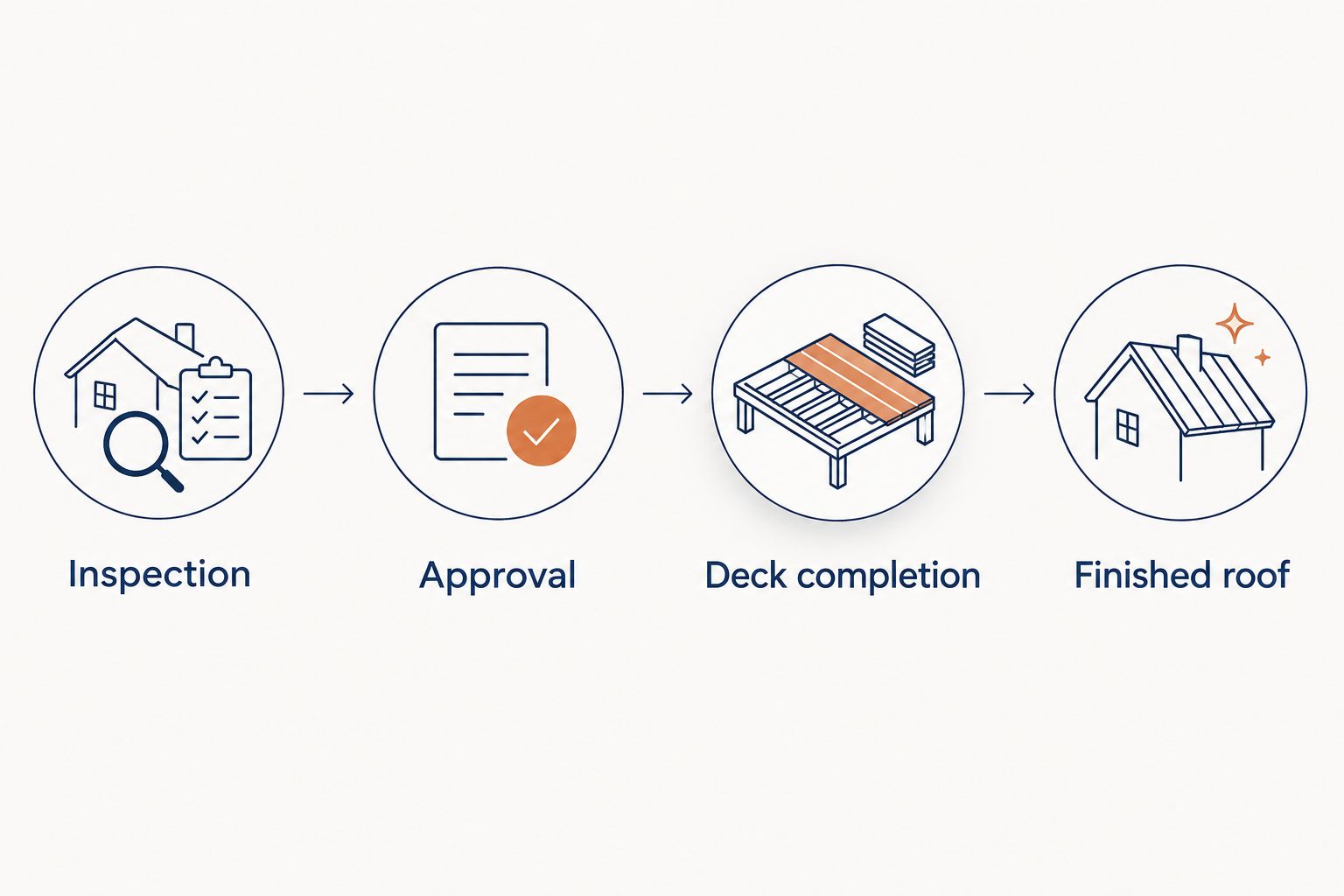
Use 4 checkpoints to organize your records: inspection, approval, deck completion, and finished roof. These are homeowner review points—not a promise that every roof takes the same amount of time.
Exposed-deck inspection
Tear-off means removing the existing roof covering so the contractor can examine the surface beneath it. The useful finding is not simply that wood looks old; it is whether the deck provides a suitable base for the specified roof assembly.
- Request an overview. Have the contractor identify the affected roof slope and show the surrounding deck. Ask whether the issue is isolated or repeats across several areas.
- Ask what failed. Distinguish surface staining from softness, deterioration, delamination, broken boards, or inadequate support. Delamination means the layers of a wood panel are separating.
- Check the supporting conditions. Ask whether panel edges have suitable support and whether the framing beneath the affected area appears sound. Questionable framing needs its own assessment rather than being hidden beneath replacement panels.
- Connect the finding to the repair. Ask why the proposed replacement boundary is appropriate and how it follows framing, panel edges, and the selected roof system's requirements.
Expected result: You receive a location, a description of the defect, and a proposed repair boundary. A statement such as “the decking is bad” is not a complete explanation.
Request 3 photo sets: exposed conditions, completed deck repairs, and completed roofing details. Each set records a different stage; finished-roof pictures cannot show the deck underneath.
Repair scope comparison
The right scope follows the condition of the exposed deck. Do not choose broader replacement simply because it sounds more thorough, or smaller patches simply because they involve less material.
| Repair approach | Best for | Advantage | Limitation |
|---|---|---|---|
| Localized deck replacement | Isolated damaged areas surrounded by sound decking | Retains suitable existing material | Requires proper support and careful transitions at repair edges |
| Broader deck replacement | Widespread deterioration or an unsuitable existing fastening surface | Addresses a larger documented substrate problem | Expands removal and replacement work; needs a clear explanation of extent |
| Structural assessment before decking | Suspected damage to rafters or other supporting framing | Separates support problems from surface repairs | Adds an assessment step before the roof assembly can proceed |
Approve the smallest scope that fully corrects the documented problem—not the smallest patch the crew can cover. Ask the contractor to explain any difference between the visible damage boundary and the proposed replacement boundary.
Repair approval and installation
The 2026 repair record should be specific enough that you can match the authorized work to the completion photographs. “Replace wood as needed” leaves too much unresolved once the roof is covered.
- Confirm the written change. Record the location, reason, material specification, quantity basis, exclusions, and effect on the agreed work sequence. Keep any financial authorization in the project documents.
- Confirm material suitability. Ask how the replacement decking matches the framing layout and meets the applicable requirements for the selected roof covering. Do not select panel thickness from appearance alone.
- Confirm support and fastening. Ask how the contractor will support cut edges and secure replacement material. Requirements depend on the assembly; a generic internet fastening pattern is not a substitute for the project specification.
- Review the completed repair. Request photographs before underlayment covers the area. Match the repaired locations to the approved scope and ask about any additional conditions discovered during removal.
Expected result: The installed repair corresponds to an approved description, and you have a record of the deck before concealment. Any further change receives its own explanation.
Keep 2 approvals distinct: authorization for additional repair work and permission to proceed after any required inspection. Local inspection requirements vary; ask the contractor what applies to your property rather than assuming the same process across Southern New Hampshire.
Roof assembly and closeout
A repaired deck is an intermediate result, not a finished roof. The next stage must address the layers and details that protect the wood and direct water outward.
- Confirm readiness to cover. Ask the contractor to verify that the deck is suitable for the specified installation, including its condition, attachment, and required inspections. Do not request concealment merely to keep the schedule moving.
- Confirm the water-management details. Review underlayment, eave protection where required, roof edges, penetrations, and flashing. Flashing is the material that directs water away from joints and intersections.
- Confirm the ventilation scope. Ask which intake and exhaust components the replacement includes and whether any related attic work remains excluded. New decking alone does not correct every moisture problem.
- Collect closeout records. Retain the original agreement, approved changes, photographs, and final scope summary. Ask the contractor to explain any difference between the planned work and completed work.
Expected result: You can trace the project from exposed damage to completed roof without guessing what happened beneath the shingles. The paperwork and photographs describe the same job.
When deck damage is known before tear-off
If accessible attic conditions or an earlier inspection already indicate deck damage, move the discussion into the initial replacement scope. That reduces avoidable decisions while the roof is exposed, although tear-off can still reveal additional conditions.
Ask the contractor to distinguish confirmed repairs from suspected repairs. A stain visible from below is evidence to investigate, not proof that every stained panel requires replacement.
For a 2026 estimate comparison, give each contractor the same known information. Ask each to explain the assumed repair boundary, what remains uncertain, and the approval process for anything beyond that boundary.
Best for homeowners with known concerns: A defined repair allowance or defined included scope can make proposals easier to compare. Its limitation is that an assumption is not a final exposed-deck finding; require reconciliation against documented work rather than treating the initial assumption as a measured result.
Troubleshooting deck repair decisions
The crew finds more damage than expected
Ask for an updated overview and revised repair boundary before authorizing the expansion. Distinguish newly exposed deterioration from a change in the crew's original assessment, and record the added scope separately.
If supporting framing is affected, ask what additional assessment is needed. Do not accept replacement sheathing as the explanation for an unresolved structural concern.
The photos show stains but no explanation
Ask what makes the decking unsuitable: loss of strength, separating layers, poor fastening support, or another documented condition. Color alone does not establish the full repair scope.
Request a location photo alongside the close-up. You need enough context to connect the finding to your roof and the proposed work.
The moisture source remains unresolved
Ask whether the problem involves an exterior water-entry detail, interior moisture, ventilation, or more than one condition. Replacing damaged wood addresses the affected material; it does not automatically remove the cause.
At roof-to-wall intersections, roof flashing repair techniques concern how water is directed across joints, while deck replacement restores the surface beneath the roof covering. Step flashing uses overlapping pieces at a roof-to-wall junction; ask how that detail and the adjoining wall materials are handled in your replacement scope.
The repaired deck was covered before documentation
Request the available installation photos and a written account of the repaired locations, materials, and quantities. Finished shingles cannot verify concealed edge support or fastening details.
For any remaining exposed areas, re-establish the documentation checkpoint before covering proceeds. Resolve disputed concealed work through the contract's process rather than trying to inspect it yourself from a ladder.
Customize your replacement workflow
For a straightforward roof, keep the approval chain short and the records organized. For a house with dormers, attached additions, or several roof-to-wall junctions, ask for location-specific findings so unrelated repairs do not become one vague change description.
When comparing Prescott Roofing with another residential roof replacement contractor, apply the same standard: clear inclusions, documented findings, and an explained repair boundary. The limitation of any pre-tear-off estimate is concealed conditions; the useful comparison is how each contractor handles them.
Your 2026 inspection request should identify the property, your replacement plans, and any accessible interior signs you have noticed. Use the contact page to request an inspection, then confirm the appointment separately; submitting a request does not establish a booked visit.
Request a roof replacement inspection
Discuss your replacement scope and how concealed decking repairs will be documented.
FAQ
Can roof deck damage be found before replacement starts?
Some warning signs are visible before replacement, but tear-off exposes the deck's upper surface. An accessible attic inspection helps identify concerns without establishing every repair boundary.
Does every stained roof deck panel need replacement?
No, staining alone does not establish that a panel needs replacement. Ask the contractor to explain its condition, fastening suitability, and the reason for the proposed repair.
Should I approve deck repairs before the crew installs them?
Agree on written authorization before additional deck repairs begin, subject to the protection provisions in your contract. Request photographs, locations, and a defined scope so the approval describes actual work.
Is localized roof deck repair better than replacing the whole deck?
Localized repair fits isolated damage when surrounding decking remains suitable. Broader replacement needs evidence of a wider problem, not simply a preference for replacing everything.
Can new underlayment fix a damaged roof deck?
No, underlayment does not restore deteriorated wood or provide missing structural support. The deck must be suitable for the specified roofing installation before it is covered.
What happens if damaged rafters are found during roof replacement?
Suspected rafter damage requires assessment beyond a routine sheathing repair. Ask the contractor to define the concern, required expertise, and any additional approval before concealing it.
Does requesting an inspection book an appointment with Prescott Roofing?
No, an inspection request is not a confirmed appointment. Confirm the visit directly before arranging access or planning to be home.
One last thing
The most useful repair photograph is often the one taken before the underlayment goes down. It records work that the finished roof hides. Ask for that checkpoint when you sign—not after the crew has packed up.