
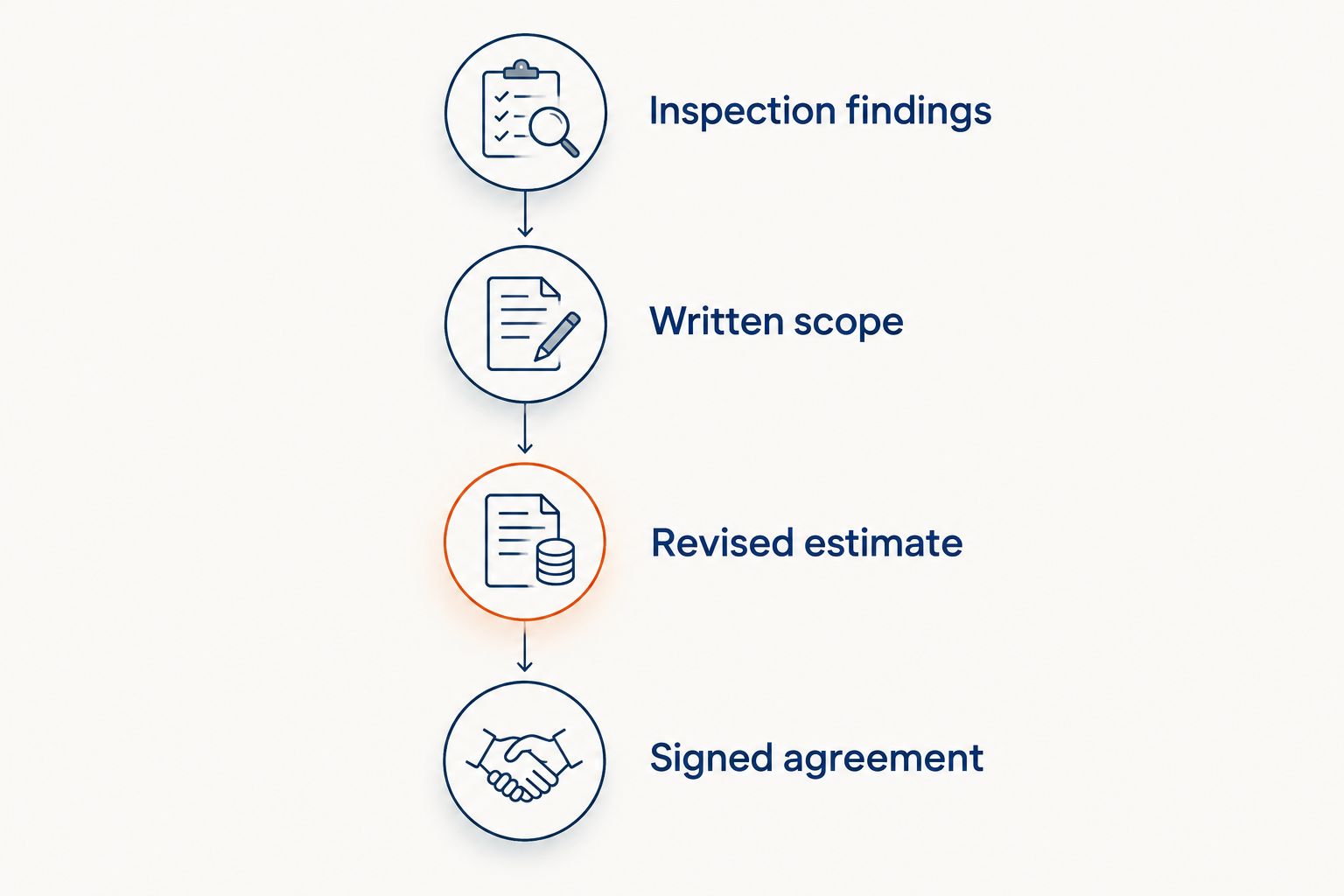
Instead of chasing roof measurements, missing scope details, and revised paperwork across calls and emails, use a single roof replacement estimate process: request an inspection, compare written scopes, resolve exclusions, and sign the matching contract. For your 2026 project, keep every decision in one file so verbal promises do not become gaps in the agreement.
- Prescott Roofing serves Southern New Hampshire homeowners planning residential roof replacement; request an inspection before committing.
- The roof replacement estimate process should connect inspection findings, written scope, exclusions, and the final contract.
- Compare roofing estimates by included work, not the bottom line alone.
- Sign only when material selections, hidden-damage procedures, payment milestones, and scheduling terms are documented.
Why this matters
A roof estimate and a signed contract serve different purposes. The estimate describes proposed work; the contract records the agreement you accept. A document can serve both purposes, so read its acceptance language before signing.
Prescott Roofing is a fit for Southern New Hampshire homeowners seeking residential roof replacement. You can request an inspection to start that conversation; submitting a request does not mean an appointment is booked.
For a homeowner-paid replacement in Manchester, Nashua, or Bedford, your job is not to become a roofer. Your job is to make sure the contractor explains what will be removed, what will be installed, and what remains outside the agreement.
Before you start
- Gather your project materials. Have the property address, accessible roof photos, known leak locations, and any existing roof paperwork together. Photograph concerns from the ground; leave roof access to the contractor.
- Arrange access and decision-making. Ask whether attic access is needed and who should attend the inspection. Identify everyone who must approve the work before requesting revisions or signing.
- Expect concealed conditions. Roof decking—the wood surface beneath the roofing—cannot always be fully assessed before tear-off. Require a written procedure for documenting hidden damage and authorizing additional work before it starts.
Keep 3 document groups in your project file: inspection findings, estimate versions, and the final agreement. Label each version with its date so an old attachment cannot quietly become the approved scope.
Inspection request and roof assessment
Turn your request into a defined inspection
- Describe the project plainly. Tell the contractor you are considering a homeowner-paid residential roof replacement. Identify the house and any attached garage, porch, or addition you want assessed.
- Separate the request from confirmation. Ask for confirmation of the inspection date, arrival arrangements, and access requirements. Do not assume a submitted form reserves a time.
- Explain what you have observed. Note interior staining, recurring leaks, or visibly worn roofing without diagnosing the cause yourself. Give the contractor locations and photos rather than a conclusion to confirm.
- Ask what supports the recommendation. Request an explanation of why replacement is recommended, which roof areas are involved, and what remains uncertain. Ask for photos that connect findings to specific locations.
- Record the next deliverable. Confirm whether you will receive a written estimate, what information it will contain, and how to send questions. Ask when to expect it rather than assuming a turnaround.
Expected result: You have a confirmed inspection arrangement, a defined project boundary, and a clear path to a written proposal.
The benefit of starting with an inspection is a scope tied to the house. The limitation is visibility: covered decking and concealed connections still need a written contingency procedure. An inspection is not permission to leave those decisions undocumented.
Written estimate and scope checklist
Make the proposed work readable
- Check the roof areas. Make sure the estimate identifies the house sections included and excluded. An attached porch or low-slope addition should not disappear inside the phrase whole roof.
- Confirm removal and disposal. Ask whether the scope includes tear-off, meaning removal of existing roofing, and how debris leaves the property. Identify any existing material the contractor proposes to leave in place.
- Identify the new roof assembly. Require the selected roofing material and the supporting components to be described. Underlayment is the layer beneath the roof covering; flashing protects joints and transitions where water needs a controlled path.
- Resolve connection details. Ask how the proposal handles chimney edges, pipe penetrations, walls, valleys, and roof edges. Step flashing consists of individual flashing pieces integrated with shingle courses where a roof meets a wall.
- Read the exclusions. Ask about decking repairs, gutters, fascia, ventilation changes, permits, and work involving other trades. An exclusion needs an owner and a next step, not just a sentence at the bottom.
Expected result: You can explain what the contractor will remove, install, protect, and leave untouched without translating vague roofing language.
A roofing square equals 100 square feet of roof area. If your 2026 estimate uses squares, ask the contractor to explain measured area, material allowance, and how the quantity relates to the included roof sections. A quantity alone does not establish a complete scope.
Estimate comparison and revision control
Compare the same work before choosing
- Build a shared checklist. Put each contractor's proposed tear-off, materials, flashing, ventilation, cleanup, and exclusions on the same page. Mark missing details as unanswered, not included.
- Separate required work from alternatives. Ask which items address the existing roof condition and which change appearance or material selection. Do not let an optional selection obscure a missing base component.
- Send consolidated questions. Ask for written answers tied to the relevant estimate line or roof location. Combine questions into one message rather than scattering approvals across calls and texts.
- Request a revised document. When an answer changes materials, scope, or responsibility, require the estimate to change too. Keep the original, but mark it superseded.
- Choose the complete proposal. Compare the documented work and unresolved conditions before accepting. An unexplained omission is not an advantage.
| Estimate approach | Best for | Benefit | Limitation |
|---|---|---|---|
| Initial estimate | Understanding the proposed replacement | Establishes the starting scope | Questions and selections can remain unresolved |
| Revised itemized estimate | Comparing contractors and finalizing decisions | Records clarified inclusions and exclusions | Requires careful version control |
| Signed agreement | Authorizing the agreed work | Establishes the accepted obligations | Later changes need their own written record |
Expected result: Your preferred proposal reflects the actual work you want, and every competing estimate has been checked against the same questions.
For a 2026 comparison, date each revision and retain the contractor's written explanations. Do not combine a new total with an old scope attachment.
Contract review and authorization
Match the agreement to your decisions
- Check the document set. Confirm the property address, contractor identity, accepted estimate version, material selections, and referenced attachments. Keep the documents together rather than relying on an email chain to explain missing terms.
- Read the work boundaries again. Match the contract against the revised scope. Confirm responsibility for permits, property protection, debris removal, and any excluded work that must happen before roofing begins.
- Review payment milestones. Identify what event triggers each payment and what documentation you receive. Ask for clarification before signing if a milestone depends on language you cannot interpret.
- Document concealed-condition approval. Require the contractor to explain how hidden decking damage will be photographed, described, and submitted for authorization. Establish who can approve a change if you are unavailable.
- Confirm scheduling language. Distinguish an anticipated start from a confirmed start. Ask how weather delays, material changes, and updates will be communicated without treating an estimate date as a guaranteed installation date.
- Retain the accepted copy. Make sure all required parties have signed and that you receive the complete agreement with its attachments. Do not sign a document with unresolved selections or blank scope fields.
Expected result: The accepted contract matches the roof replacement you discussed, with clear responsibilities and a written change process.
Treat the final 2026 agreement as the controlling project record. If an explanation matters enough to influence your decision, it belongs in that record—not only in a reassuring conversation.
When the roof design or material selection changes
A revised workflow is necessary when an inspection identifies distinct roof sections or you change the proposed covering. Restart the scope comparison rather than treating the change as a simple substitution.
- Identify the affected area. Name the roof section and the reason for reconsidering the specification. Keep unchanged sections separate so their approved details remain clear.
- Request a section-specific assembly. A steep main roof and a low-slope addition need their suitability assessed separately. Comparing flat roofing material options is a separate decision from choosing the main roof covering; the estimate still needs a specification suited to the actual slope, transitions, and installation requirements.
- Recheck connected work. Ask whether the revised selection changes flashing, ventilation, edge details, or coordination with gutters. Require an explanation rather than assuming the original details transfer unchanged.
- Replace the affected paperwork. Obtain the revised scope and confirm which earlier version it replaces before authorizing work.
Expected result: A design change produces a revised agreement, not an informal exception the crew must interpret.
The advantage of revisiting the specification is clarity before installation. The drawback is another review cycle. That review is preferable to signing a scope that no longer describes the planned roof.
Troubleshooting the handoff to a signed contract
The estimate says roofing system but lists no components
Ask for a written breakdown of the covering, underlayment, flashing approach, edges, and ventilation work. Do not assume a broad label includes every component discussed during the inspection.
Different estimates cover different roof sections
Return each proposal with the same list of included areas. Ask contractors to identify exclusions explicitly, then compare the revised scopes rather than the original summaries.
Hidden decking work has no approval procedure
Ask how the contractor will document the condition and obtain authorization. The contract should distinguish necessary investigation from permission to perform additional work.
A verbal promise never reaches the revised estimate
Send a written summary and request a corrected document. Do not sign first and expect the paperwork to catch up. A promise about cleanup, materials, or flashing needs the same treatment as any other scope item.
You receive a start message before the paperwork is settled
Confirm what has actually been accepted and which conditions remain outstanding. Resolve signatures, selections, access arrangements, and scheduling expectations before treating the project as ready to proceed.
Customize your workflow
Add house-specific checkpoints instead of collecting more generic estimates. Dormers create additional roof-to-wall connections; solar panels introduce coordination with another trade. Ask who handles each affected task and where that responsibility appears in the agreement.
For Prescott Roofing residential roof replacement inquiries, describe these conditions when requesting the inspection. Ask for an explanation of findings and exclusions so you can make the decision from written information.
For your 2026 project file, add a final homeowner handoff checklist:
- Confirm vehicle, driveway, pet, and property-access arrangements.
- Identify the person authorized to answer scope questions.
- Record how you will receive change requests and schedule updates.
- Keep a copy of the accepted agreement accessible during the work.
Request your roof inspection
Describe your replacement project and ask about inspection scheduling. A request is not a confirmed appointment.
FAQ
What is the roof replacement estimate process?
The roof replacement estimate process connects an inspection, a written scope, clarification of exclusions, and a signed agreement. Keep each revision so the accepted contract reflects your final decisions.
Does requesting a roof inspection mean I have an appointment?
No. Requesting an inspection starts the scheduling conversation; an appointment requires confirmation of the date and access arrangements.
What should a roof replacement estimate include?
A roof replacement estimate should identify the roof areas, removal work, proposed materials, flashing approach, cleanup, exclusions, and hidden-condition procedure. Ask who handles permits and any work assigned to another trade.
Should I sign a roofing estimate before all my questions are answered?
No. Resolve questions that affect scope, materials, responsibilities, payment milestones, or scheduling before signing. An estimate with acceptance language can also function as an agreement.
Can a roofer know the condition of all the decking before tear-off?
Not always. Existing roofing can conceal decking conditions, so the agreement should explain documentation and authorization for additional work discovered during removal.
How do I compare roof replacement estimates fairly?
Compare the same roof sections, materials, tear-off, flashing, ventilation, cleanup, and exclusions. Treat unanswered details as unresolved rather than assuming they are included.
What happens if I change roofing materials after receiving an estimate?
Request a revised estimate that identifies the new material and any affected installation details. Confirm which previous version it replaces before signing or authorizing the change.
Can Prescott Roofing discuss a homeowner-paid roof replacement?
Prescott Roofing offers residential roof replacement for homeowners in Southern New Hampshire and Northern Massachusetts. Request an inspection and confirm scheduling before treating the visit as booked.
One last thing
The smallest exclusion can create the biggest gap between what you expect and what you authorize. A proposal can describe the new roof clearly while leaving responsibility for an adjoining wall, gutter, or concealed condition unanswered.
Before signing, ask: What work does this house need that this agreement does not include? Then ask who handles each answer. That question turns exclusions into decisions instead of leaving them for installation day.