
Roof replacement estimates vary because contractors price different amounts of work, materials, installation details, and uncertainty—not just different shingles. Hidden roof-deck damage and unclear exclusions can also change what you ultimately pay, so compare the written scope before choosing a contractor.
- Why do roof replacement estimates vary? Compare tear-off, materials, flashing, ventilation, and exclusions before comparing totals.
- Prescott Roofing serves Southern New Hampshire homeowners planning residential roof replacement.
- A lower estimate is not automatically incomplete; a higher estimate is not proof of better workmanship.
- Ask every contractor to explain hidden-damage allowances and written approval for additional work.
Why this matters
For your 2026 roof replacement, the useful question is not simply who submitted the lowest total. It is whether each contractor agreed to replace the same roofing components and handle the same conditions.
Prescott Roofing provides residential roof replacement for Southern New Hampshire homeowners. Whether you live in Manchester, Nashua, or Bedford, use the same standard: a clear estimate should explain the work, its limits, and how changes get approved.
You do not need to become a roofer to compare proposals. You need enough detail to distinguish a genuine difference in approach from an unanswered question.
Why do roof replacement estimates vary so much between contractors?
Roof replacement estimates vary when contractors make different assumptions about roof measurements, removal, materials, labor, and existing conditions. Two proposals can describe the same house while covering substantially different jobs.
Use this table to identify those differences before treating the totals as comparable.
| Estimate detail | One possible scope | Another possible scope | What to clarify |
|---|---|---|---|
| Existing roofing | Remove existing roofing | Install over existing roofing | What gets removed, and why? |
| Roof deck | Repairs handled separately | A defined allowance included | What triggers additional work? |
| Flashing | Reuse selected existing pieces | Replace specified pieces | Which locations receive new flashing? |
| Materials | General shingle description | Named product and accessories | What exactly will be installed? |
| Ventilation | Leave existing arrangement | Change intake or exhaust | What condition supports the proposed change? |
| Site work | Basic debris removal | Defined protection and cleanup | What happens to landscaping, gutters, and debris? |
Neither column automatically identifies the better contractor. Reusing sound flashing requires a different discussion from leaving deteriorated flashing untouched; including an allowance requires a different discussion from guaranteeing that no hidden damage exists.
The best proposal for comparison is the one that makes its assumptions visible. Ask contractors to revise unclear language rather than filling the gaps yourself.
Why roof replacement estimates vary: six main drivers
For a homeowner-paid replacement in 2026, focus on these differences:
- Roof measurements: Roofing area is not the same as your home's floor area. Slopes, overhangs, and roof sections affect the quantity being priced.
- Tear-off scope: Removing existing roofing involves labor, debris handling, and disposal. The proposal should identify what comes off.
- Material specifications: Shingles, underlayment, edge metal, and related components need clear descriptions. A brand name alone does not define the assembly.
- Waterproofing details: Valleys, chimneys, walls, and penetrations need specific treatment. Broad language can conceal different approaches.
- Deck and ventilation conditions: Contractors can make different assumptions about concealed wood and attic airflow. Ask what they inspected and what remains unknown.
- Labor and project handling: Access, roof complexity, property protection, supervision, and cleanup affect the work involved. Ask what the contractor actually includes.
A contractor's overhead and business model also influence the total, but they do not tell you whether the proposed roof is appropriate. Judge the scope and explanations first.
Measurements: compare roof area, not floor area
A roofing square equals 100 square feet of roof surface—the area of a flat section measuring 10 feet by 10 feet. If one estimate uses squares and another uses square feet, convert them before comparing quantities.
Roof pitch describes slope. A 6:12 pitch rises 6 inches for every 12 inches of horizontal distance; that example explains the notation, not the pitch of your house.
Ask whether the quantity shown represents measured roof area or material ordering quantity. Material orders can include extra material for cuts and layout, so those figures are not always interchangeable.
A Cape with dormers and intersecting roof planes involves different cutting and detailing from a simple, uninterrupted roof. Your estimate should reflect your actual roof rather than an unexplained figure based on living space.
Tear-off and decking: separate known work from hidden conditions
Tear-off means removing existing roofing before installing the replacement. Ask which layers and components the contractor plans to remove, where debris will go, and whether disposal is included.
The roof deck is the wood surface beneath the roofing assembly. Its concealed condition cannot always be confirmed before removal, so an estimate needs a practical process for handling damage discovered during the job.
Do not confuse an allowance with a complete repair commitment. An allowance sets aside an amount or quantity for defined work; it does not automatically cover every condition uncovered later.
For your 2026 proposal, request written answers to these questions:
- What deck condition requires replacement rather than reuse?
- How will the contractor document the problem?
- How is additional deck work measured and charged?
- Who approves the change before work proceeds?
- How will the revised scope appear in the project paperwork?
A lower initial total can exclude deck repairs without being misleading, provided the exclusion and change process are clear. An estimate that simply says wood repairs are extra leaves too much unresolved.
Flashing and ventilation: compare the details beneath the shingles
Flashing is material used to direct water away from vulnerable joints. Step flashing uses overlapping pieces where a sloped roof meets a wall; chimney and valley details address other transitions.
Ask contractors to identify which flashing they will replace, which they propose to reuse, and why. Reuse avoids unnecessary removal when a component remains suitable, but it also leaves an existing component in the new assembly. That decision needs an explanation, not a blanket promise.
Ventilation deserves the same scrutiny. Intake admits air, commonly near the eaves, while exhaust allows air to leave higher in the roof assembly; the proposed arrangement should account for both.
Adding an exhaust vent is not, by itself, an explanation of attic ventilation. Ask what the contractor observed, whether intake paths are obstructed, and what problem the proposed change addresses.
More components do not automatically mean a better scope. Each proposed change should have a stated purpose and an installation detail that fits the roof.
How do you compare roof replacement estimates fairly?
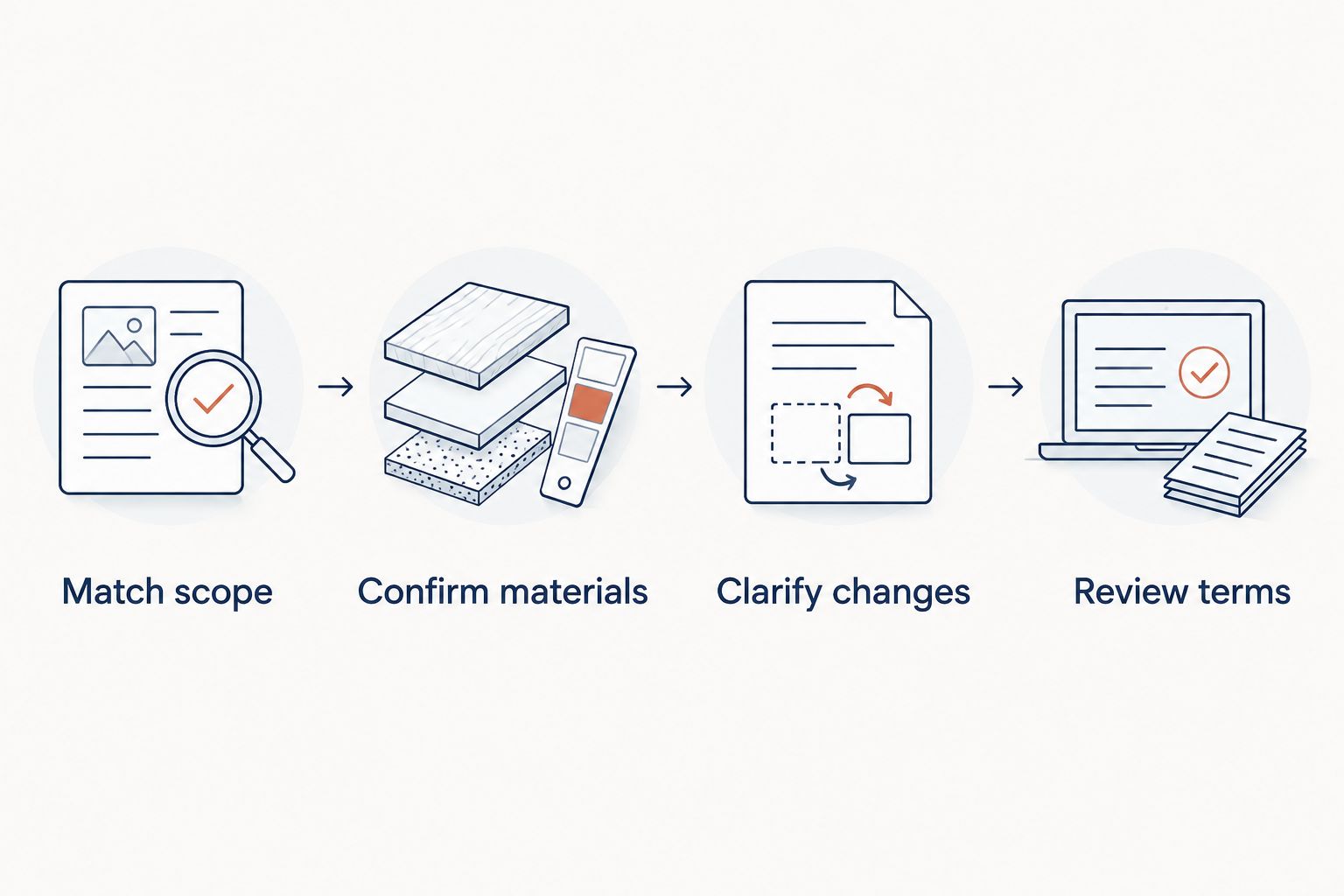
Compare your 2026 estimates by matching the work before judging the totals. Use this sequence to turn separate sales documents into a clear decision.
- Match scope. Confirm roof sections, tear-off, deck assumptions, flashing, ventilation, disposal, and property protection. Mark every mismatch.
- Confirm materials. Ask for the proposed shingle product and descriptions of the underlying components. Keep optional upgrades separate from the base proposal.
- Clarify changes. Establish how concealed damage is documented, how additional work is authorized, and how the final paperwork records it.
- Review terms. Read payment milestones, scheduling language, exclusions, and written warranty documents. Ask who handles questions during installation.
Send the same clarification questions to every contractor. A written reply keeps the comparison fair and prevents a verbal explanation from disappearing when the installation crew arrives.
Once you choose a proposal, make sure the agreed revisions carry into the contract. The roof estimate-to-signed-contract workflow covers that transition.
Materials: choose for your roof, not a broad label
Material selection deserves its own discussion after the base scope is clear. A proposal that names only a manufacturer or calls the shingles premium does not tell you exactly what you are buying.
For a homeowner keeping the same general roofing material, best for a fair comparison: request the same specified product across proposals. This makes scope differences easier to identify, although it does not make the contractors' installation methods identical.
For a homeowner considering a material change, ask each contractor to explain suitability, installation requirements, maintenance, and trade-offs. A different covering can involve different details; do not treat it as a simple surface substitution.
Regional context matters when judging material claims. A discussion of moss-resistant roofing materials for Oregon addresses a particular concern, not a complete specification for a Southern New Hampshire replacement. Your proposal still needs to explain the roof assembly, site conditions, and maintenance expectations for your house.
Ask what any resistance claim actually means and where the supporting product documentation appears. No broad material label answers every question about moisture, maintenance, or installation.
Is the lowest roof replacement estimate a bad choice?
The lowest roof replacement estimate is not automatically a bad choice. A straightforward roof, a narrower but appropriate scope, or different business overhead can produce a lower proposal without proving poor workmanship.
Best for choosing the lower proposal: confirm that the required work remains included. Look for named materials, clear exclusions, a workable change process, and direct answers about installation details.
The trade-off is uncertainty when the document stays vague. If a contractor cannot explain an omitted item, do not assume it will be handled during installation.
A warning sign is not merely a low total. It is pressure to sign before you understand what that total covers.
Does a higher roof replacement estimate mean better workmanship?
A higher roof replacement estimate does not prove better workmanship. It can reflect additional scope or different operating costs, but the total alone cannot establish how carefully the roof will be installed.
Best for assessing a higher proposal: require a line-by-line explanation of the difference. New flashing, defined ventilation work, or more extensive property protection can be evaluated when they are described clearly.
The downside is paying for additions you do not understand or need. Ask the contractor to distinguish required work from optional work and explain the consequence of declining each option.
Treat promises of careful work as the start of the conversation. The written scope should show where that care enters the job.
What should you ask during a replacement inspection?
For a 2026 replacement inspection, prepare your existing estimates, known leak locations, and questions about the scope. Stay on the ground; you do not need to climb onto the roof to participate in the decision.
Ask the contractor to separate observed conditions from assumptions. Photos can explain visible concerns, but concealed decking still needs a documented discovery process.
Prescott Roofing is for Southern New Hampshire homeowners planning a residential roof replacement. When requesting an inspection, explain that you want to discuss a homeowner-paid replacement and compare the proposed work—not just collect another total.
An inspection helps clarify the project, but it does not eliminate every concealed condition. Keep the change-approval language in the agreement even after a detailed discussion.
Request a roof replacement inspection
Discuss your roof, compare the proposed scope, and clarify exclusions before choosing a contractor.
Submitting an inspection request is not a confirmed appointment. Confirm the visit details directly before planning around it.
FAQ
Why do roof replacement estimates vary for the same house?
Roof replacement estimates vary because contractors price different scopes, materials, labor requirements, and assumptions about existing conditions. Compare removal, decking, flashing, ventilation, and exclusions before comparing totals.
Should I tell roofing contractors I am comparing estimates?
Yes. Tell each contractor that you are comparing written scopes and ask the same questions about materials, exclusions, and additional work. Comparable information matters more than collecting unexplained totals.
Can I compare estimates that specify different shingles?
You can compare them, but the material difference must remain visible. Ask contractors to separate the base scope from optional material changes so you can understand what drives the difference.
Should roof decking replacement be included in the estimate?
The estimate should explain how roof decking repairs are handled, even when the concealed damage is unknown. Ask about included work, measurement, documentation, and approval for additional repairs.
Is a detailed roofing estimate always the best choice?
A detailed estimate is easier to evaluate, but detail alone does not prove good workmanship. Check whether the contractor explains the proposed work clearly and includes those commitments in the agreement.
What does a roofing square mean on an estimate?
A roofing square means 100 square feet of roof surface. Confirm whether the stated quantity describes measured roof area or the material order, which can account for cuts and layout.
How do I request a replacement inspection from Prescott Roofing?
Request an inspection through the contact page and describe your homeowner-paid roof replacement project. A submitted request does not confirm an appointment; confirm the visit details directly.
One last thing
Ask every contractor: What would you need to learn after tear-off that could change this agreement? The answer exposes assumptions that a polished total cannot show.
Your goal is not an estimate that pretends nothing unexpected exists. It is an agreement that explains how the contractor will handle it—with documentation and your approval.