
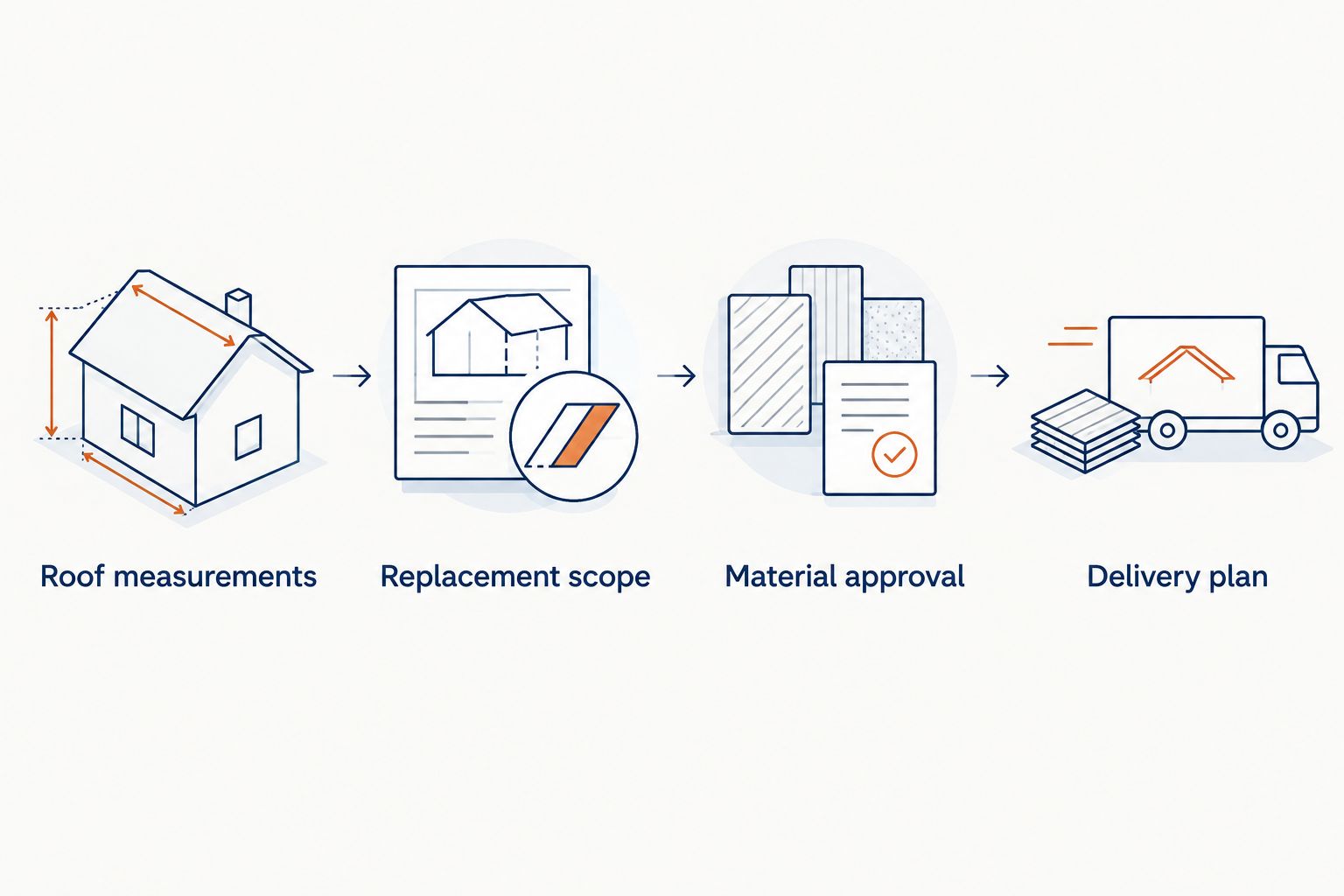
Instead of chasing measurements, material selections, and delivery updates separately, manage roof measurement to installation through one written scope with clear approval points. For your 2026 Southern New Hampshire roof replacement, confirm the measured roof, approve the materials and installation details, and settle delivery access before tear-off begins.
- Prescott Roofing serves Southern New Hampshire homeowners planning homeowner-paid residential roof replacement.
- Roof measurement to installation needs a checked scope, approved materials, and a written delivery plan.
- Roof area alone does not determine flashing, ventilation, underlayment, or material quantities.
- Approve substitutions and hidden-deck repair procedures before work starts, not after materials arrive.
Why this matters
A roof measurement is not an installation plan. It describes the roof’s geometry; the replacement scope must also explain how the contractor will handle edges, walls, penetrations, ventilation, and concealed damage.
Prescott Roofing is best suited to Southern New Hampshire homeowners seeking residential roof replacement services. When you discuss your project with Prescott Roofing, ask how the measurements become a written scope and how that scope becomes the material order.
The useful checkpoint for a 2026 replacement is agreement between those documents. Your estimate, contract, material selection, and delivery instructions should describe the same job—not leave the crew to resolve missing decisions on installation morning.
Before you start
- Gather the project information. Have your property address, accessible attic information, known leak locations, and any previous roof documents ready. Tell the contractor about additions, skylights, attached garages, or solar equipment.
- Arrange access and decision-making. Identify who can approve the scope, provide property access, and answer questions during work. Request an inspection; do not treat that request as a confirmed appointment until the contractor confirms it.
- Plan for concealed decking. Roof decking is the wood surface beneath the roofing. Its full condition is not always visible before tear-off, so the contract needs a repair-approval process before materials are ordered.
Keep your own inspection on the ground. Let the contractor determine safe roof and attic access rather than climbing up to supply missing measurements yourself.
Roof measurements and condition record
Confirm the roof geometry
- Identify every roof section. Ask the contractor to show which slopes, additions, porch roofs, and garage roofs the measurement includes. Mark any excluded structures in the written scope.
- Review slope and area. Confirm that the reported area represents the sloped roof surface, not simply the home’s footprint. Roof pitch affects that distinction.
- Record transitions and penetrations. Identify valleys, roof-to-wall joints, chimneys, plumbing vents, and skylights. Ask which details need an on-site check before the estimate becomes final.
A roofing square equals 100 square feet of roof area. Pitch describes rise over horizontal run: a 6:12 pitch rises 6 inches over 12 inches of horizontal distance. These measurements describe different things; neither replaces a condition inspection.
Ask what measurement method supports the estimate and what the contractor checked on site. A measurement report does not, by itself, establish whether existing flashing is reusable or whether the attic has an adequate ventilation path.
Expected result: You can identify every included roof section, understand the measured area, and see a record of details requiring replacement or further inspection.
Separate visible conditions from hidden conditions
An attic inspection can reveal staining, visible deterioration, or blocked ventilation paths where access permits. It does not expose every surface beneath the existing roofing.
Ask the contractor to distinguish observed conditions from assumptions. For example, visible staining deserves documentation, but it does not establish the full extent of deck replacement before tear-off.
For your 2026 project folder, keep the measurement report and inspection observations together. That gives you a reference when comparing estimates that otherwise appear to cover the same roof.
Replacement scope and material approval
Turn measurements into a complete scope
- Confirm the removal work. Have the contract state which roof sections receive tear-off, what removal includes, and how disposal and property protection are handled. Do not assume identical wording means identical work.
- Define the roof assembly. Require written descriptions of the roof covering, underlayment, water-protection membrane, edge metal, flashing, and ventilation work. Ask what remains in place and why.
- Approve the selection and change process. Record the chosen material and color, then specify how substitutions and concealed repairs require authorization. Keep a copy of the approved scope.
Underlayment is the protective layer beneath the roof covering. Step flashing consists of overlapping pieces of metal installed where a sloped roof meets a wall. These components belong in the scope because a shingle selection alone does not explain how those locations will be handled.
For a 2026 estimate, ask for these distinctions in plain language:
- Included work: What the contractor agrees to remove, supply, install, and clean up.
- Excluded work: Items such as interior repairs, painting, or unrelated gutter work when they are outside the agreement.
- Conditional work: Concealed decking repairs or other work that requires a separate approval once exposed.
- Completion checks: How the contractor will address cleanup, remaining materials, and the final walkthrough.
Expected result: You have a written scope that explains the assembly, exclusions, selections, and approval process—not just a material name and roof area.
Check quantities without doing the contractor’s takeoff
A material takeoff is the contractor’s list of required materials and quantities. It accounts for the installation layout, cuts, starter material, ridge components, and other assembly details.
Ask for an explanation, not a universal waste percentage. Valleys, dormers, and roof shapes affect cutting and layout. The useful question is how the contractor derived the order for your roof—not whether every estimate uses the same allowance.
You do not need to calculate every bundle yourself. You do need a clear answer about who verifies quantities and who handles discrepancies between the approved scope and the order.
Delivery access and installation readiness
Set the delivery plan
- Choose the staging location. Walk through truck access, driveway use, garage access, landscaping, and the planned debris-container location. Identify anything that must remain accessible.
- Confirm unloading arrangements. Ask whether materials will be staged on the ground or placed on the roof, who approves that method, and what property or roof conditions affect the decision.
- Set the release checkpoint. Before delivery, confirm the approved selection, delivery instructions, responsible contact, and current installation plan. Ask how weather changes will be communicated.
Your delivery arrangement should fit the property and the work sequence. Do not approve roof loading yourself; the contractor and delivery provider need to assess the relevant conditions.
| Delivery option | Best for | Practical advantage | Limitation to resolve |
|---|---|---|---|
| Ground staging | Properties with a suitable protected staging area | Materials remain accessible for checking before installation | Requires ground space, protection, and handling to the roof |
| Rooftop placement | Projects where the contractor and supplier approve suitable access and loading | Places materials closer to the installation area | Requires an approved placement plan; it is not appropriate for every roof or site |
Expected result: Everyone knows where materials go, what access stays open, and who authorizes a delivery change.
Establish the final pre-tear-off check
Have the contractor verify that the delivered material identification matches the approved selection. Packaging should be checked for damage, and installation-critical components should be accounted for before removal begins.
A driveway full of shingles is not proof that the complete roof assembly is ready. Missing flashing components or unresolved ventilation details still require attention.
For your 2026 installation plan, distinguish the delivery date from the work start. Ask who confirms each event and how you will receive changes; neither should depend on an assumption carried over from the initial estimate.
Installation handoff and completion record
Carry the approved scope onto the roof
- Confirm the site contact. Know who handles homeowner questions and who can authorize changes. Give that person the approved scope and any property-access restrictions.
- Use the concealed-condition process. If tear-off exposes deteriorated decking, request documentation and the agreed approval before additional work proceeds. Do not accept an undocumented change as a substitute for the contract process.
- Close against the scope. At the walkthrough, review completed work, outstanding items, cleanup, and any documents required by the agreement. Raise discrepancies while the work is still being reviewed.
The roof covering must be installed according to the applicable manufacturer instructions and local requirements. Ask the contractor to explain how the selected assembly addresses ventilation, flashing, and transitions rather than judging completion only from the yard.
Expected result: The installation follows the approved scope, authorized changes are recorded, and you know which completion items remain open.
Request a roof replacement inspection
Discuss your roof measurements, replacement scope, and delivery access before approving the work.
When your material selection changes after measurement
A material change does not always require starting the measurement process over. It does require the contractor to check whether the existing information supports the revised assembly.
If you change the roof covering after approving the estimate, follow this revised workflow:
- Pause the affected approval. Tell the contractor exactly what selection you want to change before authorizing the revised order.
- Request a scope review. Have the contractor check underlayment, flashing, ventilation, attachment requirements, and any structural questions relevant to the new selection.
- Approve the revised documents. Confirm the updated scope, material quantities, delivery method, and installation plan in writing.
Treat a material change as a scope change, not merely a color change. Even a color-only revision needs written confirmation so the supplier order matches your decision.
Prescott Roofing offers residential roof replacement services; ask which selections fit your home and have the proposed assembly documented. Do not assume a material mentioned in an online guide is part of your particular proposal.
Troubleshooting measurement-to-installation problems
The estimates show different roof areas
Ask each contractor which structures and slopes are included and whether the figure represents measured roof area or ordering quantity. Cutting allowances and accessory quantities should not be confused with the physical roof measurement.
Resolve the scope difference before choosing between estimates. A smaller reported quantity is not evidence of a more accurate measurement.
Delivered materials do not match your selection
Notify the contractor before the affected materials are installed. Compare the package identification with the written approval and request a documented resolution rather than accepting a verbal substitution.
Decking repairs appear during tear-off
Use the contract’s concealed-condition procedure. Request photographs, the proposed repair extent, and written authorization details; keep that record with the original scope.
Delivery conflicts with driveway or household access
Contact the designated project lead before unloading proceeds. Use the agreed staging plan to resolve the conflict, and confirm any new location with the contractor and delivery provider.
Weather changes the installation sequence
Ask the contractor to reconfirm delivery, material protection, tear-off, and temporary protection arrangements. A schedule change needs an updated sequence, not simply a different start date.
Customize your replacement plan
Build your homeowner checklist around the house, not a generic roof diagram. A home with dormers needs attention to roof-to-wall transitions; an attached garage creates another scope boundary; attic access affects what can be observed before tear-off.
For Prescott Roofing inspection discussions, bring the questions that affect your decision: what stays, what gets replaced, what remains uncertain, and who approves changes. A clear estimate explains those boundaries before you commit.
FAQ
What does roof measurement to installation include?
Roof measurement to installation includes documenting the roof, defining the replacement scope, approving materials, planning delivery, and completing the agreed work. The written scope connects those stages and records how changes require approval.
Can a roofer order materials from my home's square footage?
Your home's floor area alone is not enough for a reliable roof material order. Roof slope, overhangs, separate roof sections, cuts, and installation details affect the takeoff.
Do I need to be home for a roof measurement?
Confirm attendance and access requirements with the contractor before the visit. An exterior measurement and an inspection requiring attic access involve different arrangements.
Should roofing materials arrive before tear-off?
Have the contractor confirm the required materials and delivery sequence before tear-off begins. Delivery timing must match the installation and protection plan, rather than follow an assumed schedule.
What happens if the roofer finds damaged decking?
The contractor should follow the concealed-condition procedure in your agreement. Request documentation of the condition and approve the proposed additional work through that process.
Can I change my shingle color after approving the estimate?
Request the change before authorizing the affected order and obtain written confirmation. If the order has already been placed, ask the contractor to resolve the change before delivery or installation proceeds.
Does requesting an inspection book an appointment with Prescott Roofing?
Requesting an inspection does not confirm an appointment. Wait for Prescott Roofing to confirm the visit details and explain any access requirements.
One last thing
The easiest detail to overlook is who can approve a change while you are unavailable. Name that person before installation, define their authority, and give the contractor a reliable contact method. A documented decision process matters when the roof is open and a concealed condition needs an answer.