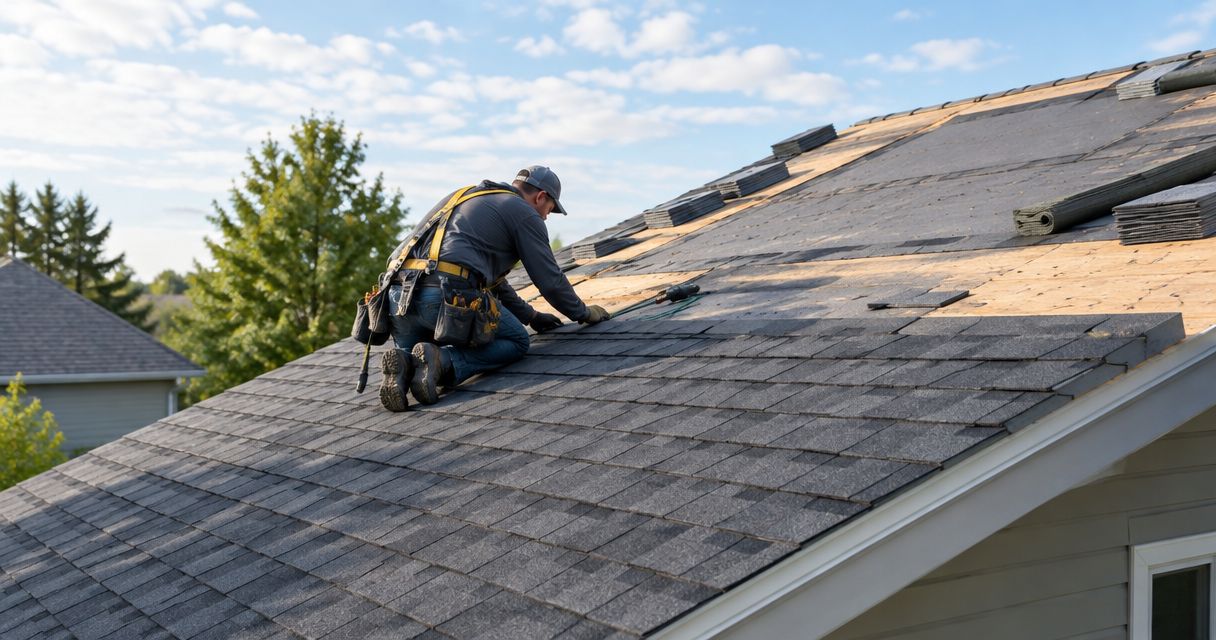
Replacing a roof in sections is worth considering when the section is physically distinct and an inspection confirms the remaining roof is sound. If connected slopes show similar wear, replacing them together avoids leaving aging materials beside new work. The deciding factor is whether the contractor can create a complete, watertight installation—not simply divide the roof into smaller jobs.
- Replace roof in sections only when an inspection supports keeping the remaining roof.
- Full roof replacement fits connected slopes with similar wear; sectional replacement fits genuinely separate roofing areas.
- Prescott Roofing serves residential roof replacement homeowners in Southern New Hampshire and Northern Massachusetts.
- Compare written replacement estimates for tear-off, flashing, decking, ventilation, and future tie-in work.
Why this matters
A smaller replacement scope leaves part of your existing roof in service. That means its shingles, flashing, and underlying materials still need to do their jobs after the contractor leaves.
For your 2026 project, judge the proposal by what it leaves behind as carefully as what it replaces. A clear roof estimate-to-contract process helps you separate a defined partial replacement from an incomplete whole-roof plan.
Is it worth replacing a roof in sections instead of all at once?
Yes, when the sections have different replacement needs and a sound construction boundary separates them. Otherwise, replacing connected, similarly worn slopes together is the better plan. An addition with newer roofing deserves a different assessment from an original roof whose slopes were all installed together.
Ask the contractor to explain both choices against the same inspection findings:
| Approach | Best for | Main advantage | Main drawback |
|---|---|---|---|
| Sectional replacement | A distinct roof area with deterioration that does not extend across the remaining roof | Keeps serviceable roofing in place | Leaves older materials and requires careful connection details |
| Full replacement | Connected slopes with similar deterioration | Addresses the connected roof assembly in one project | Removes existing roofing across the full scope, including areas that might still be serviceable |
Neither approach wins just because its proposal is shorter or longer. The right scope follows the roof's condition, layout, and installation requirements.
When sectional roof replacement makes sense
A separate garage roof or addition is a reasonable candidate for its own replacement assessment. Separation matters because the contractor needs a practical place to end the work without leaving a vulnerable joint.
Different installation histories also matter. If an addition was roofed separately, ask the contractor to evaluate its materials and condition independently rather than assume every roof surface needs replacement together.
A sectional proposal should identify:
- The exact roof planes being replaced.
- The existing materials that remain.
- The flashing and underlayment included at every boundary.
- Any adjacent materials that must be disturbed.
- The condition findings that support keeping the other sections.
A roof plane is a single sloped surface. Replacing an entire plane can provide a clearer scope than stopping midway across shingles, but the ridge, walls, valleys, and penetrations still need specific details.
Keep a section because its condition supports that decision—not because nobody inspected it. Ground-level appearance alone does not establish the condition of concealed decking or connections.
When replacing the whole roof is the better choice
Full replacement makes sense when deterioration extends across connected slopes. Replacing only the most visibly worn face leaves the other aging surfaces in place; new shingles do not improve the condition of neighboring materials.
Look beyond the shingle surface. Decking is the wood base beneath the roofing. Flashing directs water around joints and penetrations, while underlayment provides a protective layer beneath the roof covering. A replacement scope should address how these parts work together.
For a 2026 estimate, ask whether replacing one slope would require opening adjacent work again when the remaining roof is replaced. Repeated disturbance is a practical drawback even without assigning it a dollar figure.
Whole-roof replacement also has a trade-off: it removes roofing that an inspection might find serviceable. Ask for a condition-based explanation before approving that broader scope.
Why sectional replacement suitability varies
The percentage of roof being replaced does not settle the question. These factors determine whether a partial scope is sensible:
- Remaining condition: The untouched shingles, flashing, and accessible decking need their own assessment.
- Roof connections: Valleys, ridges, and roof-to-wall joints determine where new work meets old materials.
- Installation history: Separately installed sections need separate condition checks; matching appearance does not prove matching age.
- Material compatibility: New roofing must connect correctly with the materials that remain, following applicable installation instructions.
- Attic ventilation: A partial replacement must account for the attic space beneath it rather than treat roof vents as isolated accessories.
- Future work: The proposal should explain what a later replacement would disturb or require the contractor to rebuild.
Southern New Hampshire homeowners should also ask how the scope handles roof-edge waterproofing and ventilation. Those details belong in the written proposal, not in a general promise that the roof will be done correctly.
How to compare partial and full replacement estimates
Request 2 written scopes based on the same inspection: one for the proposed section and one for the connected roof as a whole. This makes omissions easier to spot without assuming either option is right before the inspection.
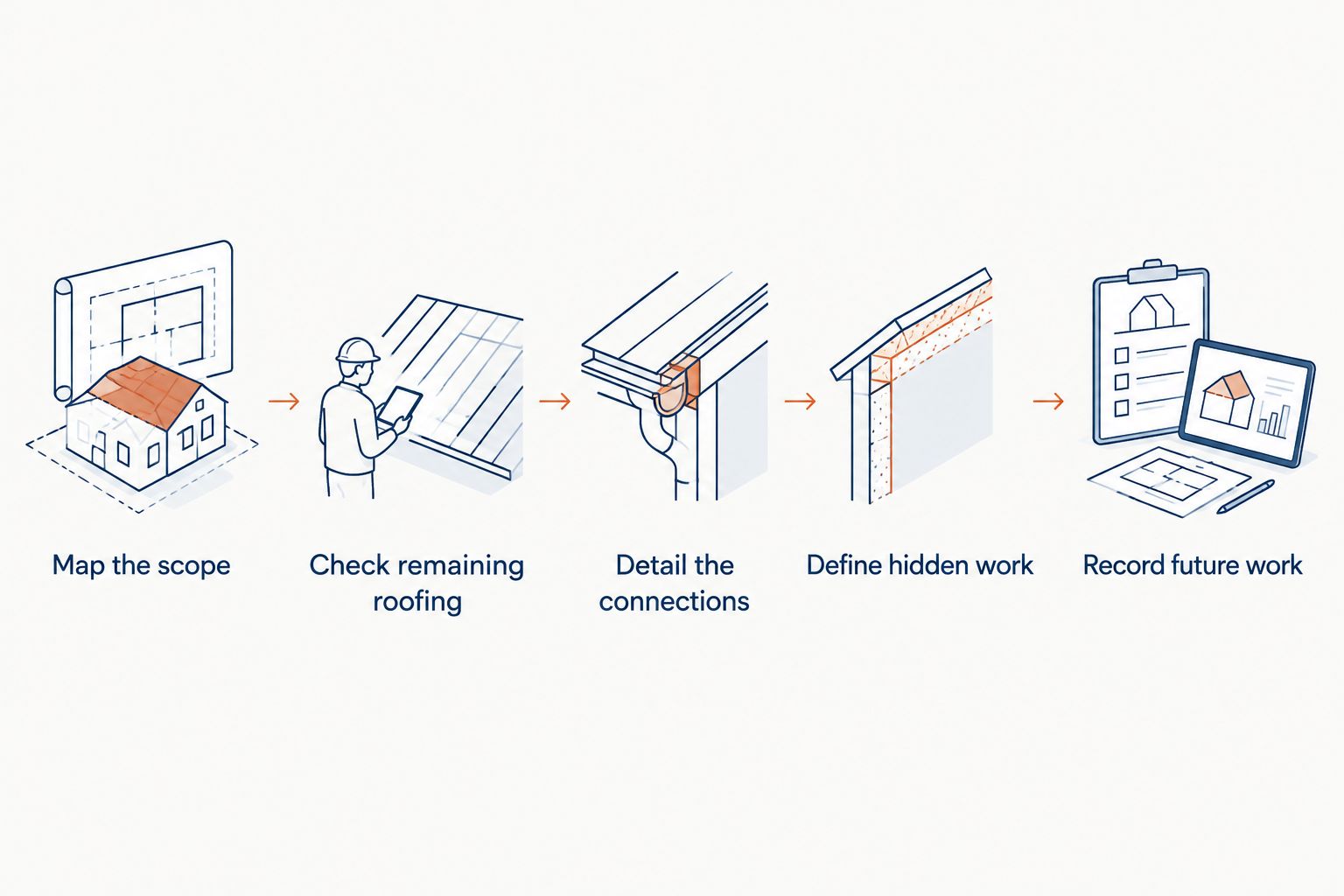
Map the scope
Have the contractor mark the replacement boundaries on a roof sketch or photographs. Labels such as “front roof” are not enough if dormers, an entry roof, or an attached garage make the boundary unclear.
Confirm whether the work includes tear-off, meaning removal of the existing roofing, or leaves existing layers in place. Those are different installation scopes and should not be treated as equivalent estimates.
Check remaining roofing
Ask what evidence supports leaving the other areas untouched. Useful documentation includes accessible attic observations and photographs showing the condition of remaining roof surfaces and connection points.
An inspection cannot reveal every concealed condition. The estimate should distinguish what the contractor observed from what will become visible only after tear-off.
Detail the connections
Require an explanation of the ridge, valleys, walls, and penetrations affected by the work. “Tie into existing roof” describes an intention, not a construction detail.
Ask which adjacent shingles or flashing must be removed and whether the work depends on reusing existing components. The answer should identify limitations before installation begins.
Define hidden work
The contract should explain how the contractor handles deteriorated decking found during tear-off. Specify the approval process, documentation, and measurement method for additional work without assuming concealed damage exists.
Also identify responsibility for debris removal, property protection, and cleanup. A smaller roof scope still needs a complete job plan.
Record future work
Ask what happens when the untouched section eventually needs replacement. Will the next project disturb the new ridge work, shared flashing, or surrounding shingles?
For a phased project beginning in 2026, keep the marked scope, photographs, product information, and completion documents together. The next contractor needs to know where the new work ends.
Pay attention to valleys, walls, and skylights
The hardest part of sectional replacement is often the connection, not the open field of shingles. A valley carries water where roof slopes meet; a roof-to-wall joint needs flashing integrated with both the roofing and the wall assembly.
Step flashing uses individual pieces of metal along a sloped roof-to-wall joint. New shingles alone do not establish whether existing step flashing can remain. Ask the contractor to explain its condition and how the replacement work will connect to it.
The same distinction applies to leaks around skylights: surrounding shingles, skylight flashing, and the skylight itself need separate evaluation before the replacement scope is settled. Replacing the nearby shingles does not establish that the entire opening has been addressed.
Do not accept a section boundary that exists only to make the proposal smaller. The boundary must also work as a durable roofing detail under the applicable installation instructions.
What a clear inspection conversation sounds like
Ask the contractor to show you the reason for the recommended scope. “This plane needs replacement, this adjoining plane remains serviceable, and here is how they connect” is more useful than “we can do whichever you want.”
Prescott Roofing is a residential roof replacement option for homeowners in Southern New Hampshire and Northern Massachusetts. When discussing sectional replacement, ask for the same condition findings and connection details you would require for a full replacement.
A residential roofing service is relevant to this decision, but the service list does not answer whether your particular roof can be divided sensibly. That requires an inspection and a written scope.
Before choosing a contractor for your 2026 replacement, ask:
- What supports keeping the remaining roof?
- Where exactly will the new work stop?
- Which existing components will be reused?
- What concealed conditions require additional approval?
- What will a later replacement disturb?
Requesting an inspection starts that conversation. It does not mean an appointment is booked; confirm the scheduling details directly.
Request a roof inspection
Discuss sectional versus full replacement and ask what each written scope includes.
Can I replace just one side of my roof?
1 roof plane can be a replacement scope when its condition and connection details support it. The contractor still needs to assess the opposite slope, ridge, shared valleys, and attic ventilation rather than assume they are unaffected.
Ask whether the proposal replaces the whole plane or stops within it. A marked drawing removes that ambiguity.
Is replacing a roof in stages the same as sectional replacement?
No. Replacing a distinct addition while keeping a sound main roof differs from splitting one connected replacement into separate projects. The first decision follows different roof conditions; the second needs a clear plan for temporary boundaries and later connections.
For staged work, ask for the complete sequence before approving the first phase. Do not treat an unfinished connected roof as though it were an independent section.
FAQ
Is it a bad idea to replace roof in sections?
Replacing a roof in sections is a bad fit when connected slopes have similar deterioration or the boundary creates unresolved connection work. It is reasonable to consider when a distinct area needs replacement and inspection supports keeping the remaining roof.
Will new shingles match the shingles already on my roof?
New shingles are not guaranteed to match weathered shingles, even when the intended color is similar. Ask the contractor to explain the expected appearance before choosing a sectional scope.
Does partial roof replacement fix old flashing?
Partial roof replacement addresses old flashing only where the written scope includes evaluating and replacing or correctly integrating it. Ask which flashing remains and why its condition supports reuse.
Can I leave a newer addition roof alone?
You can consider leaving a newer addition roof in place when an inspection supports its condition and the connection to the replacement area can be detailed correctly. A newer installation date alone does not settle the decision.
Does a partial replacement renew the warranty on my whole roof?
Do not assume a partial replacement renews coverage on the untouched roof. Ask for the applicable manufacturer and contractor terms in writing, including the covered area and exclusions.
Can Prescott Roofing inspect a roof before I choose the replacement scope?
Prescott Roofing accepts residential roof replacement inspection requests from homeowners in its Southern New Hampshire and Northern Massachusetts service area. Request an inspection and confirm scheduling directly; submitting a request does not establish a booked appointment.
One last thing
Ask this before approving your 2026 project: “What will the next roofer have to undo?” If a sectional replacement leaves a sound roof intact and gives the next project a clean boundary, the scope has a practical basis.
If later work must reopen the new installation, ask why doing the connected roof together is not the better choice. Bring that question to your Prescott Roofing roof replacement discussion before signing—not after tear-off starts.