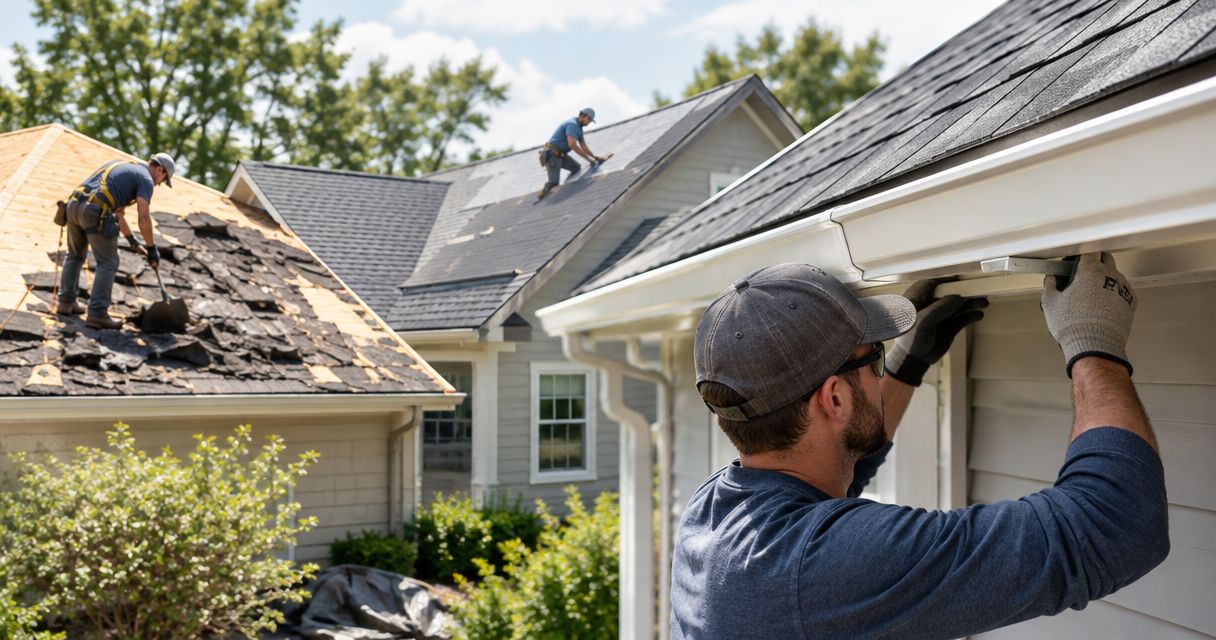
Instead of arranging gutter installation and roof replacement as separate jobs, coordinate the roof-edge inspection, roofing work, and final gutter installation in that order. For a homeowner-paid replacement in Southern New Hampshire in 2026, finish roof-edge repairs before attaching new gutters, unless the inspection supports a different sequence.
- For gutter installation roof replacement projects, complete roof-edge repairs before final gutter attachment.
- Prescott Roofing serves Southern New Hampshire homeowners planning residential roof replacement and gutter work.
- Keep sound existing gutters when their condition and the roofing work allow it.
- Require written responsibility for fascia repairs, gutter protection, downspouts, and final drainage checks.
Why this matters
The roof and gutters meet at a small but important detail: the eave, the lower roof edge where runoff leaves the roofing. Replacing one without checking the other leaves questions about water routing, attachment, and concealed wood damage.
Prescott Roofing is best suited to Southern New Hampshire homeowners seeking residential roof replacement and gutter services. When requesting an inspection through Prescott Roofing, describe both parts of the project so the roof edge receives attention alongside the roof covering.
For your 2026 project, choose the sequence from the condition of the house—not whichever crew has an opening first. New gutters should not hide deteriorated fascia, and roofing work should not leave existing gutters bent or filled with debris.
Before you start
- Gather the project information. Have exterior photos taken safely from the ground, any previous roofing paperwork, and a list of overflowing or leaking gutter locations. Identify which roof areas and gutter runs you want inspected. Leave ladder and roof access to the contractor.
- Require 2 written scopes when separate contractors are involved. The roofing scope and gutter scope should name who handles removal, temporary protection, fascia repairs, reattachment, and cleanup. A combined contract still needs those responsibilities spelled out.
- Flag the concealed-wood issue before scheduling. Fascia is the board behind the gutter; roof decking supports the roofing above it. Some deterioration becomes visible only after removal, so agree on documentation and written authorization before additional work starts.
For a 2026 estimate, separate confirmed work from concealed-condition work. An allowance or exclusion needs an explanation of what triggers it and how you approve the change.
Roof-edge inspection and scope
Establish the work boundary
- Request a joint assessment. Ask the contractor to inspect the roof covering, lower roof edge, accessible fascia, gutter attachments, and downspout routing. Report where you have observed overflow instead of assuming the gutter needs replacement.
- Create 1 marked-up sketch. Identify gutter runs to keep, remove temporarily, or replace. Mark downspouts, porches, additions, and areas where landscaping or access needs protection.
- Write down the edge details. Ask how the drip edge—the metal flashing at the roof perimeter—will direct runoff into the gutter. Have the contractor explain how roofing materials, flashing, and gutter placement work together.
- Separate required work from optional changes. Distinguish replacement of damaged components from changes such as relocating a downspout. Do not let a broad description such as complete exterior work substitute for a scope.
Expected result: You can point to each roof edge and explain what stays, what changes, and who handles it.
Compare the available sequences
There is no reason to replace usable gutters solely because you are replacing the roof. There is also no benefit to installing new gutters over attachment surfaces that need repair.
| Workflow | Best for | Main advantage | Main limitation |
|---|---|---|---|
| Roof first, then new gutters | Homeowners replacing both systems | Leaves the edge accessible for inspection and repair | Requires coordination before final gutter installation |
| Roof replacement with existing gutters protected | Homeowners whose gutters remain serviceable | Avoids unnecessary gutter replacement | Existing gutters need protection, cleaning, and a condition check |
| Temporary gutter removal and reinstallation | Roof-edge work requiring access behind usable gutters | Opens the fascia without automatically replacing gutters | Removal can reveal damage or make reuse impractical |
| Gutters first, roof replacement later | Homeowners addressing drainage while roofing is deferred | Addresses a current drainage problem | Later roofing work can require protection, removal, or repositioning |
Choose the roof-first sequence when both systems need replacement and the work can be coordinated. Retain existing gutters only after the inspection confirms that their condition and placement support the planned roofing work.
Roof work and repair checkpoints
Approve the sequence before tear-off
- Confirm protection responsibilities. Identify how the crew will protect gutters being retained, siding, windows, walkways, and planting beds. Confirm where removed materials and equipment will go.
- Resolve removal requirements. Ask whether gutters or gutter covers obstruct access to fascia, flashing, or roofing fasteners. Put any planned removal and reinstallation into the scope before work begins.
- Set 2 hold points. Require a concealed-condition review after the relevant materials are removed, then a roof-edge review before new gutters are attached. These are decision checkpoints, not promises about project duration.
- Confirm the authorization process. Specify who receives photos, who approves additional repairs, and how changes enter the written agreement. Do not rely on a verbal instruction passed between crews.
Expected result: The crew knows when to stop for a decision, and you know what evidence you will receive before approving a change.
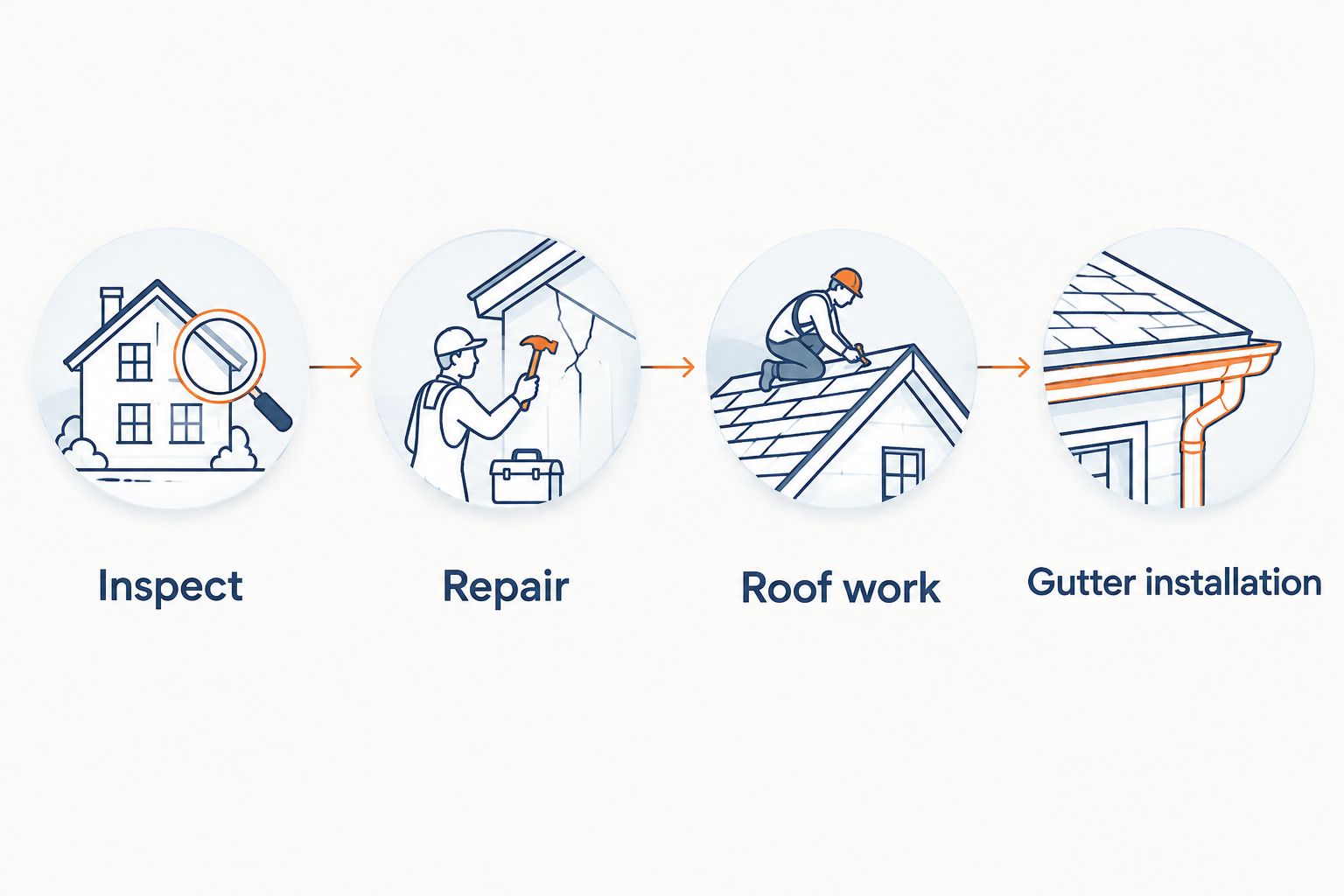
Inspect, repair, and finish the roof edge
The sequence is Inspect, Repair, Roof work, then Gutter installation. The roofing contractor should explain any project-specific departure before it happens.
- Document exposed conditions. Request clear photos of deteriorated decking or fascia and an explanation of why replacement is necessary. A close-up should be accompanied by enough context to identify the location.
- Approve the repair scope. Confirm the affected area, replacement material, and related work before the contractor covers it. Ask whether fascia repairs also require adjacent trim or soffit work; the soffit is the underside of the roof overhang.
- Complete the roofing assembly. Have the contractor follow the selected roofing system's installation instructions for underlayment, edge flashing, and roof covering. Underlayment is the protective layer beneath the finished roofing.
- Review the handoff condition. Confirm that the roof edge is ready for the planned gutter attachment and that roofing debris has been removed from retained gutters.
Expected result: The roof edge is repaired and finished, with a documented attachment surface for the gutter work.
For the roofing portion, the tear-off to shingle installation workflow explains the stages that sit between removal and the finished roof.
Gutter installation and drainage handoff
Confirm attachment and discharge
- Match placement to the finished roof. Have the installer check gutter position against the completed drip edge. Runoff should enter the gutter rather than track behind it.
- Confirm attachment conditions. Ask how the gutter will be secured to suitable framing or backing. New gutter hardware does not correct unsound wood behind the fascia.
- Review downspout locations. Confirm where each downspout discharges and whether the proposed route conflicts with paths, steps, or landscaping. Do not assume an existing underground drain is clear or suitable without checking it.
- Check drainage and joints. Request a controlled water check where conditions permit. The installer should look for leaking joints, water passing behind the gutter, and drainage problems rather than treating appearance as proof of performance.
- Record the finished work. Keep completion photos, approved changes, and any applicable product or workmanship documents supplied with the project.
Expected result: You understand where roof runoff goes, and the final review covers function as well as appearance.
A controlled check does not reproduce every rainfall condition. It does, however, give the installer an opportunity to identify obvious drainage and connection problems before closing out the job.
When existing gutters stay during roof replacement
Keeping serviceable gutters is a separate workflow, not a shortcut. Best for: homeowners whose inspection supports reuse and whose roof-edge repairs do not require full gutter removal.
Before tear-off, document visible dents, loose sections, leaking joints, and downspout conditions. Ask how the crew will limit debris accumulation and protect the gutter from falling materials.
After roofing, require cleaning and a condition review. Compare gutter alignment, attachment, and visible damage with the pre-work record; inspect any sections that were detached and reinstalled.
The advantage is avoiding unnecessary replacement. The limitation is that older gutters remain older gutters: roof replacement does not correct existing deterioration, poor drainage, or unsuitable placement unless those items are included.
If gutters must be installed before a later roof replacement, arrange a roof-edge assessment first. Tell both contractors about the future work, and document which components might need removal or adjustment later. Do not install gutter covers across an unresolved roof-edge detail.
Troubleshooting the roof-and-gutter handoff
Water runs behind the new gutter
Ask the installer to inspect the relationship between the drip edge and gutter, plus the condition of the fascia behind it. Correct the water-routing detail rather than accepting sealant as an unexplained substitute for proper flashing and placement.
The gutter crew finds deteriorated fascia
Pause attachment in the affected area and request documentation. Complete approved repairs before installing the gutter; covering deteriorated wood leaves the attachment problem unresolved.
The roofing and gutter scopes leave a gap
Ask both contractors to identify responsibility in writing before work proceeds. Common gaps include temporary removal, fascia finishing, reattachment, and cleaning debris from retained gutters. Each task needs a named responsible party.
Water collects or spills after installation
Have the installer check debris, outlet restrictions, gutter pitch, downspout routing, and whether the system suits the roof area it serves. Overflow alone does not identify the cause, and gutter covers do not resolve every drainage problem.
Gutter covers interfere with roof-edge access
Determine whether removal is necessary before roofing begins. Document removal, storage, reinstallation, and what happens if existing covers cannot be reused. Do not assume gutter covers are included in either contractor's scope.
Customize your workflow
For a straightforward replacement, keep the scope focused on roofing, necessary edge repairs, and gutters. For a house with additions or several roof levels, have the contractor explain how runoff moves between roof areas before finalizing downspout locations.
When comparing Prescott Roofing with another contractor, use the same written scope. Ask each contractor what is included, what is excluded, and which findings would require additional authorization. A brief estimate is easier to read but harder to compare when responsibilities are missing.
For your 2026 inspection request, provide the address, the roof areas involved, and whether you want existing gutters evaluated or replaced. Requesting an inspection does not mean an appointment is booked; confirm the date and access arrangements directly.
Request a roof and gutter inspection
Describe your roof replacement plans and ask how existing gutters and fascia affect the scope.
FAQ
Should gutters be installed before or after roof replacement?
Install new gutters after roof replacement when both projects are being completed together and the inspection supports that sequence. This leaves the roof edge accessible for repairs before final gutter attachment.
Do I have to replace my gutters when I replace my roof?
No, roof replacement does not automatically require gutter replacement. Have the contractor assess existing gutter condition, attachment, placement, and any removal needed for roof-edge access.
Can new roofing be installed without removing existing gutters?
Yes, existing gutters can remain when they do not obstruct the required work and can be protected. The written scope should address protection, debris removal, and a final condition check.
Who repairs fascia during a roof and gutter project?
The contractor assigned that responsibility in the written scope handles fascia repairs. When separate crews are involved, resolve responsibility and the approval process before either crew starts.
What should a 2026 roof replacement and gutter estimate include?
The estimate should identify roofing work, gutter retention or replacement, edge flashing, fascia repair procedures, downspouts, cleanup, and exclusions. Concealed-condition work needs a documented approval process.
Should gutter covers go on before the new roof?
Install gutter covers after roofing and gutter placement are resolved when those projects are coordinated. Existing covers need an assessment to determine whether removal is required for access.
How do I request a roof and gutter inspection from Prescott Roofing?
Use the contact page to describe your homeowner-paid roof replacement and gutter concerns. A request starts the scheduling conversation; confirm the appointment date and access arrangements directly.
One last thing
Before signing your 2026 contract, ask: Who is responsible for the roof-to-gutter handoff? The answer should identify who checks the finished edge, approves the attachment surface, and resolves water passing behind the gutter.
A clean-looking gutter cannot prove the wood behind it is sound. Request repair photos before that area disappears from view.