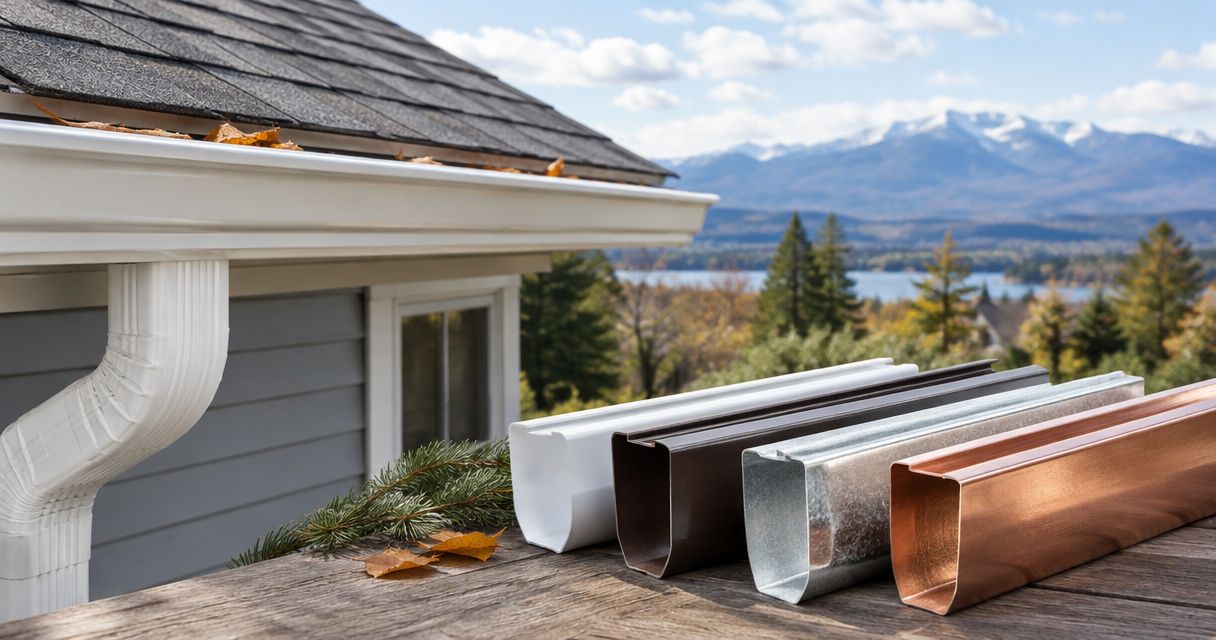
Best overall: aluminum. Best for rigidity: steel. Best for traditional detailing: copper. For a homeowner-paid roof replacement in 2026, the best gutter materials for New Hampshire homes depend on the roof edge, attachment details, and drainage layout—not the metal alone.
- Aluminum leads the best gutter materials for New Hampshire homes when paired with sound fascia and proper drainage.
- Choose steel for rigidity, copper for traditional detailing, and zinc for an unpainted patina.
- Prescott Roofing roof replacement estimates should be reviewed for explicit gutter, fascia, and roof-edge scope.
- Request separate descriptions for gutters, downspouts, attachment hardware, and concealed wood repairs.
Why this matters during a roof replacement
A new roof and new gutters meet at the same critical location: the eave. Replacing shingles without checking that connection leaves an important part of the project unresolved.
Prescott Roofing is a fit for Southern New Hampshire homeowners coordinating residential roof replacement with gutter work. When discussing residential roofing services, ask whether the proposed work includes keeping, removing, or replacing the existing gutters. Do not assume a roof replacement estimate includes them.
Your 2026 decision should start with the condition of the fascia—the board behind the gutters—and the route water takes to each downspout. A stronger gutter cannot correct rotten attachment wood or a poorly placed outlet.
What makes the best gutter material?
Use these criteria before comparing materials. Each addresses a different reason a gutter system succeeds or fails.
- Attachment strength: The fascia, hangers, and fasteners must support the installation. Material alone does not establish load capacity.
- Corrosion resistance: Consider the gutter body, cut edges, joints, and contact with other metals.
- Repairability: Ask how an installer will repair a damaged section or leaking connection without replacing unrelated work.
- Water handling: Profile, pitch, outlets, and downspouts determine drainage alongside the material.
- Roof compatibility: The gutter must work with the roof-edge flashing and the roof covering above it.
- Appearance: Compare painted finishes, natural patinas, profiles, and how those choices fit your house.
Gutter materials at a glance
These rankings describe distinct uses, not a claim that every house needs the same system. Installation details remain part of every choice.
| Rank and material | Best for | Standout feature | Key limitation |
|---|---|---|---|
| 1. Aluminum | Most residential replacement projects | Resists rust and can be formed into long runs | Dents and deforms under force |
| 2. Steel | Homeowners prioritizing rigidity | Stiffer than aluminum in comparable profiles | Protective coatings need attention at damage and cuts |
| 3. Copper | Traditional architectural detailing | Natural patina without a painted finish | Requires compatible metals and skilled joining |
| 4. Zinc | An unpainted, weathering finish | Develops a protective surface patina | Installation requires attention to expansion and compatibility |
| 5. Vinyl | Small, simple detached structures | Does not rust and uses sectional components | Cold-weather brittleness and joint movement limit its appeal |
1. Aluminum: best gutters for most roof replacements
Aluminum is the default recommendation for homeowners who want a practical gutter system alongside a residential roof replacement. It does not rust like exposed steel, and installers can form long runs that reduce the number of intermediate joints. Corners, outlets, and end caps still need proper connections.
Aluminum pros:
- Resists rust without relying on a sacrificial coating.
- Supports long, formed runs with fewer intermediate seams.
- Offers painted finishes for different exterior trim schemes.
- Is relatively light to handle during installation.
Aluminum cons:
- Dents under ladders, impacts, and concentrated force.
- Thin material and poor attachment remain weak points.
- Painted surfaces can scratch or wear.
Best for: Most Southern New Hampshire homeowners replacing a residential roof in 2026.
Ask the contractor to identify the aluminum thickness and hanger system in writing. Two estimates that both say aluminum gutters do not necessarily describe equivalent work.
Verdict: Buy aluminum as the default, provided the estimate specifies the material and attachment details.
2. Steel: best gutters for added rigidity
Steel makes sense when resistance to bending is a priority. Galvanized steel uses a zinc coating to protect the underlying metal; damaged coatings and exposed edges require attention because the steel beneath can rust.
Rigidity is not permission to ignore drainage or loading. The attachment still depends on the condition of the wood and the fastening method.
Steel pros:
- Provides greater stiffness than comparable aluminum profiles.
- Resists incidental deformation better than softer metals.
- Supports painted finishes where a natural-metal appearance is unwanted.
Steel cons:
- Exposed steel can corrode after coating damage.
- Heavier sections require appropriate handling and support.
- Cut edges and connections need careful detailing.
Best for: Homeowners who place rigidity ahead of an unpainted, naturally weathering finish.
Ask which protective coating the proposed steel uses and how the installer treats cut edges. The word steel alone leaves too much unspecified.
Verdict: Buy steel when the estimate explains corrosion protection, not just strength.
3. Copper: best gutters for traditional detailing
Copper suits houses where the gutter is part of the architecture rather than something to conceal. Its surface changes as it weathers, developing a patina instead of retaining a freshly installed appearance.
Copper also changes the installation discussion. Joining methods, expansion, and compatibility with adjacent metals deserve explicit attention.
Copper pros:
- Develops a natural patina without a painted finish.
- Fits traditional roof-edge and ornamental details.
- Can use soldered joints when the system is designed accordingly.
Copper cons:
- Runoff can stain adjacent surfaces.
- Contact or runoff interactions with other metals require planning.
- Skilled fabrication and joining are important.
Best for: Homeowners preserving traditional architectural details during roof replacement.
Choose copper because you want its weathered appearance, not because you expect it to stay bright. Ask how the contractor will coordinate the gutter with existing flashing and trim.
Verdict: Buy copper for an intentional architectural choice with compatible roof-edge details.
4. Zinc: best gutters for an unpainted patina
Zinc offers a different natural-metal appearance from copper. Architectural zinc develops a protective patina, making it a candidate for homeowners who want a weathering surface without a painted coating.
The specific system matters. Ask for the material specification and the joining method rather than accepting a general reference to zinc gutters.
Zinc pros:
- Develops a protective surface patina.
- Avoids dependence on a painted decorative finish.
- Offers a subdued natural-metal appearance.
Zinc cons:
- Thermal movement needs proper detailing.
- Incompatible materials and trapped moisture create installation concerns.
- Repairs require familiarity with the selected system.
Best for: Homeowners specifically seeking an unpainted, weathering finish distinct from copper.
For a 2026 roof replacement, request examples of the proposed finish after weathering. A fresh sample does not show the final appearance.
Verdict: Buy zinc only with a clearly specified system and an installer familiar with it.
5. Vinyl: best reserved for small detached structures
Vinyl gutters do not rust, and sectional systems can suit straightforward layouts. Those characteristics do not make vinyl the strongest default for a New Hampshire house undergoing roof replacement.
Cold temperatures make vinyl more brittle, while temperature changes cause expansion and contraction. Connections and support details therefore deserve close attention.
Vinyl pros:
- Does not rust.
- Uses sectional components for simple layouts.
- Does not require a painted metal finish.
Vinyl cons:
- Becomes more brittle in cold conditions.
- Expands and contracts with temperature changes.
- Sectional layouts introduce multiple connections to maintain.
Best for: Small detached structures with simple rooflines, rather than the main house in this comparison.
Verdict: Skip vinyl as the default for a full residential roof replacement in Southern New Hampshire.
What your roof-and-gutter estimate should spell out
Prescott Roofing roof replacement discussions should separate gutter work from roofing work so you can compare the scope accurately. Ask for written descriptions rather than relying on a conversation about doing everything at once.
Start with these connected parts:
- Roof edge: Identify the drip edge and how water moves from the roofing into the gutter. Drip edge is the metal flashing along the roof perimeter.
- Fascia: State whether existing boards stay, receive inspection after removal, or require replacement where damaged.
- Hangers: Identify the attachment system and the sound material receiving the fasteners.
- Downspouts: List locations, outlet connections, and where discharge will go.
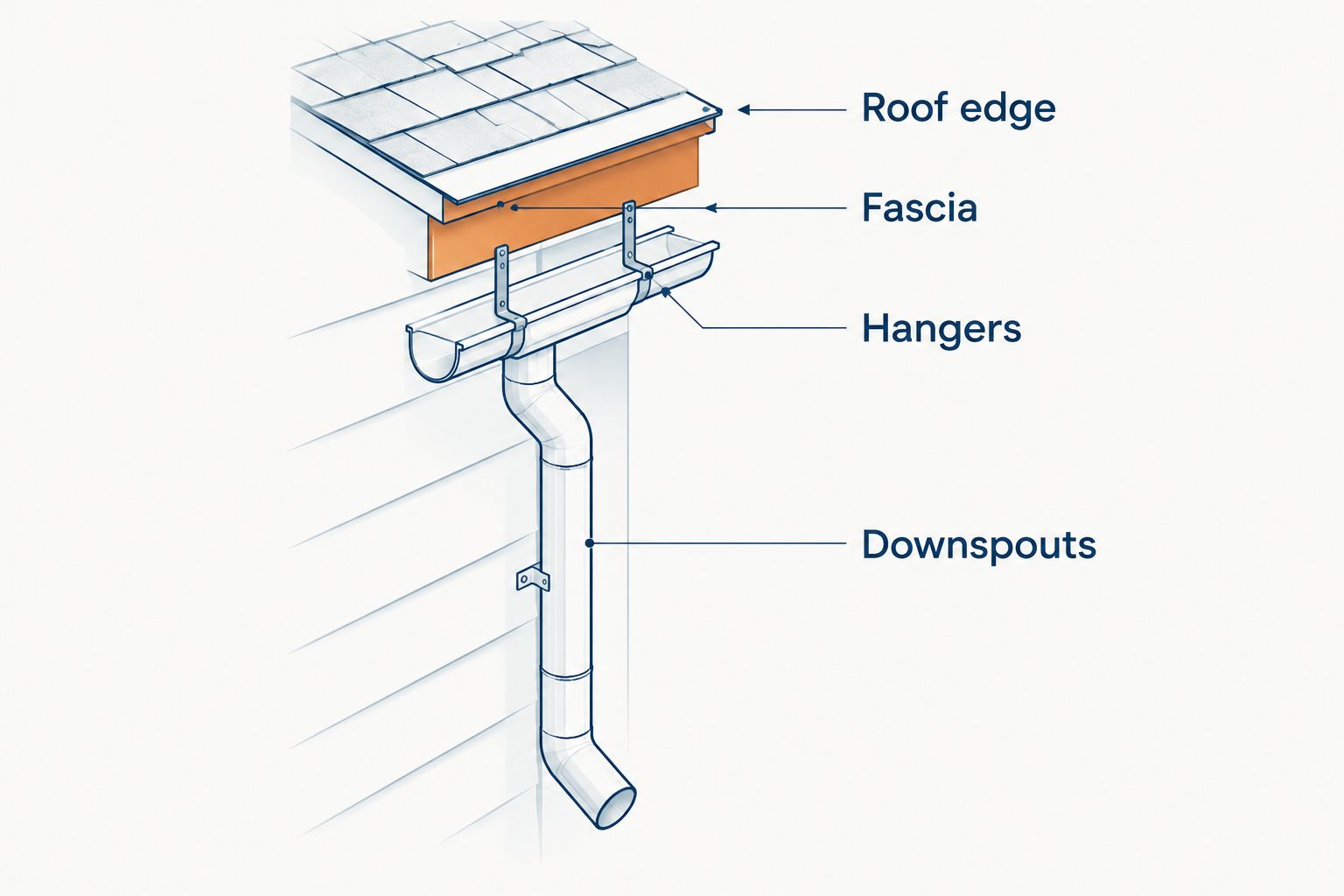
Ask how concealed damage will be documented and approved before additional work proceeds. Also identify removal, disposal, protection of landscaping, and whether existing downspouts will be reused.
The soffit and fascia material comparison addresses the trim surrounding that attachment area. New gutters should not hide a board that needs repair.
Size and debris matter as much as material
Common residential options include 5-inch and 6-inch gutters, with downspout profiles such as 2-by-3-inch and 3-by-4-inch. These are component dimensions, not automatic recommendations for your house. Roof area, pitch, valleys, outlets, and local rainfall conditions determine the drainage design.
A valley concentrates runoff from adjoining roof planes. Ask the estimator to explain how that concentrated flow reaches an outlet rather than assuming a larger gutter fixes every overflow problem.
Trees add another decision. Comparing gutter guards for pine needles means looking at the openings and cleaning access, because narrow needles behave differently from broad leaves. A guard does not correct poor pitch, an obstructed outlet, or weak fascia.
Keep guards separate from the material ranking. Aluminum describes the gutter body; a screen or cover is another component with its own installation and maintenance requirements.
How these materials were ranked
Aluminum ranks first because it combines rust resistance, formed-run construction, and a straightforward fit for residential replacement work. Steel earns a separate place for rigidity; copper and zinc serve distinct appearance goals. Vinyl falls last for the main house because cold-weather brittleness and sectional connections work against this application.
These are material-based recommendations, not laboratory test results or endorsements of unnamed manufacturers. For 2026, compare complete installations—not material labels stripped of attachment, flashing, and drainage details.
Which gutter material should you choose?
Choose aluminum unless your house or priorities give you a specific reason to choose something else. Move to steel for rigidity, copper for traditional detailing, or zinc for its unpainted patina. None removes the need for sound fascia and a defined discharge route.
When requesting a Prescott Roofing inspection, explain that you are planning a homeowner-paid roof replacement and want the existing gutters assessed as part of that decision. Requesting an inspection does not mean an appointment is booked; confirm scheduling separately.
Request a roof replacement inspection
Ask to discuss roof-edge condition, existing gutters, and the scope of your replacement estimate.
FAQ
What's the best gutter material for a New Hampshire home?
Aluminum is the best default gutter material for most New Hampshire residential roof replacements. It resists rust and supports long formed runs, but the fascia, hangers, outlets, and roof-edge details still need proper installation.
Are steel gutters better than aluminum gutters?
Steel is better when rigidity is your main priority, while aluminum avoids the rust risk of exposed steel. Compare coating details, material thickness, and attachment specifications rather than choosing by the metal name alone.
Should I replace gutters when I replace my roof?
Replace gutters during roof replacement when their condition or the planned roof-edge work justifies it. Sound existing gutters do not automatically need replacement; ask how they will be protected, removed, or reinstalled.
Do I need 5-inch or 6-inch gutters?
Choose gutter size from the roof's drainage requirements, not the material alone. Roof area, pitch, valleys, outlet placement, and downspout capacity all affect the selection.
Are copper gutters maintenance-free?
Copper gutters are not maintenance-free. Outlets still need to remain clear, connections need inspection, and runoff or contact with other materials requires attention.
Do gutter guards solve pine needle buildup?
Gutter guards do not eliminate every pine needle or maintenance problem. Compare opening design and cleaning access, and keep the outlets and discharge route accessible.
What should I ask Prescott Roofing about gutters in a roof estimate?
Ask Prescott Roofing whether the roof replacement estimate includes gutter removal, replacement, reinstallation, fascia work, and downspouts. Request written details for exclusions and approval of concealed repairs before signing.
One last thing
A gutter can look straight from the driveway and still sit below a poorly detailed roof edge. Before approving your 2026 roof replacement, ask the contractor to explain where water goes at the eave and where it exits at ground level. A clear answer connects the roof, gutter, and downspout—not just the material you selected.