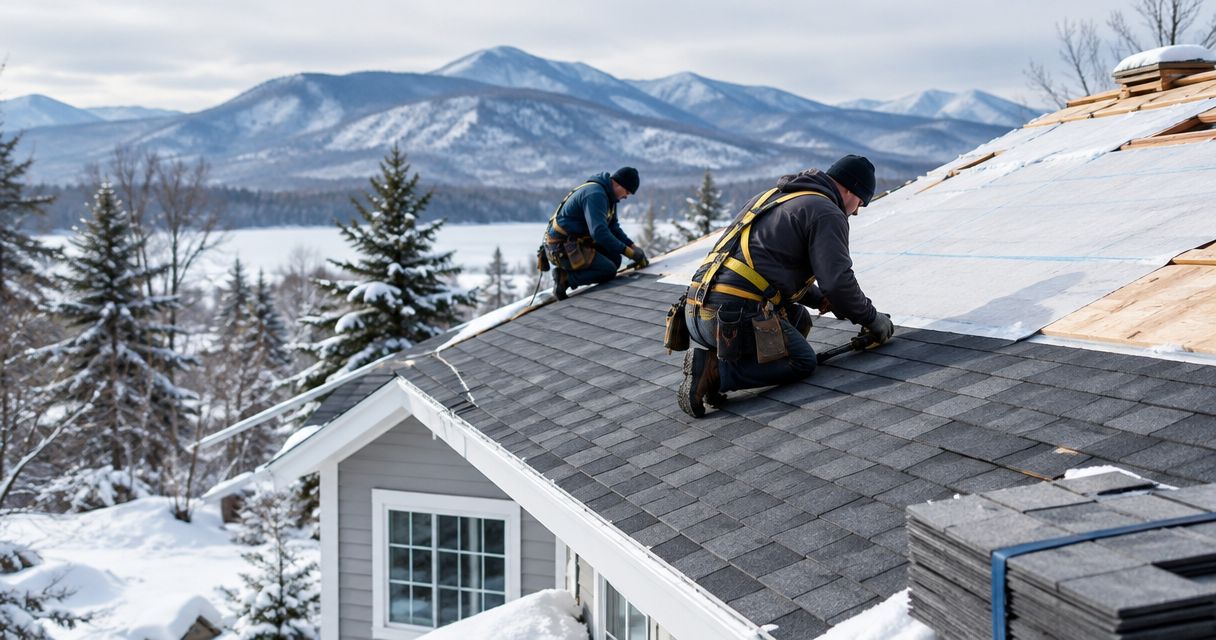
Yes, you can replace a roof during winter in New Hampshire when the roof is dry, access is safe, and conditions meet the selected roofing materials’ installation instructions. Cold-weather work requires particular attention to shingle handling, sealing, underlayment, and protecting exposed decking. For a homeowner-paid replacement in 2026, choose the installation window by roof condition and product requirements—not simply by the month.
- Roof replacement in winter NH is possible when safe conditions and material installation requirements align.
- Cold asphalt shingles need careful handling; self-sealing adhesive does not necessarily bond immediately.
- Compare written roof replacement estimates for decking, flashing, weather delays, and overnight protection.
- Prescott Roofing serves Southern New Hampshire homeowners planning residential roof replacement.
Can you replace a roof during winter in New Hampshire?
Yes—but a suitable workday is not the same as a suitable installation window. Your contractor needs enough time to remove existing roofing, assess the decking, and protect the exposed area before conditions change. A clear morning does not settle those questions.
Winter replacement and waiting for warmer weather both have advantages and limitations. Your existing roof’s condition should determine which option deserves serious consideration.
| Approach | Best for | Advantage | Limitation |
|---|---|---|---|
| Replace during a suitable winter window | Homeowners whose roofs need replacement before warmer weather | Addresses the existing roof’s condition without waiting for spring | Requires cold-weather installation procedures and weather-dependent scheduling |
| Wait for warmer conditions | Homeowners whose inspected roofs can remain in service | Avoids some cold-weather handling and sealing complications | Leaves the existing roof in place longer; suitability depends on its condition |
Prescott Roofing is a fit for Southern New Hampshire homeowners seeking residential roof replacement. Start with an inspection request through Prescott Roofing, then ask whether your roof’s condition supports waiting or calls for a winter installation plan.
Why this matters before you sign an estimate
A winter roof replacement is more than removing shingles and installing new ones. The crew must manage exposure, material behavior, and the transition between unfinished and completed work. Those responsibilities belong in the scope discussion before you accept a proposal.
For a Manchester or Bedford homeowner planning a 2026 replacement, the useful question is not whether a contractor works through winter. Ask how the contractor decides when to start, when to stop, and how to leave your home protected.
A start date is a scheduling target, not permission to ignore unsuitable conditions. You need a clear weather-delay process as much as a proposed installation date.
What makes a winter installation acceptable?
A dry, suitable roof deck
The roof deck is the wood surface beneath the roofing system. Once the old covering comes off, the contractor must check that surface for damage and suitability before covering it again. New shingles do not correct deteriorated decking underneath them.
Ask how the crew will handle frost, moisture, and damaged sheathing discovered during tear-off. The estimate should distinguish ordinary preparation from additional deck replacement and explain how you approve changes before that extra work proceeds.
Do not climb onto the roof to check conditions yourself. Ask the contractor to document the deck during the work, particularly where damage changes the agreed scope.
Material-specific cold-weather instructions
Asphalt shingles become less flexible in cold conditions, making careful handling important. Their self-sealing adhesive also depends on suitable conditions to bond. Fastening a shingle in place and achieving its intended seal are separate parts of installation.
Ask the contractor to identify the exact shingle and explain its cold-weather instructions, including any required hand-sealing. Hand-sealing means applying compatible adhesive as directed by the manufacturer; it is not a substitute for following the rest of the installation instructions.
Avoid accepting a general temperature rule as proof that every component is suitable. Shingles, self-adhered membranes, sealants, and other materials have their own requirements.
Safe access and a workable protection plan
Snow, ice, and slippery surfaces affect access for the crew and material handling. Conditions at the driveway do not establish conditions on a shaded roof slope. The contractor must assess the actual work area.
Ask how walkways, entrances, landscaping, and material staging will be managed. You also need to know how the crew will protect unfinished areas if work stops before the roof is complete.
How should a winter roof replacement proceed?
The homeowner does not need to supervise installation techniques. You do need to understand the sequence well enough to recognize whether the proposal addresses the points where your home becomes exposed.
- Inspect. Establish the roof’s condition, visible problem areas, access limitations, and whether waiting is reasonable. An inspection cannot reveal every concealed defect, so the estimate needs a process for discoveries after tear-off.
- Confirm materials. Identify the roofing products and applicable cold-weather instructions. Ask how the contractor will handle storage, application conditions, fastening, and sealing.
- Check conditions. Reassess the forecast and actual roof conditions before starting. Confirm who communicates a postponement and what happens to deliveries or staging if the start moves.
- Protect decking. Remove only the area the crew can manage and protect under the conditions. Check the exposed deck before installing the specified roof-system layers.
- Document completion. Review completed work, changes to the original scope, cleanup, and any remaining items. Ask for photographs of concealed details before they disappear beneath finished roofing.
The sequence matters because tear-off changes the risk immediately: the old covering is no longer protecting that area. A contractor’s plan should connect removal directly to inspection and protection, rather than treating them as unrelated tasks.
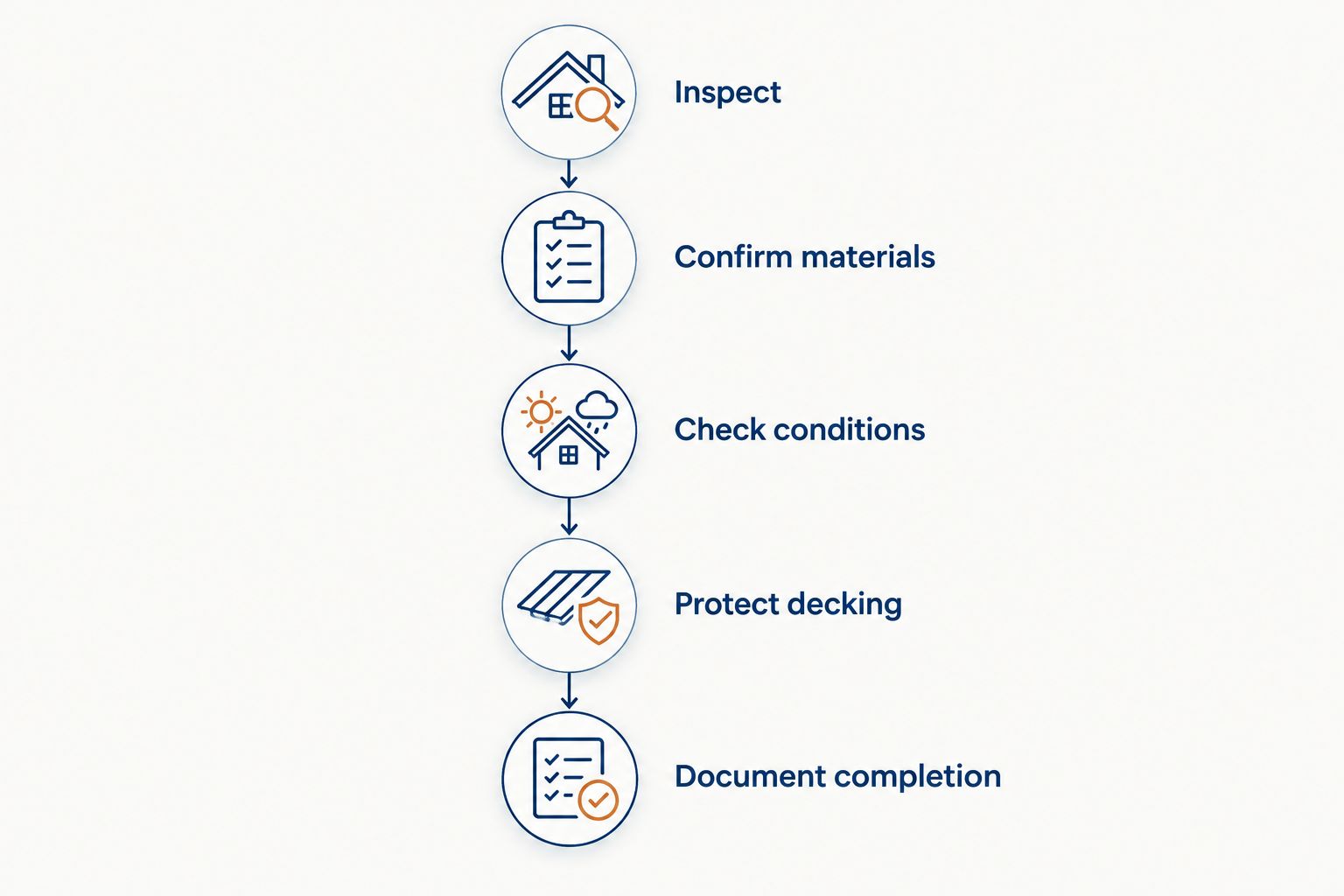
Ask for the same sequence in plain language when comparing proposals. For a closer look at the construction stages, review the tear-off to shingle installation workflow before your estimate discussion.
Why winter roof replacement plans vary
A winter proposal should reflect your house and selected materials. These factors explain why neighboring homes do not necessarily have the same installation plan:
- Existing roof condition. A roof that can remain in service presents a different scheduling decision from one with ongoing deterioration. Ask the contractor to explain the evidence behind the recommendation.
- Roof shape and access. Steep slopes, dormers, valleys, and restricted access affect how the crew reaches and protects each work area.
- Sun and shade. Roof surfaces do not all experience the same conditions. A sunny front slope does not establish that a shaded rear slope is ready for work.
- Selected materials. Each product’s installation instructions govern its use. The plan must address the full assembly, not just the visible shingles.
- Decking and flashing scope. Concealed deck damage or additional work around chimneys and walls changes the work required after tear-off.
- The usable weather window. Precipitation, wind, surface conditions, and the forecast affect when exposed work can proceed safely.
For your 2026 project, ask which of these factors the contractor has already assessed and which remain uncertain until removal begins. An honest estimate separates observed conditions from allowances and exclusions.
What should a winter replacement estimate include?
Compare scope before comparing totals. Two proposals are not equivalent if one replaces flashing and explains deck repairs while the other leaves those items undefined.
Look for these items in writing:
- Tear-off and disposal: What existing roofing will be removed, and who handles debris removal and final cleanup?
- Deck inspection: How will the contractor document damaged wood, explain additional work, and obtain your approval?
- Roof-system materials: Which shingles, underlayment, water-protection membranes, fasteners, and accessories are specified?
- Flashing details: What happens at chimneys, walls, valleys, and roof penetrations? Which components are replaced, and which are proposed for reuse?
- Ventilation scope: What existing ventilation will remain, and what changes are included?
- Winter procedures: How will the crew address material handling, sealing, unsuitable surfaces, and interruptions?
- Completion terms: What establishes completion, and how are unfinished items recorded?
Flashing deserves a direct conversation. Step flashing consists of individual pieces that direct water away where a sloped roof meets a wall. A proposal that says only “new roof” does not tell you how that connection will be handled.
For a homeowner-paid replacement, require written approval for changes outside the agreed scope. That keeps a concealed decking discovery from becoming an unexplained addition at the end of the job.
Should you replace your roof now or wait until spring?
Wait only when the roof’s assessed condition supports waiting. A calendar preference cannot establish whether the current covering, decking, or vulnerable connections can remain in service.
Ask your contractor to separate the recommendation into 3 decisions: whether replacement is needed, whether waiting is reasonable, and whether current conditions support installation. Those are different questions, and each deserves an explanation.
A winter installation has a clear benefit when replacement should not be deferred: it addresses the existing roof sooner. Its limitation is the need to work within suitable conditions rather than treating the schedule as fixed.
Waiting avoids some cold-weather complications, but it is not automatically the safer choice for the house. If you postpone, ask what conditions should trigger another inspection and whether any interim work is recommended under a separate written scope.
What should you ask a contractor before agreeing?
For a 2026 winter project, use specific questions instead of asking whether winter roofing is “fine.” The answers should explain decisions, responsibilities, and documentation.
Ask these 6 questions during your estimate review:
- What observed roof conditions support replacing now rather than waiting?
- Which installation instructions apply to the exact materials proposed?
- What conditions would cause you to postpone or stop work?
- How will you protect exposed decking if the weather changes?
- How will you document and obtain approval for additional work?
- What completion photographs and written records will I receive?
Do not accept “we do this all the time” as the whole answer. Experience is useful, but your proposal still needs a plan for your roof.
Prescott Roofing offers residential roof replacement in Southern New Hampshire. When requesting an inspection, describe whether you are planning ahead or already seeing a problem, and ask for an explanation of the timing recommendation—not simply the earliest opening.
Request a roof inspection
Discuss your roof’s condition, replacement scope, and winter timing before choosing a start date.
Does winter installation automatically affect the warranty?
Winter installation alone does not establish whether a warranty applies. The relevant terms and the actual installation requirements determine that question. Ask for the applicable documents rather than accepting a broad verbal assurance.
Separate material coverage from workmanship coverage when reviewing the contract. Do not assume a manufacturer’s material warranty covers every installation issue, and do not assume a contractor’s workmanship terms are identical to the manufacturer’s terms.
Before signing, request 1 written explanation of how the proposed cold-weather procedures follow the selected products’ instructions. Keep it with the estimate, contract, approved changes, and completion records for your 2026 replacement.
FAQ
Can you replace an asphalt shingle roof in a New Hampshire winter?
Yes, an asphalt shingle roof can be replaced during winter when safe conditions and the selected products’ installation instructions allow it. The contractor must address cold-weather handling, sealing, dry decking, and protection during interruptions.
What temperature is too cold to replace a roof?
There is no single temperature limit that applies to every roofing product and installation method. Ask the contractor to identify the instructions for the exact shingles, membranes, and sealants in your proposal.
Will new shingles seal immediately in winter?
New asphalt shingles do not necessarily self-seal immediately in winter. Follow the manufacturer’s cold-weather instructions, including any required hand-sealing, rather than assuming fastening alone completes the seal.
Should I wait until spring to replace my roof?
Wait until spring only if an inspection supports leaving the existing roof in service. Ask the contractor to explain the condition-based reason for waiting or replacing now.
Can a roofer install shingles over a frosty roof deck?
Do not approve installation over frost-covered decking without resolving the surface condition and confirming the roofing products’ substrate requirements. Ask how the contractor checks and prepares the deck before covering it.
What happens if the weather changes during roof replacement?
The contractor should stop unsuitable work and protect exposed areas according to the project’s weather-protection plan. Ask about that plan before tear-off, including who communicates delays and unfinished work.
Does requesting an inspection book my roof replacement?
Requesting an inspection does not book a roof replacement or confirm an inspection appointment. Ask Prescott Roofing to confirm the inspection arrangements, then review the proposed scope and scheduling separately.
One last thing
Ask for photographs before the roof is fully covered, not just after cleanup. Finished shingles hide the deck, underlayment, and portions of the flashing work—the very details you discussed when choosing a contractor.
The strongest winter replacement plan explains what happens when conditions are wrong, not just when they are right. Get that answer before you authorize tear-off.