Yes, you can get a roof estimate without inspection in person when a contractor uses aerial measurements, photographs, and information you provide. Treat it as a preliminary roof replacement estimate: remote measurements do not establish the condition of concealed decking, flashing, or attic ventilation, and the written scope must explain how unknown work will be handled.
- A roof estimate without inspection supports planning, not confirmation of hidden roof conditions.
- Remote roof replacement estimates need written assumptions about materials, tear-off, flashing, and concealed decking.
- Prescott Roofing serves Southern New Hampshire homeowners considering residential roof replacement.
- Before signing, separate confirmed work from allowances, exclusions, and changes requiring your approval.
Can you get a roof estimate without an in-person inspection?
Yes—but measuring a roof and inspecting a roof answer different questions. A remote measurement helps establish roof dimensions and visible geometry. An inspection evaluates accessible conditions that affect the replacement scope.
For your 2026 roof replacement, use the comparison below to decide what each stage can establish. None eliminates every unknown beneath the existing roof covering.
| Assessment stage | Best for | What it supports | Main limitation |
|---|---|---|---|
| Remote assessment | Early project planning | Measurements, visible roof features, and a preliminary scope | Cannot physically examine materials or concealed conditions |
| On-site inspection | Refining the replacement scope | Accessible exterior details, site access, and attic observations when accessible | Existing shingles still conceal parts of the roof assembly |
| Exposed-deck assessment during tear-off | Confirming concealed substrate conditions | Direct examination of decking after the old covering is removed | Happens after work begins, so an approval process must already be written down |
For a local next step, you can contact Prescott Roofing to request an inspection for a homeowner-paid residential replacement. A submitted request is not a booked appointment; confirm the date and access arrangements directly.
Why this matters
A detailed-looking document is not proof that every condition has been checked. Roof area, material quantities, and a polished presentation can make an estimate appear settled while important scope decisions remain open.
That distinction matters when you compare contractors in Southern New Hampshire. One estimate might include replacing flashing at a chimney, while another assumes the existing metal will remain. Those are different jobs, even when both documents say roof replacement.
Compare the work being promised before comparing the bottom line. Your goal is a written explanation of what the contractor knows, what remains assumed, and what happens when an assumption proves wrong.
Remote assessment: useful for planning, limited for diagnosis
A remote estimate can start with your address, overhead imagery, ground-level photographs, and a description of the roof you want replaced. Depending on the available imagery, a contractor can identify roof planes, ridges, valleys, dormers, and visible penetrations such as vent pipes.
The useful output is a preliminary scope with its assumptions attached. That lets you discuss material choices and project boundaries before arranging access to the property.
The limitation is physical access. An overhead image does not let anyone lift a shingle edge, examine a flashing connection closely, or look inside the attic. Trees, shadows, older imagery, and additions also deserve attention when checking whether measurements represent the current house.
Ask the contractor to identify the measurement source and confirm whether the imagery matches your present roof. If your home has an addition or an attached garage, make sure the document includes it—or expressly excludes it.
On-site inspection: better detail, not complete visibility
An on-site inspection gives the contractor an opportunity to examine accessible roof details and plan the work around the actual property. Ground access, driveway placement, landscaping, and debris removal arrangements belong in that discussion.
Attic access, when available and appropriate, adds another view of the assembly. Visible staining, ventilation openings, and the underside of accessible decking can help inform the replacement scope. Ask what was inspected rather than assuming every attic area was reached.
Even an in-person inspection has limits. Existing shingles and underlayment conceal the upper surface of the decking, and finished interior spaces can restrict visibility below it.
An honest inspection identifies its limits instead of promising that nothing unexpected will appear. Ask for photographs or a written explanation of the findings that affect your proposed replacement.
Tear-off assessment: when concealed decking becomes visible
Tear-off means removing the existing roof covering. Once that covering is removed, the contractor can directly examine the exposed decking—the wood surface that supports the new roofing materials.
That is why a roof estimate can be detailed without treating every piece of decking as confirmed sound. The important protection is a written process for documenting deterioration, proposing additional work, and obtaining your approval.
Do not accept an undefined promise to handle anything found later. Ask how decking replacement is measured, how the work is documented, and when you will be contacted before additional work proceeds.
The deck repair discovery to finished roof workflow explains where this decision fits within a replacement. Set the approval process before tear-off, not after exposed wood creates an urgent decision.
Why a roof estimate without inspection varies
Remote estimates vary because contractors must make assumptions about conditions they have not physically examined. These are the main assumptions to make explicit:
- Roof geometry: Valleys, dormers, intersecting roof planes, and penetrations affect material quantities and installation details.
- Existing roof layers: State what the estimate assumes about removing the current covering and disposing of debris.
- Decking condition: Separate confirmed observations from concealed conditions that require assessment after tear-off.
- Flashing scope: Identify which metal connections at walls, chimneys, and penetrations will be replaced or retained.
- Ventilation scope: Explain whether the proposal includes evaluating or changing attic intake and exhaust ventilation.
- Property access: Clarify material staging, debris handling, and protection of areas around the house.
Your 2026 estimate should turn those assumptions into readable scope language. A general statement that everything is included does not tell you how any of these details will be handled.
How to get a useful remote estimate
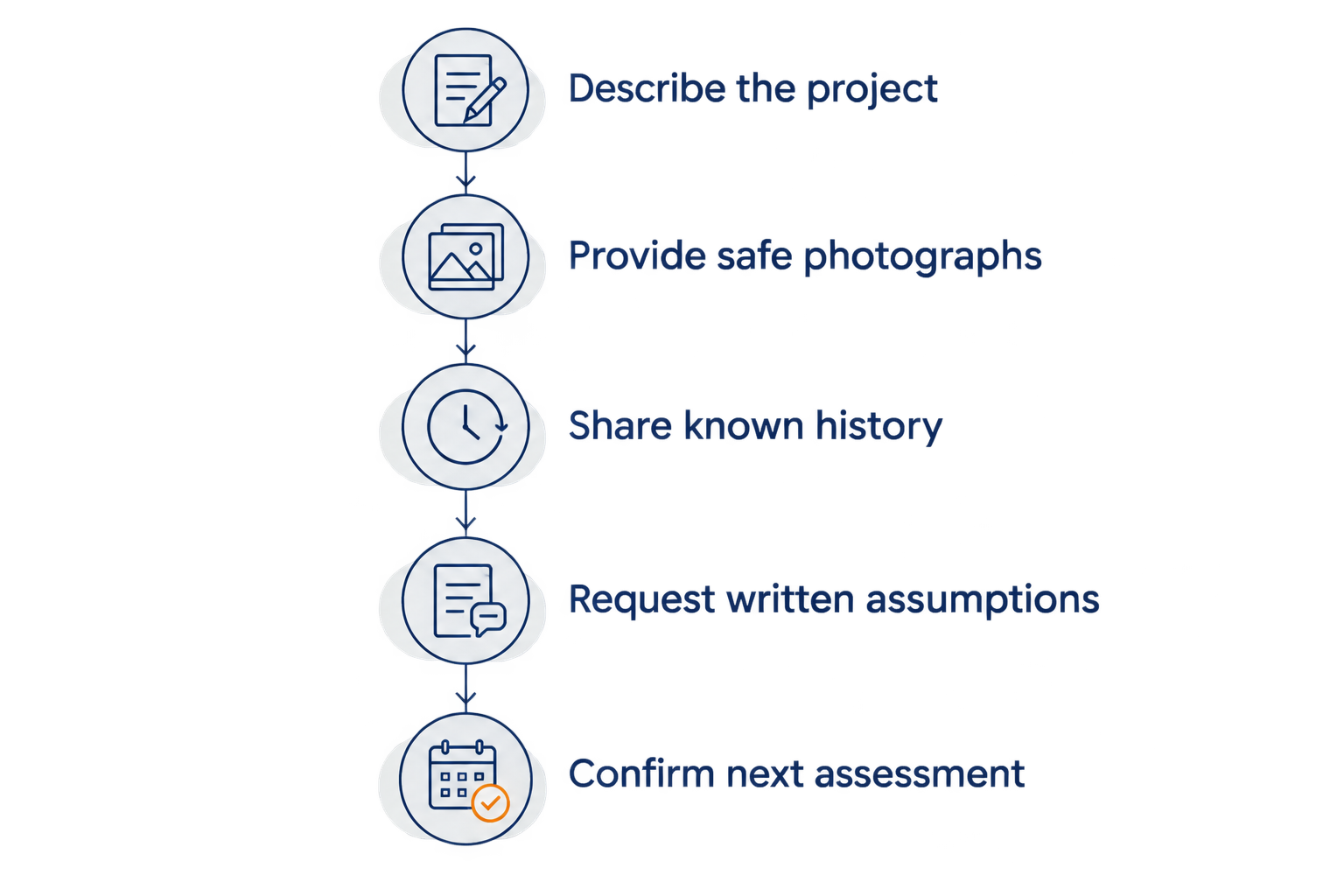
Use these 5 steps to make the first conversation productive without treating it as a substitute for a physical assessment.
- Describe the project. State that you are planning a homeowner-paid residential roof replacement. Identify the house, attached structures, and any roof areas outside the project.
- Provide safe photographs. Send available ground-level views showing each side of the house and visible roof features. Do not climb onto the roof to complete an estimate request.
- Share known history. Provide records you already have about the existing covering, additions, prior roof work, or attic changes. Label uncertain information as uncertain.
- Request written assumptions. Ask the contractor to identify the material scope, tear-off assumptions, flashing approach, and concealed-work procedure.
- Confirm the next assessment. Ask what needs an on-site visit, what remains hidden until tear-off, and when the written proposal will be updated.
For your 2026 planning file, keep photographs and contractor responses together. That makes it easier to compare the same project boundaries across proposals instead of relying on memory.
What should the written estimate include?
Before you treat a 2026 proposal as ready for a signing decision, check these 6 scope fields. Each should say what is included, what is excluded, or what needs further assessment.
Project boundaries
Identify every roof area included in the replacement. An attached garage, porch roof, or addition should not disappear into an ambiguous description of the house.
Removal and disposal
State whether the project includes tear-off, what existing layers the proposal assumes, and how roofing debris will be handled. Ask what happens if the existing assembly differs from that assumption.
Replacement materials
Identify the proposed roof covering and supporting materials. Underlayment is the layer beneath the roof covering; its scope should not be confused with replacing damaged wood decking.
Flashing details
Flashing directs water away from vulnerable roof connections. Step flashing consists of individual metal pieces installed where a sloped shingle roof meets a wall; ask whether existing pieces will be replaced, inspected for reuse, or excluded.
Ventilation and accessories
Clarify the treatment of vents and other roof penetrations. If ventilation changes are proposed, ask how intake and exhaust paths will be assessed rather than accepting a recommendation based only on exterior appearance.
Concealed work and approval
Define how additional decking or other concealed work will be documented and approved. The proposal should explain who contacts you and what written authorization is required before the additional work proceeds.
Can a remote roof estimate be accurate?
A remote roof estimate can describe the planned replacement scope accurately when the measurements and assumptions are correct. It cannot verify concealed physical conditions from imagery alone.
Ask a more useful question than whether the estimate is accurate: Which parts are confirmed, and which parts are conditional? A contractor should be able to answer that without treating reasonable questions as an objection to the project.
Do I need an inspection before signing a roof replacement contract?
For a homeowner-paid roof replacement, request an on-site assessment before committing to a scope that depends on unverified conditions. This is a practical decision safeguard, not a claim that every contract legally requires an inspection.
If you choose to proceed before a visit, the agreement needs especially clear assumptions and a written change-approval process. Do not treat a remote measurement report as evidence that the decking, flashing, and attic have been physically evaluated.
What should I ask before requesting an inspection?
Ask what the visit covers, whether attic access is requested, and what written findings or proposal changes will follow. Also ask who confirms the appointment and whether you need to be present.
Prescott Roofing is a fit for Southern New Hampshire homeowners seeking residential roof replacement. Use the inspection conversation to establish the same scope expectations described here; do not assume a particular inspection method or deliverable without confirming it.
Request a roof replacement inspection
Describe your project and ask about inspection arrangements. Confirm your appointment directly.
FAQ
Can I get a roof replacement estimate using only my address?
An address can support a preliminary estimate when usable aerial measurements are available. It does not establish concealed decking condition, flashing condition, or the full installation scope.
Is a satellite roof measurement the same as an inspection?
No. A satellite roof measurement describes visible dimensions and geometry, while an inspection examines accessible physical conditions. Neither reveals every condition beneath existing shingles.
Should I send roof photos before an inspection?
Yes, available ground-level photographs can help explain your project and identify visible roof features. Do not climb onto the roof to gather photographs for an estimate.
Can an in-person inspection find every decking problem?
No. Existing roof materials conceal parts of the decking, even during an on-site inspection. Ask how findings after tear-off will be documented and submitted for your approval.
What should a remote roof replacement estimate exclude clearly?
A remote estimate should clearly identify work not included and conditions not verified. Pay particular attention to decking, flashing, ventilation changes, and roof areas outside the replacement scope.
Can Prescott Roofing help with a residential roof replacement?
Prescott Roofing offers residential roof replacement for homeowners in Southern New Hampshire and Northern Massachusetts. Request an inspection and confirm its scope and appointment details directly.
Does requesting a roofing inspection mean it is booked?
No. Requesting an inspection starts the scheduling conversation; it does not confirm an appointment. Confirm the date, access arrangements, and whether you need to be present.
One last thing
Before signing a 2026 roof replacement agreement, ask the contractor to mark each important item as confirmed, assumed, or excluded. This simple distinction exposes the gap between measuring a roof and taking responsibility for a defined scope.
Keep that marked-up document with the agreement. If a later discussion changes the work, ask for the change in writing rather than relying on a phone conversation.