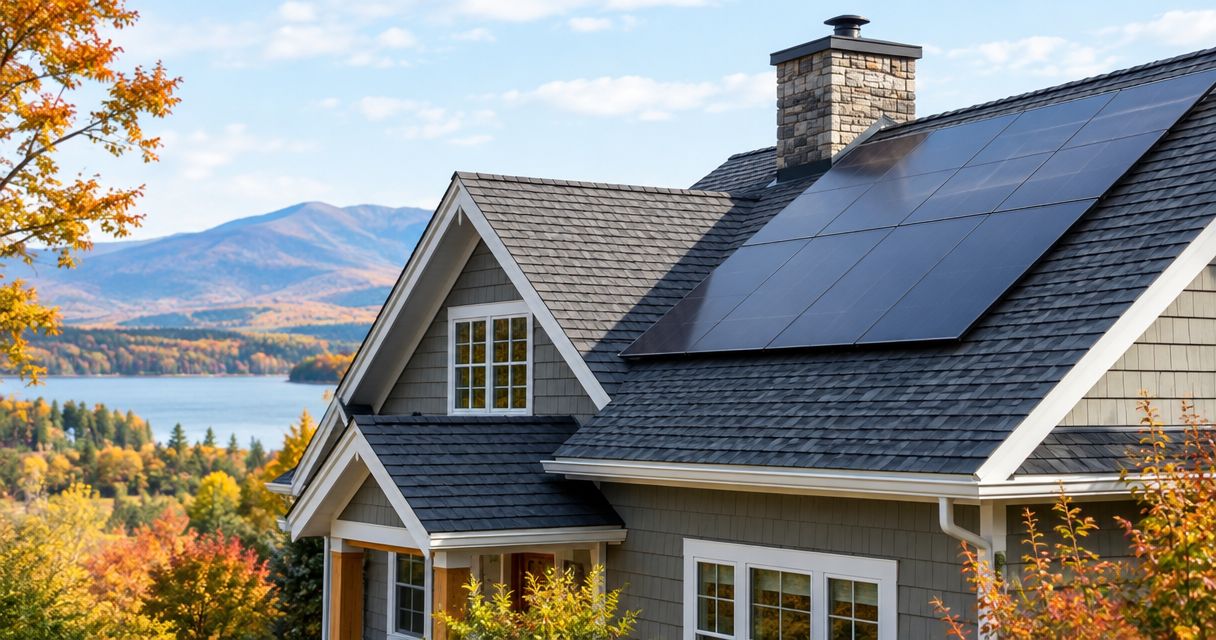
Best overall for a conventional pitched NH home: solar-reflective architectural asphalt shingles. Best for a metal roof replacement: reflective standing-seam metal; best for a low-slope roof section: a reflective TPO membrane. This 2026 guide compares where each material belongs, what limits its energy benefit, and what your replacement estimate should include.
- The best energy efficient roofing materials for NH homes depend on roof slope, reflective ratings, and attic conditions.
- Solar-reflective architectural asphalt shingles are the default shortlist for conventional pitched roofs, not a guaranteed energy-saving upgrade.
- Reflective standing-seam metal suits homeowners choosing metal; reflective TPO belongs on compatible low-slope roof sections.
- Prescott Roofing serves homeowners planning residential roof replacements in Southern New Hampshire and Northern Massachusetts.
Why this matters in New Hampshire
A reflective roof reduces absorbed sunlight; it does not replace attic insulation or air sealing. New Hampshire homeowners need to consider both summer cooling and winter heating rather than treating a cooler roof surface as proof of lower annual energy use.
Prescott Roofing is a residential roof replacement option for Southern New Hampshire homeowners. Before choosing a material, ask for an inspection that separates roof-covering decisions from attic problems and identifies which work belongs in the replacement estimate.
A roof replacement opens a practical opportunity to inspect the roof deck, flashing, and ventilation details. It does not automatically include insulation or air sealing. Get those boundaries in writing before comparing proposals.
What makes the best energy-efficient roofing materials?
Judge these materials against the same criteria. A familiar material name or pale color is not enough to establish energy performance.
- Product-specific reflectance: Solar reflectance describes how much incoming sunlight a surface reflects. Ask for documentation for the exact product and color.
- Thermal emittance: This describes how readily a surface releases heat. Read it alongside reflectance, not as a substitute for it.
- Roof-slope compatibility: The covering must suit the measured pitch and the manufacturer's installation requirements.
- Attic compatibility: Insulation, air leakage, and the roof's ventilation design affect the building's thermal performance independently of shingle color.
- Complete installation scope: Deck preparation, underlayment, flashing, and transitions belong in the comparison. A reflective surface cannot correct poor water-management details.
- Local energy trade-offs: Reduced summer heat absorption does not establish a net annual benefit in a heating climate. Treat savings claims as claims requiring evidence.
Energy-efficient roofing materials at a glance
These 2026 recommendations rank materials by their fit for a residential replacement project—not by an unsupported promise of energy savings.
| Material | Best for | Standout feature | Main advantage | Key limitation |
|---|---|---|---|---|
| Solar-reflective architectural asphalt shingles | Conventional pitched homes retaining a shingle appearance | Reflective granules in documented product-and-color combinations | Keeps the familiar asphalt-shingle roof format | Reflectance varies; ordinary light-colored shingles are not automatically equivalent |
| Reflective standing-seam metal | Homeowners already choosing a metal roof replacement | Reflective finish on panels with raised seams | Offers a reflective surface within a metal roofing system | Finish, panel design, attachment, and detailing all require review |
| Reflective TPO membrane | Compatible low-slope additions and roof sections | Reflective single-ply membrane with heat-welded seams | Fits roof geometry unsuitable for shingles | Requires membrane-specific drainage, attachment, and transition details |
1. Reflective asphalt shingles: best for conventional pitched homes
Solar-reflective architectural asphalt shingles use granules designed to reflect more solar energy than a comparable conventional surface. They retain the layered appearance homeowners associate with architectural shingles. Performance depends on the exact shingle and color—not merely the word architectural.
Best for: Homeowners replacing a pitched asphalt roof who want to compare a reflective option without switching roofing systems.
Reflective asphalt shingle pros
- Keeps a familiar shingle appearance on a conventional residential roof.
- Lets you compare reflective and conventional products within the same general roof-covering category.
- Offers product-specific reflectance information when the manufacturer publishes or rates the selected combination.
Reflective asphalt shingle cons
- A color name or sample board does not establish reflective performance.
- A reflective shingle does not correct missing insulation or air leakage from living space.
- Reduced solar heat absorption does not prove lower annual energy use in New Hampshire.
For a 2026 replacement estimate, require the manufacturer, product line, and color in writing. If reflectance is part of the recommendation, request the corresponding technical data. Do not accept a rating for a different color as evidence for your selection.
Keep the rest of the scope comparable. A proposal with new flashing and defined deck-repair terms is not equivalent to one that leaves those items unresolved.
Verdict: Buy for a conventional pitched roof when the selected product fits the roof and its reflective performance is documented.
2. Reflective standing-seam metal: best for a metal replacement
Standing-seam metal roofing uses panels joined along raised seams. A reflective finish can reduce solar absorption, but metal alone is not proof of a cool roof. The panel's finish and published performance matter.
Best for: Homeowners who want a metal roof and are prepared to evaluate its attachment, expansion details, and transitions as part of the replacement.
Reflective standing-seam metal pros
- Provides a reflective-finish option for homeowners choosing metal rather than shingles.
- Uses raised seams to connect adjacent panels.
- Makes finish selection an explicit part of the roof specification.
Reflective standing-seam metal cons
- An unspecified metal panel or paint color does not establish energy performance.
- Thermal movement requires suitable attachment and detailing.
- Connections around chimneys, walls, and adjoining roof materials require careful planning.
Ask the contractor to identify the panel profile, finish, attachment method, and minimum permitted slope. Different standing-seam systems have different installation requirements; the category name does not settle those questions.
For energy comparisons, distinguish initial ratings from aged ratings when both are published. An initial rating describes a new surface, while an aged rating helps you assess performance after weather exposure. Compare equivalent measures rather than selecting whichever figure looks stronger.
Verdict: Buy when you already prefer metal and the proposal specifies both the reflective finish and the complete panel system.
3. Reflective TPO: best for compatible low-slope roof sections
TPO, or thermoplastic polyolefin, is a single-ply roofing membrane with heat-welded seams. Reflective TPO is a candidate for compatible low-slope residential sections, such as an addition where shingles do not suit the pitch. It is not the default substitute for a visible, steep shingle roof.
Best for: Homeowners replacing a low-slope roof section that needs a membrane system rather than shingles.
Reflective TPO pros
- Provides a reflective roof surface for compatible low-slope applications.
- Uses heat-welded seams between membrane sheets.
- Allows drainage and transitions to be addressed as part of a defined membrane assembly.
Reflective TPO cons
- A reflective membrane does not fix standing water caused by inadequate drainage design.
- Penetrations and edges need membrane-specific details.
- A low-slope section connected to a shingle roof needs a clearly specified transition between systems.
Ask whether the estimate includes insulation, tapered insulation where needed for drainage, edge metal, and connections to adjacent walls or roofs. Tapered insulation changes thickness to help create drainage slope; ordinary flat insulation does not perform that same job.
Do not select TPO because its surface looks brighter than shingles. Start with roof geometry, then evaluate the membrane assembly and its reflective properties.
Verdict: Buy for a compatible low-slope section with a complete drainage and transition plan; skip it as a default steep-roof replacement.
How these materials are ranked
The ranking puts roof suitability before reflectance. Reflective architectural shingles take the default slot for a conventional pitched shingle replacement; standing-seam metal serves homeowners choosing metal; reflective TPO serves compatible low-slope sections.
The criteria are product documentation, slope compatibility, attic conditions, and installation scope. This is a decision guide, not a laboratory performance comparison. No material receives a savings estimate or a claimed payback period.
Check the roof assembly before choosing the surface
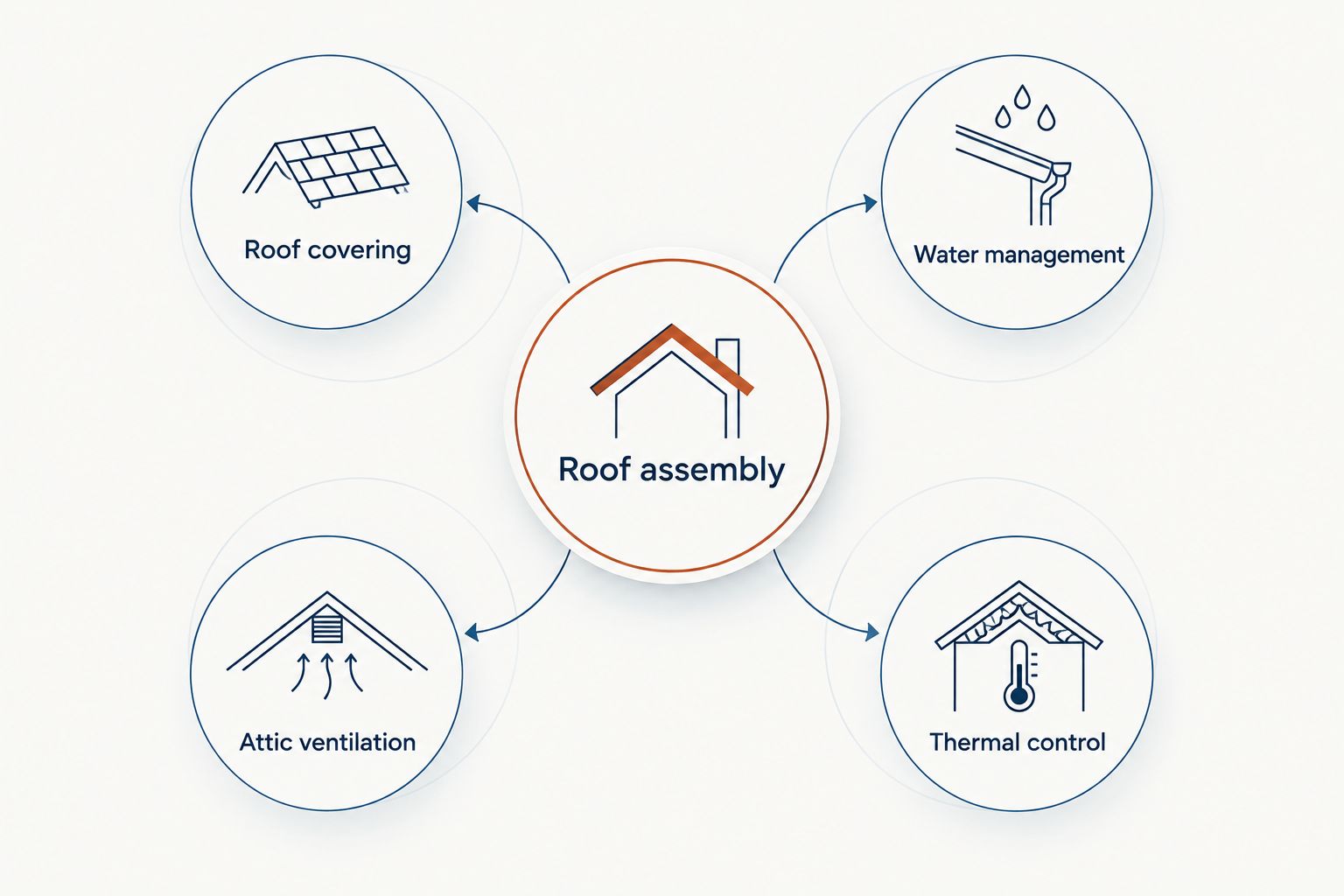
A useful 2026 inspection separates four connected subjects: roof covering, water management, attic ventilation, and thermal control. Treating them as one vague roofing package makes omissions harder to spot.
- Roof covering: Identify the exact material, product, color, and permitted slope.
- Water management: Review underlayment, flashing, edges, valleys, and roof-to-wall connections.
- Attic ventilation: Identify the existing intake and exhaust arrangement where the roof assembly is vented. Do not add vents without understanding the assembly.
- Thermal control: Identify insulation gaps and air leakage separately from the exterior roof replacement.
Insulation slows heat transfer; air sealing limits air movement through gaps. A reflective roof addresses absorbed solar energy at the exterior surface. Those functions differ, so your estimate should not present one as a replacement for another.
What your replacement estimate should include
Ask Prescott Roofing to separate the residential roof replacement scope from any proposed attic work. An estimate should explain what gets removed, what gets installed, and what triggers additional work. Use the same checklist for every contractor you consider.
Material and quantity
The proposal should identify the roof covering and measured area. Roofers often use a square, meaning 100 square feet of roof area. Ask how the material quantity accounts for cuts, valleys, and waste rather than comparing bundle or panel counts alone.
Pitch and installation requirements
A 2:12 pitch means 2 inches of rise for every 12 inches of horizontal run. Asphalt shingles generally require at least that slope, and roofs below 4:12 require special underlayment treatment under commonly adopted residential-code provisions. The applicable code and selected manufacturer's instructions govern your project.
Tear-off and deck repairs
Tear-off means removing the existing roof covering. Ask which layers will be removed, how exposed decking will be inspected, and how additional deck repairs require your approval. Hidden damage needs a defined process, not an open-ended promise.
Flashing and transitions
Flashing directs water away from joints and penetrations. Step flashing uses individual pieces along a roof-to-sidewall intersection. The estimate should state what flashing gets replaced, what remains, and how the contractor will handle transitions between different roof coverings.
Energy documentation and exclusions
Request technical documentation for any reflective-performance claim. Identify whether insulation, air sealing, ventilation changes, permits, debris removal, and final cleanup are included or excluded. Never assume a roof replacement includes every attic improvement discussed during the inspection.
Request a roof replacement inspection
Discuss material choices, attic concerns, and the scope of your homeowner-paid replacement.
Which energy-efficient roofing material should you choose?
For a conventional pitched NH home, start by comparing documented solar-reflective architectural shingles with a conventional shingle specification. Choose reflective standing-seam metal if you prefer a metal replacement. Use reflective TPO where the roof geometry calls for a compatible low-slope membrane.
For your 2026 decision, reject a material recommendation that skips slope, attic conditions, or flashing. Requesting an inspection starts the evaluation; it does not mean an appointment is booked. Confirm the appointment and the areas to be inspected before the visit.
FAQ
What's the best energy-efficient roofing material for an NH home?
Solar-reflective architectural asphalt shingles are the default shortlist for a conventional pitched shingle replacement. Reflective standing-seam metal fits homeowners choosing metal, while reflective TPO suits compatible low-slope sections. The roof's geometry and attic conditions come first.
Will a reflective roof lower my winter heating bill?
A reflective roof is not a winter heating upgrade. It reduces absorbed sunlight, while insulation and air sealing address different sources of heat transfer and heat loss. Evaluate annual heating and cooling effects rather than assuming savings.
Is a metal roof automatically more energy efficient than shingles?
No, metal alone does not establish better energy performance than shingles. Compare the exact finishes, colors, and published reflective properties, along with the roof assembly beneath them.
Are lighter roof colors always the best choice?
No, color alone is not a complete measure of roof energy performance. Request product-specific reflectance and emittance documentation, then consider the home's heating and cooling needs and the roof's appearance.
Should I replace attic insulation when I replace my roof?
Assess attic insulation during replacement planning, but do not assume it needs replacement or is included in the roofing contract. Ask the inspection to identify insulation gaps and air leakage, then obtain a separate written scope for any recommended work.
Can I install reflective shingles on a low-slope addition?
Only if the measured slope and selected shingle's installation requirements permit it. A lower-slope section can require special underlayment or a different roof-covering system. Have the contractor document the pitch before selecting materials.
What should I ask Prescott Roofing before choosing an energy-efficient roof?
Ask Prescott Roofing to identify the roof slope, explain material choices, and separate roof replacement work from attic improvements. Request the exact product and color, supporting reflective-performance documentation, and written inclusions and exclusions.
One last thing
Put the exact roof color in the signed scope—not just the product line. Reflective properties can vary within a roofing collection. For a 2026 replacement, keeping the selected color and its technical documentation together makes the energy claim specific enough to check.