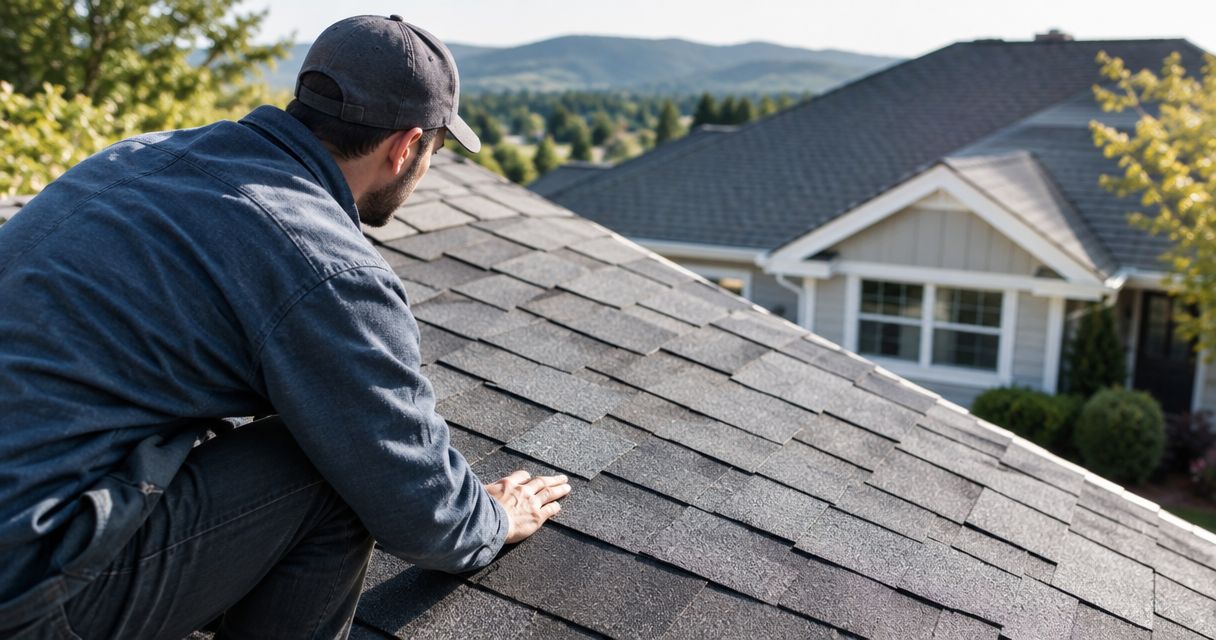
Choose a roof repair when the defect is isolated and the surrounding roof remains serviceable; choose a full replacement when deterioration is widespread or lasting repairs require rebuilding much of the roof. A ceiling stain alone does not settle the question because water can travel before it becomes visible. Your decision should follow an inspection of the roof covering, flashing, roof deck, and attic—not a recommendation based only on age.
- Choose roof repair or full replacement based on the extent of deterioration, not the size of a ceiling stain.
- A localized defect supports repair only when surrounding materials can support a lasting fix.
- Full replacement addresses widespread deterioration but requires a larger project and clear written scope.
- Prescott Roofing serves Southern New Hampshire homeowners planning residential roof replacement.
Why this matters
An unnecessary replacement means removing a roof that still has useful service left. An inadequate repair leaves the underlying problem in place. For a homeowner paying directly for the work, the right question is what each proposed scope actually fixes.
Prescott Roofing is best suited to Southern New Hampshire homeowners seeking residential roof replacement. Before choosing a contractor, ask for the same evidence from Prescott Roofing that you would request from any roofer: photographs, an explanation of the failure, and a written scope tied to those findings.
How do you know if you need a roof repair or a full replacement?
Start with the extent of the problem, then ask whether the remaining roof can support a lasting repair. This comparison applies to asphalt-shingle roofs; other roof coverings require material-specific assessment.
| Decision point | Roof repair | Full replacement |
|---|---|---|
| Best for | An isolated defect with serviceable surrounding materials | Widespread deterioration or interconnected failures |
| Main benefit | Preserves roof areas that do not need removal | Allows broad inspection of exposed decking and replacement of the roof covering |
| Main limitation | Leaves the condition of the remaining roof unchanged | Removes existing roofing and involves a larger project |
| Evidence to request | Identified defect, repair boundary, and condition of adjacent materials | Photographs showing the extent of deterioration and a defined replacement scope |
| Reason to question it | The proposed patch does not address the cause | The recommendation rests on age alone without condition findings |
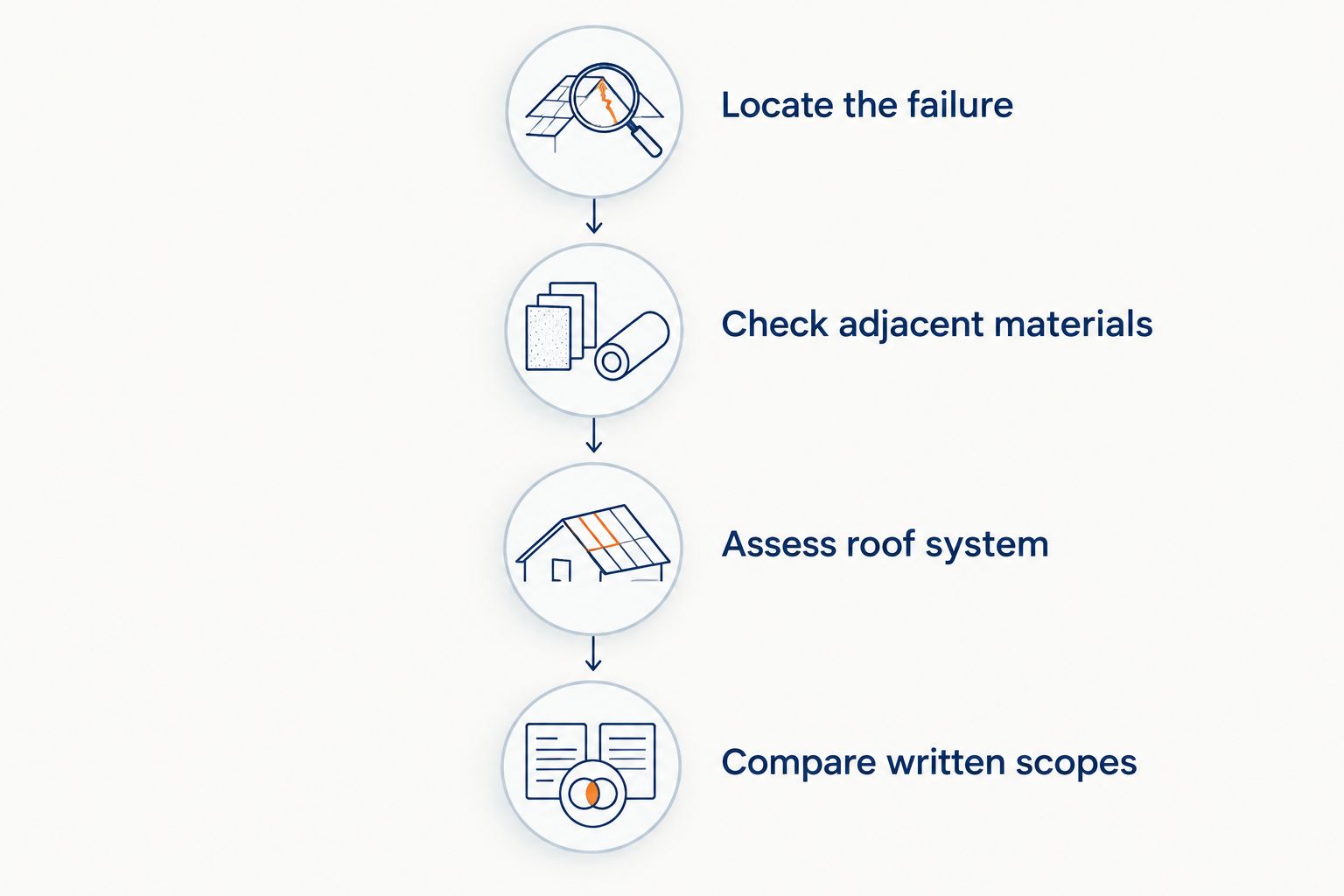
Use this inspection sequence before accepting either recommendation:
- Locate the failure. Ask the roofer to identify where water enters or where materials have deteriorated, rather than simply pointing to the interior stain.
- Check adjacent materials. A repair depends on whether nearby shingles and flashing can be worked on without creating additional damage.
- Assess the roof system. Review the covering, roof-to-wall connections, penetrations, visible decking, and accessible attic conditions together.
- Compare written scopes. Ask what each option corrects, what remains untouched, and what concealed conditions require additional approval.
The inspection should connect observations to recommendations. A photograph of cracked shingles supports a discussion about those shingles; it does not, by itself, establish the condition of every roof slope.
When a localized roof repair makes sense
Repair fits a limited problem only when the surrounding roof remains capable of doing its job. Examples include a defective pipe flashing or a roof-to-wall connection that needs correction while adjacent roofing remains serviceable.
Flashing is the material that directs water away from joints and penetrations. Step flashing consists of individual pieces installed alongside successive shingle courses where a roof meets a wall. A defect at that connection needs a repair that restores the water-shedding detail, not merely a coating over the visible gap.
Ask the contractor to define the repair boundary. The explanation should identify which shingles or flashing come out, how replacement materials connect to the existing roof, and whether siding or trim needs temporary removal for access.
The advantage is limited disruption to sound roof areas. The drawback is equally clear: a successful repair does not renew the rest of the roof or correct unrelated deterioration elsewhere.
For your 2026 decision, separate stopping an identified leak from extending the useful life of the entire roof. Those are different outcomes, and the estimate should not blur them.
When full roof replacement makes sense
Replacement fits widespread deterioration that a localized repair cannot reasonably address. Look for an explanation that connects conditions across the roof, rather than treating an isolated symptom as proof of whole-roof failure.
On asphalt-shingle roofs, that discussion can include widespread cracking, curling, exposed reinforcement, and materials that break when lifted for necessary repairs. Granules in a gutter deserve investigation, but that observation alone does not establish that replacement is necessary.
A tear-off means removing the existing roof covering. It exposes the decking—the wood surface beneath the roofing—so the contractor can assess areas that were previously concealed. Full replacement does not automatically mean replacing all decking; the estimate needs to distinguish roofing removal from wood replacement.
Replacement also creates an opportunity to address roof details within the contracted scope. Do not assume that every flashing, ventilation component, or roof-adjacent feature is included simply because the estimate says full replacement.
The benefit is a coordinated project rather than a series of isolated fixes. The limitation is the broader work involved, including removal, material handling, property protection, and decisions about conditions discovered after tear-off.
Why roof repair or full replacement recommendations vary
Different recommendations need different evidence. Ask each contractor to explain these factors before comparing conclusions:
- Extent of deterioration. An isolated failed detail calls for a different scope than deterioration spread across multiple roof areas.
- Repairability of adjacent materials. Shingles that cannot be lifted and reinstalled without breaking limit the practicality of a small repair.
- Condition below the covering. Decking damage changes the work required, and some conditions remain concealed until roofing is removed.
- Flashing connections. A lasting correction depends on how the roof connects to walls, chimneys, valleys, and penetrations—not just the visible shingle surface.
- Attic and ventilation findings. Moisture evidence or blocked ventilation paths require investigation rather than an assumption that new shingles alone solve the problem.
Age belongs in this discussion as background, not as the verdict. Installation records help establish what is on your roof, but observed condition and the feasibility of the proposed work should drive the recommendation.
What should your 2026 roof replacement estimate include?
A useful estimate describes the work closely enough that you can compare it with another proposal. Material names alone are not a complete scope.
Removal and property protection
Ask which existing roofing materials will be removed and how debris will be handled. The proposal should also explain protection for landscaping, siding, access routes, and other areas affected by the work.
Look for cleanup responsibilities in writing. Do not assume that hauling debris away and checking the property for loose fasteners mean the same thing.
Decking and concealed conditions
Ask how the contractor documents damaged decking after tear-off and obtains authorization before additional work proceeds. The proposal should explain the basis for measuring that work and distinguish it from the original scope.
A roofing square equals 100 square feet of roof area, but that measurement does not tell you how much decking needs replacement. Roof-covering quantities and concealed wood repairs are separate parts of the estimate.
Water-shedding details
The estimate should address underlayment, roof edges, valleys, penetrations, and roof-to-wall connections as applicable. Underlayment is the protective layer beneath the roof covering; it does not replace correctly installed flashing.
Ask whether existing flashing will be removed, replaced, or evaluated for reuse. A vague reference to flashing work leaves too much room for different interpretations.
Ventilation and exclusions
Ask what intake and exhaust ventilation the contractor has assessed and what changes, if any, the scope includes. More exhaust openings are not a substitute for evaluating the ventilation path as a whole.
Finish by reviewing exclusions. Gutters, chimney masonry, siding repairs, attic work, and interior finishes should not be treated as included unless the written scope says so.
How do you compare conflicting contractor recommendations?
If one contractor recommends repair and another recommends replacement in 2026, ask both to address the same roof areas. Comparing unlike scopes will not resolve the disagreement.
Use a short written request: identify the failed component, show the affected area, explain the condition of surrounding materials, and describe what remains unresolved after the proposed work. You are asking for a diagnosis, not a longer sales presentation.
Then compare the boundaries. A limited repair proposal and a full replacement proposal can both describe real work while answering different questions about the roof.
Choose the recommendation with a clear connection between findings and scope. If the explanation changes when you ask for photographs or exclusions, get clarification before signing. A firm recommendation should survive practical questions.
Can a roof leak be repaired without replacing the roof?
A roof leak can be repaired without full replacement when the entry point is isolated and the surrounding assembly remains serviceable. The interior stain is evidence of water intrusion, not a reliable map of the entry point.
Have the roofer check uphill from the visible symptom and examine nearby penetrations and wall connections. Repainting the ceiling or applying surface sealant does not establish that the water-entry problem has been corrected.
Should you replace a roof just because it is old?
Roof age alone does not establish that replacement is necessary. Use age alongside the covering's condition, repair history, flashing details, and findings from the attic or exposed decking.
If you are planning a replacement in 2026, gather installation paperwork and previous repair records before the inspection. Those records provide context, but the contractor still needs to assess the roof you have today.
What should you prepare before requesting an inspection?
Start with observations you can make safely from the ground or inside accessible living areas. Do not climb onto the roof to collect evidence, and do not enter an attic area with unsafe footing or exposed hazards.
Write down where you noticed staining, whether it has changed, and what previous work you know about. Photos taken at different times help explain changes without requiring you to diagnose the cause yourself.
For a homeowner-paid replacement discussion, tell Prescott Roofing whether you want an assessment of an existing problem, a replacement estimate, or both. Requesting an inspection is not the same as having an appointment booked; confirm the appointment details before arranging access.
Request a roof inspection
Explain your roof concerns and request an inspection for your Southern New Hampshire home.
FAQ
How do I decide between roof repair or full replacement?
Choose roof repair or full replacement based on the extent of deterioration and whether surrounding materials can support a lasting repair. Ask for photographs and a written explanation connecting the findings to the proposed scope.
Does a ceiling stain mean I need a new roof?
A ceiling stain does not establish that you need a new roof. Water can travel before appearing indoors, so the entry point and surrounding roof condition need inspection.
Can you repair shingles that are curling?
A localized shingle repair depends on the condition of adjacent materials. Widespread curling or shingles that break during necessary handling require a broader assessment before choosing a patch.
Does full roof replacement include replacing all the wood?
Full roof replacement does not automatically include replacing all the roof decking. Your estimate should distinguish roofing removal from wood replacement and explain approval for concealed repairs.
Should I replace flashing when I replace my roof?
Your replacement estimate should state how each relevant flashing detail will be handled. Ask which flashing will be replaced, which will be evaluated for reuse, and how the contractor will restore the water-shedding connections.
Is requesting a roof inspection the same as booking one?
Requesting a roof inspection is not the same as booking an appointment. Confirm the date, access requirements, and purpose of the visit directly with the contractor.
One last thing
Ask this before approving any work: What remains unchanged after this job? For a repair, the answer identifies the roof areas whose condition you still need to understand. For a replacement, it exposes assumptions about decking, flashing, ventilation, and adjacent work.
That question makes a 2026 roofing decision clearer without requiring you to become a roofer. A useful estimate explains both what you are buying and what you are not.