
A roof replacement estimate is fair when it covers the work your roof needs, identifies the materials and installation details, and compares reasonably with other written proposals for the same scope. For your 2026 replacement, check exclusions and concealed deck repair terms before judging the total: an incomplete estimate is not a reliable bargain.
- Is my roof replacement estimate fair? Compare matching scopes before comparing totals.
- Prescott Roofing serves Southern New Hampshire homeowners considering residential roof replacement.
- A roof replacement estimate should explain tear-off, materials, flashing, ventilation, cleanup, and exclusions.
- Resolve deck repair allowances and change-order approval before signing a roofing contract.
How do you know if a roof replacement estimate is fair?
A fair estimate lets you identify what you are buying, what remains uncertain, and who pays when the scope changes. Compare written details rather than judging the total in isolation.
Use this checklist alongside the guide to what a roof replacement estimate includes. Ask each contractor to clarify blank or general entries before you compare proposals.
| Estimate item | What a clear proposal explains | What needs clarification |
|---|---|---|
| Roof coverage | Roof sections and measured area included | Whether a porch, addition, or garage is excluded |
| Tear-off | Existing roofing removal and disposal | Whether the proposal leaves existing layers in place |
| Materials | Named roofing material and supporting components | Descriptions such as standard shingles without identification |
| Deck repairs | How concealed damage is documented and authorized | Open-ended repairs without an approval process |
| Flashing | Locations receiving replacement or reuse | Whether roof-to-wall and chimney details are included |
| Ventilation | Existing conditions and proposed changes | A general ventilation allowance without a defined scope |
| Site work | Property protection, debris removal, and cleanup | Responsibilities left entirely unstated |
| Contract terms | Payment stages, exclusions, and change procedures | Verbal promises absent from the written agreement |
An estimate does not need a separate charge beside every component to be useful. It does need enough detail to show that competing contractors are proposing equivalent work.
Why this matters before you choose a roofer
Your roof replacement is a construction project, not just a delivery of shingles. The written scope determines whether removal, water-management details, concealed repairs, and cleanup belong to the agreed work or become separate discussions later.
For a Southern New Hampshire homeowner comparing 2026 proposals, the useful question is not simply whether one total looks reasonable. Ask whether another contractor could read the proposal and understand the same job.
Do not confuse a detailed estimate with a complete estimate. A long material list still leaves gaps if it says nothing about flashing reuse, deck repairs, or work around an attached addition.
Compare estimates using the same scope
The best comparison starts with the same roof sections and the same replacement approach. Otherwise, you are comparing different jobs.
Match the roof area and measurement units
A roofing square equals 100 square feet of roof area, equivalent to an area 10 feet by 10 feet. It measures roof surface, not your home's interior floor area.
A 2026 estimate expressed in roofing squares cannot be compared directly with a proposal listing only the home's floor area. Ask contractors to identify measured roof area separately from the amount of material ordered.
Material orders also account for cuts and layout. If quantities differ, ask what explains the difference rather than assuming that the larger quantity proves waste or the smaller quantity proves efficiency.
Match the removal and installation plan
Tear-off means removing existing roofing before installing the replacement. Ask which layers and roof sections the contractor plans to remove, how debris leaves the property, and what happens after the decking becomes visible.
Do not treat a tear-off proposal as equivalent to an estimate that leaves existing roofing underneath. The preparation differs, so a direct comparison of totals does not establish fairness.
Match materials by name, not description
Ask for the manufacturer and product identification for the proposed roof covering. Then check the underlayment, edge components, ventilation components, and flashing scope.
Underlayment is the protective layer beneath the roof covering. A proposal that names the shingles but leaves every supporting component unspecified still needs clarification.
How should you handle different estimate formats?
An itemized estimate and a bundled estimate can both describe a clear project. Their usefulness depends on what they reveal, not how many lines appear on the page.
| Estimate format | Best for | Benefit | Limitation |
|---|---|---|---|
| Itemized proposal | Homeowners checking individual work categories | Makes inclusions and differences easier to locate | Numerous line items can still omit necessary work |
| Bundled proposal with detailed scope | Homeowners comparing complete replacement packages | Keeps the agreement readable while defining the job | Requires clear supporting descriptions and exclusions |
| Preliminary estimate | Homeowners planning before a full assessment | Establishes an initial project outline | Unresolved conditions prevent a final comparison |
Choose the proposal that makes responsibilities clear, not automatically the longest document. If a bundled proposal explains the work thoroughly, ask targeted questions instead of demanding a separate line for every fastener.
A preliminary estimate serves a different purpose. Treat it as planning information until the contractor explains which assumptions need confirmation and what turns the estimate into an agreed scope.
Why roof replacement estimates vary
Differences need an explanation tied to your roof. These factors help you separate a real scope difference from an unclear proposal:
- Roof covering and components. Different specified materials mean you are not comparing identical systems. Match the selections before evaluating the difference.
- Roof shape and details. Dormers, valleys, chimneys, and roof-to-wall intersections create work beyond covering an uninterrupted roof plane. Ask where that work appears in the estimate.
- Removal scope. The proposal should identify what existing material comes off and whether disposal is included. Different removal plans produce different jobs.
- Deck condition. Concealed wood damage is not fully visible before tear-off. Compare how contractors handle discovery, documentation, authorization, and added work.
- Ventilation and related work. An estimate that includes attic ventilation changes or related edge repairs differs from one limited to replacing the roof covering. Have each contractor mark the boundaries.
A higher total does not prove better workmanship. A lower total does not prove an omission. Require an explanation you can connect to a specific task, material, or project condition.
Check the details that affect the finished roof
Some of the most useful questions concern components you will not see clearly from the driveway. You do not need to design the roof yourself; you need the contractor to explain the proposed treatment.
Flashing: replacement or reuse?
Flashing directs water at roof intersections and penetrations. Step flashing consists of overlapping pieces installed where a sloped roof meets a wall.
Ask which flashing will be replaced and whether any existing flashing will remain. If the contractor proposes reuse, request an explanation of its condition and how that decision fits the replacement work.
An estimate that says flashing as needed leaves the decision undefined. Ask the contractor to identify the locations and the conditions that trigger additional work.
Decking: what happens after tear-off?
Decking is the wood surface supporting the roof assembly. Some conditions become visible only after the old roofing comes off, so an estimate should explain how concealed repairs are handled.
Request photographs of discovered damage and a written description of proposed repairs. Agree on the authorization process before work begins, including how the contractor will communicate with you while the roof is open.
Ventilation: what is actually changing?
A ventilation entry should describe more than adding a vent. Ask what the contractor observed, which components will change, and whether the proposed work addresses intake and exhaust paths.
If ventilation is outside the replacement scope, have that exclusion written down. You can then decide whether to address it separately instead of assuming it belongs to the roofing agreement.
How do you compare estimates without getting overwhelmed?
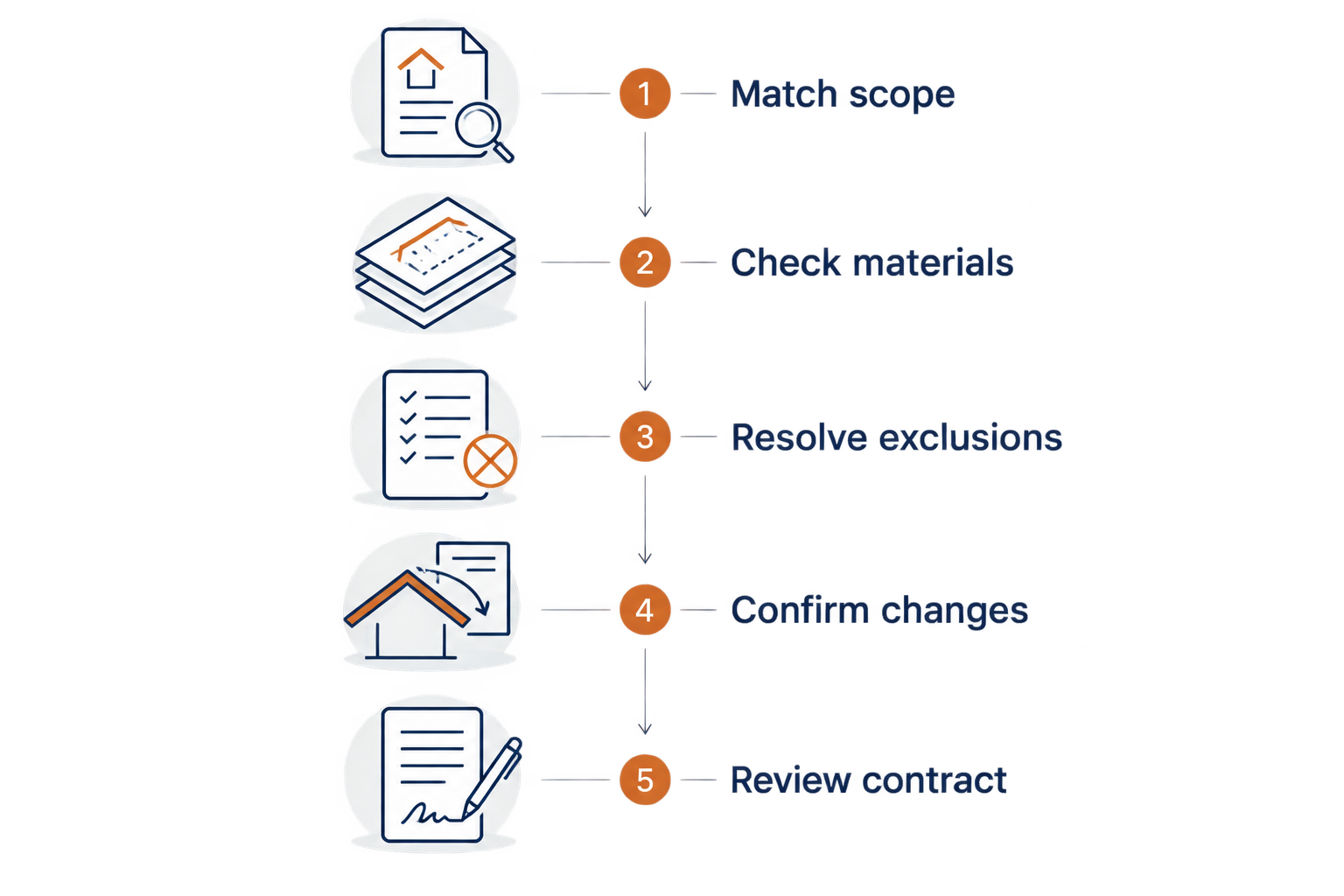
Use the same sequence for every proposal. Keep the discussion focused on unresolved differences rather than asking each roofer to defend another contractor's total.
- Match scope. Confirm roof sections, removal work, and disposal responsibilities.
- Check materials. Match the roof covering and supporting components by their written descriptions.
- Resolve exclusions. Identify omitted work and clarify deck repair assumptions.
- Confirm changes. Establish how additional work is documented and approved.
- Review contract. Check that the final agreement contains the explanations you received.
These steps separate the technical comparison from the signing decision. Complete the scope review before discussing which contractor you prefer.
Keep the written clarifications with the estimate. If a contractor answers an important question by phone, ask for that answer to appear in the revised proposal or contract rather than relying on your notes alone.
Is the lowest roof replacement estimate a bad choice?
The lowest estimate is not automatically a bad choice. It becomes difficult to judge when its scope is less clear than the alternatives.
Ask the contractor to confirm that the comparison includes the same roof sections, preparation, materials, flashing treatment, and cleanup. A clear explanation is more useful than a general assurance that everything is covered.
Do not reject a complete proposal just because it is lower, and do not accept an incomplete proposal just because it is lower. Scope comes first.
Should you ask a roofer to explain a higher estimate?
Yes. Ask the roofer to identify the specific work or materials behind the difference, using the written proposal as the reference.
For your 2026 contractor discussions, useful questions include: What does this proposal include that the other one excludes? Which existing conditions influenced the scope? What remains uncertain until removal?
A contractor does not need to criticize another company to answer those questions. You need an explanation of the proposed job, not a sales argument about the competition.
When is an estimate ready to become a contract?
An estimate is ready for a signing decision when you understand the scope, exclusions, payment obligations, and change process. Confirm who handles required permits, how scheduling is communicated, and what completion means under the agreement.
Prescott Roofing is best suited to Southern New Hampshire homeowners seeking residential roof replacement. When discussing your project, ask for explanations of the same items you would expect from any contractor: preparation, materials, flashing, decking, and cleanup.
You can request a roof replacement inspection to discuss your home's replacement needs. Submitting a request does not mean an appointment is booked; confirm the appointment details directly before making arrangements.
FAQ
Is my roof replacement estimate fair if another roofer quoted less?
A lower competing estimate does not establish whether your roof replacement estimate is fair. Compare the same roof sections, materials, removal work, flashing, exclusions, and concealed repair terms before judging the difference.
Can a roof replacement estimate be fair without being itemized?
A bundled roof replacement estimate can be fair if its written scope clearly defines the work. Separate line items help comparison, but they do not replace clear inclusions, exclusions, and change procedures.
Should my roof replacement estimate include wood repairs?
Your estimate should explain how concealed wood repairs will be handled, even when their full extent is unknown. Ask how damage will be documented and how you will authorize additional work.
What does a roofing square mean on my estimate?
A roofing square equals 100 square feet of roof area. Ask whether listed quantities describe measured roof surface or ordered material that also accounts for cuts and layout.
Is an estimate that only names the shingles detailed enough?
Naming the shingles alone does not define a complete roof replacement. Ask about removal, underlayment, flashing, ventilation, deck repairs, property protection, and cleanup.
Should I sign a roof estimate before the contractor answers my questions?
Resolve material questions before signing a roof replacement agreement. Ask the contractor to put important explanations and agreed changes into the written document.
Can I ask Prescott Roofing about a homeowner-paid roof replacement?
Prescott Roofing offers residential roof replacement for homeowners in Southern New Hampshire and Northern Massachusetts. Request an inspection and confirm the appointment directly; a submitted request is not a booked visit.
One last thing
The most revealing estimate question is often: What is not included? An exclusions list gives you something concrete to review; an assurance that everything is included still needs a defined boundary.
Before signing your 2026 agreement, ask the contractor to walk through those boundaries using your actual roof. A clear answer should leave you knowing what happens next, including what happens when concealed conditions change the job.