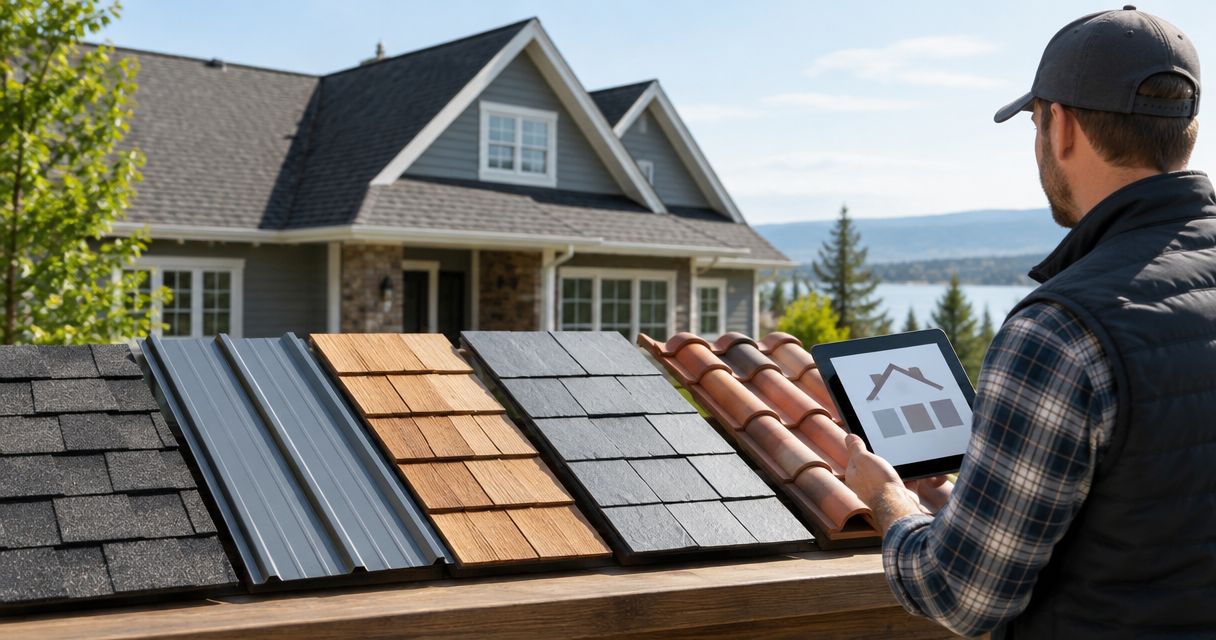
Best overall: architectural asphalt shingles. Best for a concealed-fastener metal roof: standing-seam metal. Best budget-first comparison: three-tab asphalt shingles. For NH homeowners comparing roofing materials by cost per square in 2026, start with architectural shingles, then compare alternatives against the same replacement scope—not just the roof covering.
- Best roofing materials ranked by cost per square NH: compare architectural shingles first, then evaluate alternatives against identical scope.
- One roofing square equals 100 square feet of roof surface, not living space.
- Prescott Roofing provides residential roof replacement services for homeowners in Southern New Hampshire.
- Compare tear-off, decking, flashing, underlayment, ventilation, and cleanup before choosing a roof replacement estimate.
Why this matters
A material-only comparison does not tell you what replacing your roof involves. Your estimate also needs to address removal, the wood beneath the covering, water protection, flashing, access, and disposal. Those details determine whether two proposals describe the same job.
Prescott Roofing is a residential roof replacement option for Southern New Hampshire homeowners. When you discuss a replacement with Prescott Roofing, ask for the proposed material and the supporting work to be explained separately. A recognizable shingle name does not explain how a chimney or roof-to-wall connection will be handled.
This 2026 guide ranks materials as a practical buying shortlist. It does not treat every roof as interchangeable: a straightforward gable roof and a roof with dormers, valleys, and several penetrations need different work.
What makes the best roofing material for your NH home?
Judge each option against these criteria before comparing proposals:
- Complete replacement scope: Identify what gets removed, replaced, retained, and excluded.
- Roof suitability: Confirm slope, structural support, and compatibility with the chosen roof system.
- Water management: Specify underlayment, eave protection, valleys, and flashing at walls and penetrations.
- Installation demands: Match the contractor's experience to the actual material and roof details.
- Maintenance access: Understand how future inspections and repairs will be performed.
- Appearance: Compare samples against your siding, trim, and roof shape—not a brochure house.
For a homeowner-paid replacement, keep two questions separate: which roof covering suits the house, and what work does the house need? Changing the material does not remove a deteriorated deck or solve an attic moisture problem.
Roofing materials at a glance
Read this as a budget-first decision guide, not a universal installed-cost ladder. Architectural shingles rank first as the default comparison; the remaining options serve distinct priorities. Actual proposals must use matching measurements and scope.
| Rank and material | Best for | Standout feature | Main limitation |
|---|---|---|---|
| 1. Architectural asphalt shingles | A conventional residential replacement | Layered shingle appearance and familiar installation methods | Flashing and ventilation still require separate attention |
| 2. Three-tab asphalt shingles | A simpler, flat shingle appearance | Regular, uniform roof pattern | Less dimensional appearance; not a substitute for scope savings |
| 3. Standing-seam metal | Homeowners seeking concealed-fastener panels | Raised seams and concealed attachment | Expansion, transitions, and snow shedding require careful detailing |
| 4. Synthetic slate | A slate-style appearance without natural stone | Molded units with a stone-like profile | Composition and installation requirements vary by product |
| 5. Natural slate | Homes where genuine stone is the priority | Individual natural stone roofing units | Structural review and specialist workmanship are essential |
1. Architectural shingles: best for a conventional replacement
Architectural asphalt shingles use a layered construction to create a dimensional roof surface. They are the strongest starting point for a homeowner who wants to compare a conventional replacement without changing to a specialized roof system.
Ask for the exact shingle line, not simply “architectural shingles.” The estimate should also identify starter shingles, ridge treatment, underlayment, and flashing work so you can compare the complete assembly.
Architectural asphalt shingle pros:
- Dimensional appearance suits many residential roof shapes.
- Individual shingles allow localized repair when conditions permit.
- A clearly specified assembly makes competing proposals easier to compare.
Architectural asphalt shingle cons:
- Shingles do not correct inadequate attic ventilation.
- Valleys, walls, and penetrations still depend on careful flashing.
- Product names alone do not establish installation quality.
Best for: Homeowners seeking a conventional replacement with a clearly defined scope.
Verdict: Buy when the estimate explains the complete roof assembly, not just the shingle.
2. Three-tab shingles: best for a flat, uniform appearance
Three-tab asphalt shingles create a regular pattern with a flatter appearance than architectural shingles. Include them when you prefer that look or want to understand exactly what changes between asphalt proposals.
Do not assume a simpler shingle makes every part of the replacement simpler. Tear-off, decking repairs, flashing, and disposal still need to be addressed.
Three-tab asphalt shingle pros:
- Uniform pattern provides a straightforward appearance.
- Familiar asphalt construction is easy to explain in an estimate.
- Offers a useful comparison against a dimensional shingle proposal.
Three-tab asphalt shingle cons:
- Less dimensional appearance than architectural shingles.
- Manufacturer-specific performance requirements still need review.
- Choosing the covering does not eliminate underlying roof work.
Best for: Homeowners who specifically prefer a flat, regular shingle pattern.
Verdict: Hold until a same-scope architectural shingle comparison explains the trade-off.
3. Standing-seam metal: best for concealed-fastener panels
Standing-seam metal uses long panels joined at raised seams, with concealed attachment in the roof system. It changes both the appearance of the house and the installation details compared with asphalt shingles.
Ask how the proposed system handles panel movement, valleys, chimneys, and roof-to-wall transitions. For Southern NH homes, also discuss where sliding snow would land relative to entrances, walkways, and lower roofs.
Standing-seam metal pros:
- Concealed attachment avoids exposed fasteners across the panel field.
- Long panels create a clean, continuous roof appearance.
- Panel layouts can be planned around the roof's geometry.
Standing-seam metal cons:
- Thermal movement needs appropriate attachment and detailing.
- Snow shedding needs attention above occupied areas.
- Complex roof shapes require more involved transitions.
Best for: Homeowners who want a metal roof and understand its detailing requirements.
Verdict: Buy only after panel specifications, transitions, and snow-management needs are explained.
4. Synthetic slate: best for a slate-style appearance
Synthetic slate describes manufactured roofing units designed to resemble stone slate. It is a category, not one standardized material: composition, fastening patterns, and roof requirements differ between products.
Compare the exact product rather than treating every synthetic slate roof as equivalent. Ask to see a physical sample and the installation requirements for your roof's slope and details.
Synthetic slate pros:
- Provides a stone-like profile without using natural slate units.
- Individual units create a patterned roof surface.
- Product-specific samples help you judge texture and edge detail.
Synthetic slate cons:
- Requirements vary across manufacturers and materials.
- Appearance needs evaluation beyond a small online image.
- Future repairs depend on compatible replacement units.
Best for: Homeowners who prioritize a slate-like roof and will evaluate a specific product.
Verdict: Hold until the exact material, installation method, and repair approach are documented.
5. Natural slate: best for a genuine stone roof
Natural slate roofing uses individual pieces of stone attached to the roof. It belongs on the shortlist when authentic material matters more than keeping the replacement conventional.
A slate proposal needs attention to structural support, fastening, flashing, and access for future maintenance. Do not treat it as a simple substitution for asphalt shingles.
Natural slate pros:
- Genuine stone provides natural variation in texture and appearance.
- Individual slates allow targeted replacement by a qualified specialist.
- Suits projects where retaining a traditional material is the goal.
Natural slate cons:
- Roof support must be assessed for the proposed assembly.
- Installation and repairs require slate-specific workmanship.
- Careless foot traffic can damage individual units.
Best for: Homeowners committed to genuine slate and a specialist installation.
Verdict: Wait until structural suitability and specialist workmanship are confirmed.
What does cost per square actually measure?
One roofing square equals 100 square feet of roof surface. A 10-foot by 10-foot section is one square; a hypothetical 1,000-square-foot roof surface contains 10 squares before ordering allowances. These are area conversions, not an estimate for your house.
Your home's floor area is not its measured roof area. Pitch, overhangs, attached sections, and roof geometry affect the surface being covered, while cuts and layout affect the amount ordered.
For your 2026 estimate, ask whether “per square” describes roofing material alone or a defined installed scope. Also ask whether the quantity represents measured roof area or the material order. Without those definitions, the same unit can describe different things.
Compare the complete written scope before comparing any per-square figure. A proposal that leaves out flashing replacement is not equivalent to one that includes it.
What your replacement estimate should explain
Use these five headings to organize a proposal from Prescott Roofing or any other contractor. Each heading should tell you what happens on your house, not merely name a material.
Tear-off
Identify which existing roof layers will be removed and where disposal is included. Ask how landscaping, siding, and access areas will be protected during removal.
Decking
Decking is the wood surface beneath the roof covering. The estimate should explain how damaged decking is documented and how you approve additional work after removal exposes it.
Water protection
Identify underlayment and ice-barrier locations rather than accepting “waterproofing” as a complete description. Ask how valleys, eaves, and transitions are treated for the selected roof system.
Flashing
Flashing directs water away from joints and penetrations. Step flashing uses overlapping pieces where a sloped roof meets a wall; the proposal should state what gets replaced and what, if anything, remains.
Ventilation
Ask how intake and exhaust ventilation will be assessed. New shingles do not automatically correct an unbalanced attic ventilation arrangement, and adding exhaust alone does not explain the intake path.
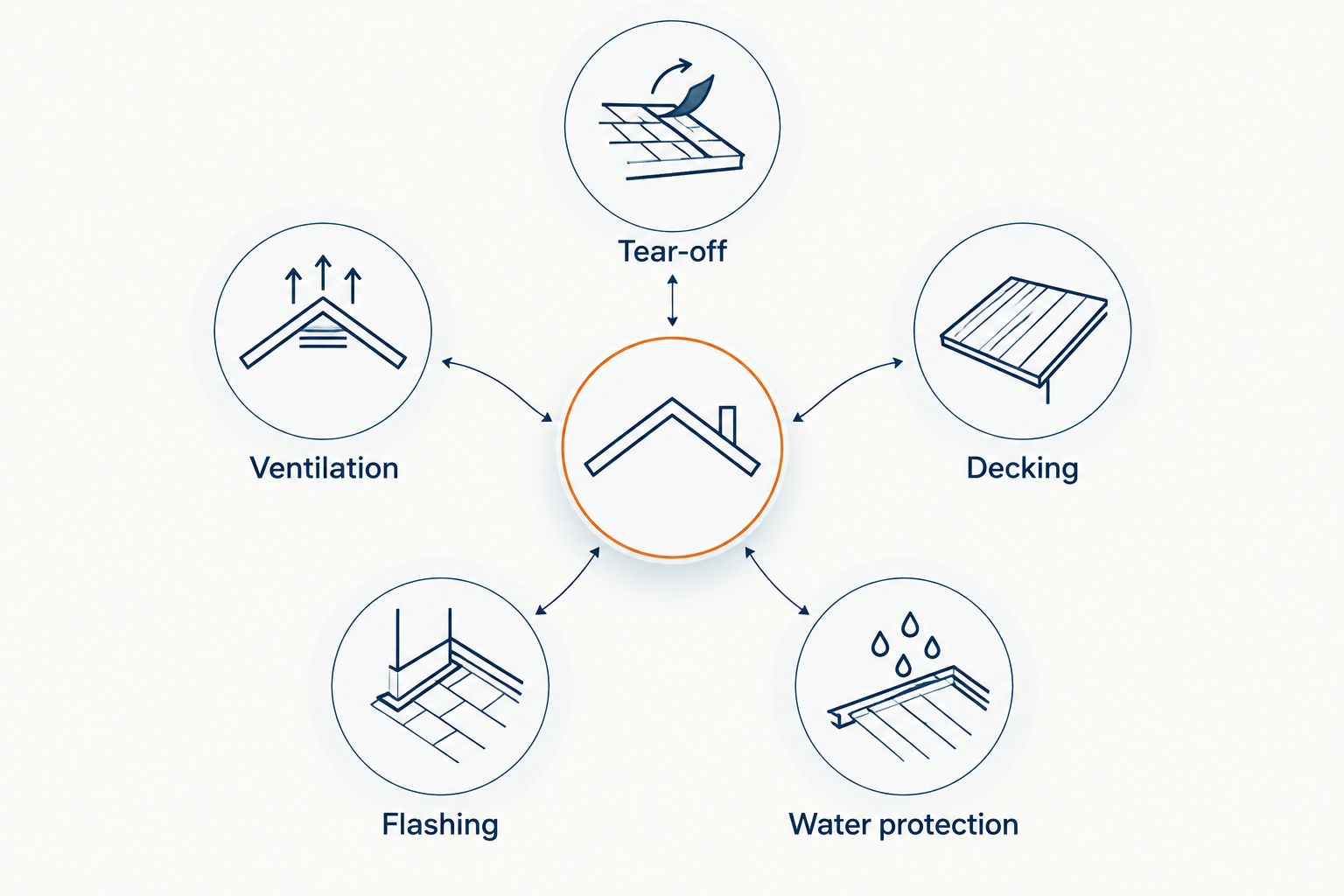
Keep exclusions visible beside these headings. Chimney masonry, interior repairs, gutters, and trim work should not be assumed included simply because the contractor is replacing the roof.
Request a roof replacement inspection
Discuss your roof's condition, material choices, and replacement scope. Appointment details require confirmation.
How these materials were ranked
Architectural shingles take the default position because they provide a conventional starting point for a residential replacement comparison. Three-tab shingles address a simpler appearance; standing-seam metal, synthetic slate, and natural slate each answer a different material preference.
The 2026 ranking prioritizes roof suitability, complete scope, installation demands, maintenance, and appearance. It is not a claim that every contractor's proposals will follow the same order. Compare actual written estimates before committing.
Which roofing material should you choose?
Choose architectural shingles as your starting comparison unless you have a clear reason to select another roof system. Then ask what changes—not just in appearance, but in flashing, attachment, maintenance, and the work required beneath the covering.
For a 2026 replacement in Manchester, Nashua, Bedford, or nearby communities, bring your priorities to the inspection: appearance, existing concerns, and the parts of the estimate you need explained. Keep the discussion focused on your house rather than a generic material ranking.
FAQ
What's the best roofing material for an NH roof replacement?
Architectural asphalt shingles are the starting comparison for a conventional residential replacement. Confirm roof suitability and compare the complete installation scope before choosing a material.
How much roof area is in one roofing square?
One roofing square equals 100 square feet of roof surface. Roof measurements are separate from your home's floor area and from the material quantity ordered.
Can I compare roof estimates using cost per square alone?
No. Compare cost per square only after confirming that measurements, tear-off, decking provisions, flashing, underlayment, ventilation, and disposal cover equivalent work.
Is standing-seam metal better than architectural shingles?
Standing-seam metal is better suited to homeowners who specifically want a concealed-fastener panel roof. Architectural shingles remain a conventional alternative; compare roof details, maintenance needs, and appearance rather than declaring one universally better.
Does a new roof estimate include replacement decking?
The written estimate determines whether decking replacement is included or handled as additional work. Ask how concealed damage will be documented and approved after tear-off.
Can natural slate replace asphalt shingles on any house?
No. Natural slate requires an assessment of structural suitability and a slate-specific installation plan. Confirm those requirements before selecting it.
How do I request a roof replacement inspection from Prescott Roofing?
Use the contact page to request a residential roof replacement inspection. Sending a request does not book an appointment; confirm scheduling details directly.
One last thing
Ask this before signing: “Which existing roof components are staying, and why?” That question brings reused flashing, retained ventilation, and excluded work into the open. A new roof covering does not mean every component underneath it is new.