
A roof estimate is generally a preliminary projection, while a roof quote presents a proposed amount for a defined scope of work. Neither label guarantees a fixed final total: exclusions, concealed roof damage, and the written change-order terms determine what can change before and during your replacement.
- Roof estimate vs quote: compare the written scope and change terms, not just the document title.
- A detailed roof replacement estimate is more useful than a vague quote with unexplained exclusions.
- Prescott Roofing serves Southern New Hampshire homeowners considering residential roof replacement.
- Require written approval for additional work, and resolve missing details before signing a roofing contract.
Why this matters
When you pay for a roof replacement yourself, you need to understand both the planned work and your responsibility if conditions change. A document headed Quote does not answer those questions unless its terms explain them.
For a 2026 replacement, start with what a roof replacement estimate includes. Then compare the actual work described, rather than assuming different contractors use estimate and quote consistently.
What's the difference between a roof estimate and a quote?
An estimate projects the job; a quote proposes defined work under stated terms. In everyday roofing conversations, contractors sometimes use the words interchangeably. Read the document before deciding how firm the proposal is.
| Document | Best for | Main advantage | Main limitation |
|---|---|---|---|
| Preliminary roof estimate | Early planning before the scope is settled | Helps you discuss the likely extent of replacement | Assumptions can remain unresolved |
| Detailed written roof quote | Comparing defined replacement proposals | Connects the proposed amount to named work and materials | Exclusions and concealed conditions can still permit changes |
| Roofing contract | Authorizing the agreed replacement | Records the accepted scope, obligations, and change process | Missing or unclear terms still need correction before signing |
These are practical distinctions, not a legal ruling about a particular document. Whether acceptance creates an enforceable agreement depends on the wording and applicable law, not simply the heading.
Ask the contractor to identify which document authorizes work. Do not assume an inspection request, an emailed proposal, and a signed replacement agreement mean the same thing.
What makes an estimate useful?
A useful estimate explains its assumptions. It identifies the roof areas being considered, the proposed material, and any work that has not yet been evaluated.
A preliminary estimate can help you plan without committing to a final scope. Its weakness is uncertainty: if the contractor has not assessed roof access, flashing, or visible deck conditions, those details still need attention before you authorize replacement.
What makes a quote useful?
A useful quote ties the proposed amount to a specific job. It states what the contractor will remove, install, protect, and clean up, along with the conditions that allow a change.
Detail matters more than the title. A thorough estimate with clear exclusions can give you a better basis for a decision than a short quote that only says replace roof.
What should your 2026 roof replacement proposal spell out?
A replacement proposal should let you explain the planned work without filling gaps yourself. Use the following checks whether the contractor calls the document an estimate, quote, or proposal.
Tear-off and disposal
Tear-off means removing the existing roofing. Ask whether the proposal includes removal down to the roof deck, which is the wood surface supporting the roofing system.
The document should also address debris removal and disposal. If removal depends on an assumed number of existing layers, have the contractor explain how a different finding will be handled.
Materials and installation details
Look for the roofing material and the associated components, not just a color selection. Underlayment, roof-edge details, flashing, and ventilation should be addressed wherever they are part of the proposed work.
A brand name alone does not define an installation. Ask which components are included, which existing components remain, and what installation requirements apply to the selected materials.
Flashing and roof penetrations
Flashing directs water away from joints and transitions. Step flashing consists of overlapping pieces used where a sloped roof meets a wall; pipe boots seal around plumbing vent pipes.
Ask whether existing flashing will be replaced, reused after assessment, or excluded. A phrase such as replace as needed leaves an important decision unresolved unless the proposal also explains the assessment and approval process.
Roof deck repairs
Roof coverings conceal portions of the deck. An inspection can identify visible concerns, but it cannot establish the condition of every covered surface before tear-off.
Your proposal should explain how the contractor documents deteriorated decking, describes the required repair, and obtains authorization. A concealed condition needs a defined process, not an open-ended permission slip.
Protection, cleanup, and responsibilities
Ask how the crew will address landscaping, driveway access, debris, and cleanup. Clarify which responsibilities belong to you, such as moving vehicles or clearing access to the work area.
Permit responsibility, payment milestones, and any written warranty terms also belong in the agreement. Do not treat a verbal explanation as a substitute for terms you need to rely on later.
Why roof estimates and quotes vary
Different totals do not establish that a contractor is overcharging or leaving something out. First determine whether the proposals describe the same replacement.
- Inspection scope: A preliminary assessment and a closer examination do not resolve the same questions. Ask what was inspected and what remains unknown.
- Removal assumptions: Existing layers, disposal arrangements, and the planned tear-off affect the work being proposed.
- Roof geometry and access: Slopes, dormers, wall intersections, and access affect installation planning. Confirm that each proposal covers the same roof areas.
- Material and component choices: Different underlayment, flashing, ventilation, and roof coverings create different scopes, even when the finished color looks similar.
- Exclusions and allowances: Work left outside the base scope, or included only as an allowance, changes how much uncertainty you retain.
For your 2026 comparison, separate confirmed work from assumptions. Ask each contractor to revise unclear wording before treating the documents as comparable offers.
How do you compare a roof estimate with a quote?
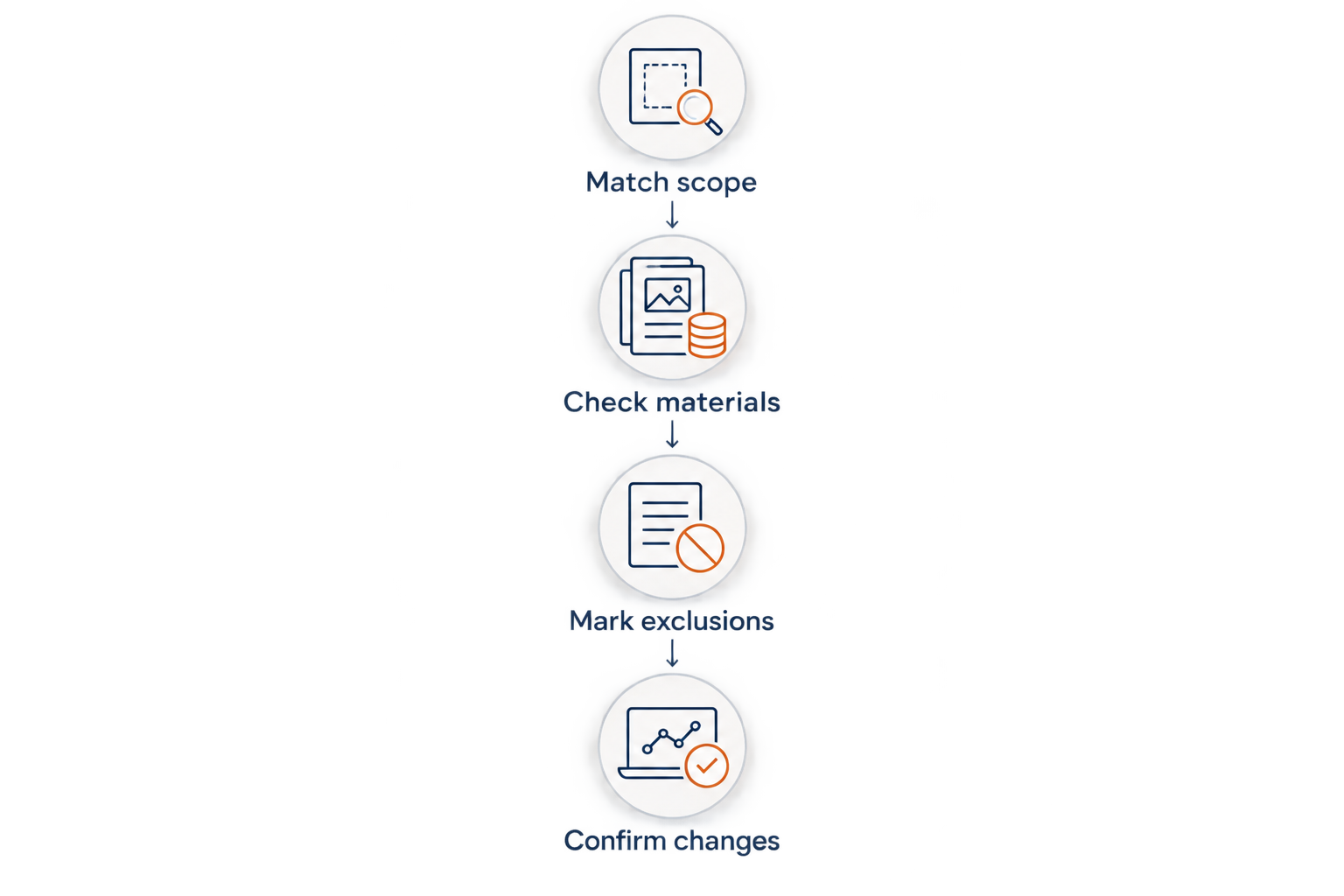
Use the same sequence for every proposal. You are checking whether the contractor has defined the work well enough for you to authorize it.
- Match scope. Confirm that each proposal covers the same house, garage, additions, and roof sections. Resolve differences before comparing totals.
- Check materials. Compare the roof covering and supporting components. Identify anything described only as standard or equivalent.
- Mark exclusions. Highlight deck repairs, flashing decisions, ventilation changes, and any other work outside the stated scope.
- Confirm changes. Require a written process for documenting additional work and obtaining your approval before it proceeds.
The strongest comparison is a marked-up set of proposals with the same questions answered. You do not need to become a roofer; you need each contractor to explain the commitments plainly.
Check that measurement units match
Roofing proposals sometimes describe area in squares. A roofing square equals 100 square feet of roof area, not the floor area of your home.
Pitch describes slope rather than area. For example, a 6:12 pitch rises 6 inches over a horizontal run of 12 inches. Those measurements describe different things, so ask the contractor to explain unfamiliar quantities instead of comparing numbers without their units.
You do not need to climb onto the roof to verify a proposal. Request an explanation of the measured roof areas and how the contractor used those measurements in the scope.
Can a roof quote change after you accept it?
A roof quote can include terms that allow changes, including concealed deck deterioration or homeowner-requested additions. The accepted agreement should explain those circumstances and the approval process.
Separate a newly discovered condition from work that was already included. If replacement of a particular component appears in the signed scope, ask why it is being presented again as additional work.
Before signing your 2026 agreement, ask how the contractor will provide photographs or other documentation, describe the additional work, and record your authorization. Confirm who can approve changes if you are away from home.
Is a signed roof estimate the same as a contract?
A signed estimate can serve as an agreement, depending on its wording and applicable law. The word estimate does not make a signature meaningless.
Read the acceptance language, attached terms, payment provisions, and cancellation terms before signing. If you only intend to request an inspection or receive information, make sure the document does not authorize construction or another commitment you did not intend.
For an unclear legal obligation, get qualified legal advice before accepting. A contractor should still be able to explain the proposed roofing work in plain language.
Before you request a roof replacement inspection
Prepare a short description of the replacement you are considering. Identify whether you want the entire roof assessed, mention known concerns, and ask what access the contractor needs.
For residential roof replacement in Southern New Hampshire, Prescott Roofing is a relevant option for homeowners seeking a local contractor. Service-area fit is a starting point, not proof of what a particular proposal includes; apply the same written-scope checks to every contractor.
When contacting Prescott Roofing in 2026, request an inspection and ask what happens next. Submitting a request does not mean an appointment is booked; wait for confirmation of the visit details.
Request a roof replacement inspection
Discuss your Southern New Hampshire roof replacement and ask how to arrange an inspection.
FAQ
Is a roof quote always fixed?
No. A roof quote can contain exclusions, allowances, and change provisions. Read the accepted agreement to understand which circumstances permit a revision and how you approve it.
Should I choose a roofing quote over an estimate?
Choose the clearer written scope, not the more reassuring title. A detailed estimate can be more useful than a quote that leaves materials, exclusions, and additional-work procedures unexplained.
Can a roofer know whether all the decking needs replacement before tear-off?
A roofer cannot inspect every concealed deck surface before the covering is removed. Ask the contractor to explain visible findings and the process for documenting and approving concealed repairs.
Does accepting a roof estimate authorize the contractor to start?
Acceptance can authorize work if the document's terms say it does. Read the authorization language before signing and distinguish an inspection request from a construction agreement.
What should I do when roofing proposals include different materials?
Ask each contractor to explain the material differences and provide a comparable scope. Compare underlayment, flashing, ventilation, and removal work as well as the visible roof covering.
Can I request a Prescott Roofing inspection without already choosing a roof material?
You can request an inspection while you are still considering roof replacement options. Explain that you have not selected a material, and confirm the inspection arrangements directly before treating a visit as booked.
One last thing
Before accepting a 2026 roof replacement proposal, ask the contractor to walk through what is not included. That conversation can be more useful than another explanation of the included shingles.
If an exclusion could require your decision during tear-off, settle the approval process now. Clear boundaries make it easier to understand the work you are authorizing without expecting an inspection to reveal every concealed condition.