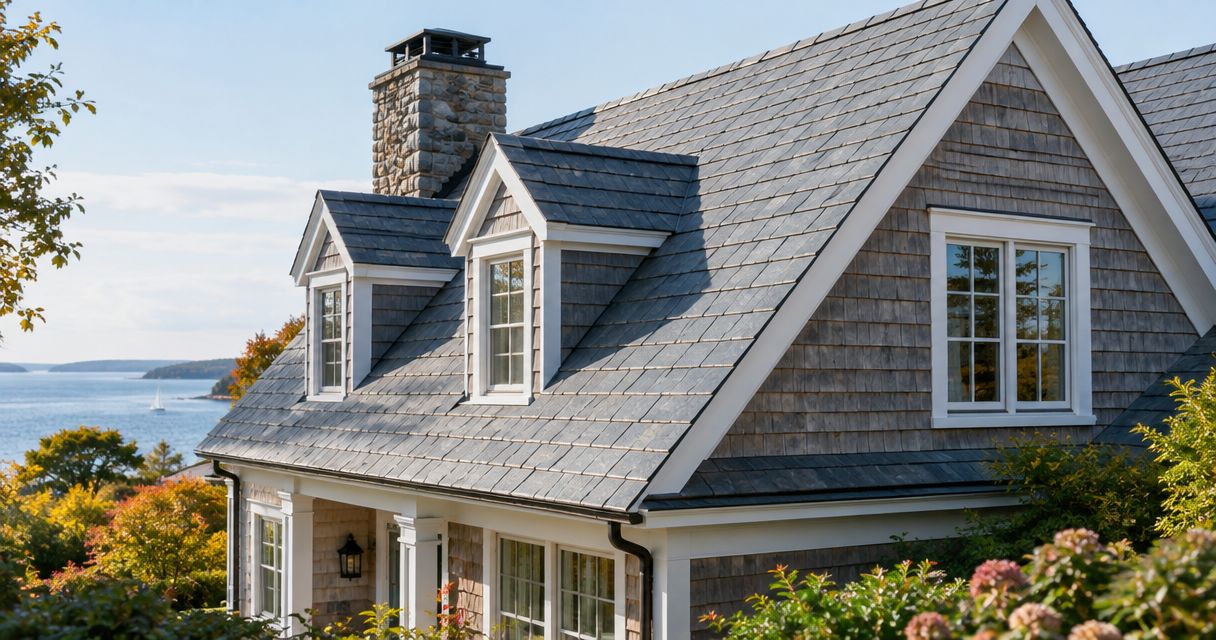
Best overall: CertainTeed Grand Manor for a layered slate appearance. Best for cut-corner detailing: CertainTeed Carriage House. Best for a simpler asphalt interpretation: GAF Slateline. Best non-asphalt alternative: DaVinci Multi-Width Slate. This 2026 guide compares appearance, installation considerations, and estimate details for a homeowner-paid roof replacement.
- The best slate look shingles for New England homes depend on roof shape, material preference, and installation details.
- CertainTeed Grand Manor is the default shortlist choice for a layered asphalt slate appearance.
- GAF Slateline suits homeowners who prefer a more restrained slate pattern.
- Prescott Roofing serves Southern New Hampshire homeowners planning residential roof replacement; request an inspection before choosing materials.
Why this matters
A slate-look roof needs to work as a roof, not just resemble stone in a brochure. The shingle profile affects the appearance; the deck, flashing, underlayment, and ventilation affect the finished assembly.
For Southern New Hampshire homeowners, the next move is an inspection and a written scope—not a color commitment. Prescott Roofing offers residential roof replacement; ask which materials suit your roof and what each estimate includes. Requesting an inspection does not mean an appointment is booked; confirm the date directly.
This 2026 shortlist separates asphalt shingles from composite slate. Those are different material choices, even when their photographs look similar.
What makes the best slate-look shingles?
Judge these options against the same criteria before comparing estimates:
- Slate resemblance: Look at tab shape, shadow lines, surface texture, and the installed pattern—not just a close-up sample.
- Architectural fit: Match the roof's visual weight to the house. An elaborate pattern is not automatically better.
- Roof suitability: Check slope, deck condition, and any structural questions before selecting a material.
- Installation requirements: Compare fastening, flashing, valleys, and ventilation against the exact manufacturer's instructions.
- Estimate clarity: Require named materials, defined exclusions, and a written process for concealed deck repairs.
- Repair planning: Ask how individual damaged pieces would be replaced and how replacement materials would be matched.
Choose the appearance you want only after confirming that the proposed roof assembly suits your house. That rule matters more than the order of a product list.
Slate-look roofing at a glance
These are appearance-led recommendations, not results from a laboratory comparison. The table distinguishes what each option does well from the trade-off you need to examine.
| Option | Best for | Standout feature | Key limitation |
|---|---|---|---|
| CertainTeed Grand Manor | Layered asphalt slate appearance | Substantial overlapping profile | Strong visual depth can dominate a small roof |
| CertainTeed Carriage House | Cut-corner slate detailing | Shaped tabs and a distinct repeating pattern | Decorative geometry does not suit every house |
| GAF Slateline | Restrained asphalt slate styling | Slate-inspired lines and shadow definition | Does not reproduce natural stone texture |
| DaVinci Multi-Width Slate | A non-asphalt slate alternative | Composite slate in multiple widths | Requires its own installation details and scope |
None of these options is natural quarried slate. If actual stone is your requirement, treat that as a separate material decision with its own structural and installation assessment.
1. CertainTeed Grand Manor: best for a layered slate appearance
CertainTeed Grand Manor is an asphalt shingle designed to evoke the depth and overlapping appearance of slate. Its substantial profile makes it the default shortlist choice when a flat-looking roof is what you want to avoid.
The appearance deserves a full-roof review. On a house with dormers, intersecting roof planes, or prominent front-facing slopes, shadow lines become part of the architecture rather than a small finish detail.
CertainTeed Grand Manor pros:
- Creates a layered appearance rather than a plain rectangular field.
- Offers an asphalt route to a slate-inspired roof.
- Suits homeowners who want visible depth across the roof surface.
CertainTeed Grand Manor cons:
- Its pronounced pattern can compete with detailed siding or masonry.
- An asphalt surface still looks different from split natural stone at close range.
Ask the estimator to name Grand Manor explicitly rather than writing only designer shingles. The proposal should also identify the matching accessories and how transitions around dormers and walls will be handled.
Best for: Homeowners who want the roof to be a noticeable architectural feature.
Verdict: Buy if a layered asphalt appearance is your priority and the inspection supports the proposed assembly.
2. CertainTeed Carriage House: best for cut-corner detailing
CertainTeed Carriage House is an asphalt shingle with cut-corner styling intended to resemble slate. Its geometry gives you a different visual direction from Grand Manor's heavier-looking layers.
That distinction matters on a roof you see clearly from the street. Repeating shapes draw the eye, so judge an installed-roof photograph alongside a sample rather than choosing from a small color chip.
CertainTeed Carriage House pros:
- Provides recognizable cut-corner detailing.
- Makes the shingle pattern part of the house's appearance.
- Offers another asphalt option when conventional architectural shingles look too plain.
CertainTeed Carriage House cons:
- The repeating pattern can look busy beside other decorative exterior features.
- Slate-inspired geometry does not make asphalt equivalent to natural slate.
Ask how hips, ridges, and visible roof edges will finish. Those transitions deserve attention because a carefully selected field pattern does not resolve an awkward edge detail.
Best for: Homeowners who specifically prefer shaped tabs and a more decorative slate pattern.
Verdict: Buy for the cut-corner appearance; skip it if you want the roof to recede visually.
3. GAF Slateline: best for restrained asphalt slate styling
GAF Slateline is an asphalt shingle with slate-inspired lines and shadow definition. It belongs on the shortlist when you want a slate reference without making decorative tab shapes the main feature.
For your 2026 replacement, compare the pattern against the house's siding, trim, and masonry. A sample that looks understated on a table can read differently across a large, uninterrupted roof plane.
GAF Slateline pros:
- Offers a slate-inspired appearance within the asphalt category.
- Uses defined lines to establish the roof pattern.
- Gives you a distinct alternative to cut-corner styling.
GAF Slateline cons:
- Its surface does not reproduce the irregular texture of natural slate.
- Homeowners seeking pronounced sculpted depth should compare larger samples before deciding.
Do not accept an estimate that treats all asphalt shingles as interchangeable. Ask for the exact shingle, accessory materials, and installation requirements in writing so a later substitution requires your approval.
Best for: Homeowners who want a more restrained slate-inspired pattern.
Verdict: Buy for simpler styling; hold if realistic stone texture is your main requirement.
4. DaVinci Multi-Width Slate: best non-asphalt alternative
DaVinci Multi-Width Slate is composite slate roofing rather than an asphalt shingle. Its multiple-width format makes it a separate material route for homeowners who want to move beyond an asphalt interpretation of slate.
Keep that distinction visible in the estimate. Compare the complete proposed installation, not an asphalt proposal with a different product name substituted at the top.
DaVinci Multi-Width Slate pros:
- Provides a non-asphalt slate-look option.
- Uses multiple widths to vary the installed pattern.
- Lets you compare composite styling directly with asphalt samples.
DaVinci Multi-Width Slate cons:
- Composite slate is not natural quarried stone.
- Installation details must follow the composite system rather than assumptions carried over from asphalt work.
Ask prospective installers to explain the layout, fastening, flashing, and accessory requirements for this exact product. A clear explanation is more useful than a broad statement that the crew installs every kind of roof.
Best for: Homeowners who prefer composite slate and are prepared to evaluate a product-specific installation scope.
Verdict: Buy only after reviewing the composite sample and a clearly defined installation proposal.
How this shortlist is ranked
The ranking prioritizes slate resemblance, distinct appearance choices, and the questions a homeowner can resolve before signing. Grand Manor is the default for layered asphalt styling; Carriage House, Slateline, and DaVinci Multi-Width Slate serve different preferences rather than acting as interchangeable runners-up.
No position here establishes a longer service life, better wind performance, or better workmanship. Those claims require evidence for the exact product and installation. Your 2026 decision should pair a material preference with an acceptable roof assessment and contract.
Compare samples from the ground, not just the kitchen table
Start with 2 sample boards representing genuinely different patterns. For example, compare layered styling with cut-corner styling before getting caught in a long color discussion.
View the samples outside in daylight, then step back 20 feet as a practical viewing exercise—not a technical standard. You are checking whether the pattern still reads clearly at a distance and whether it competes with the rest of the house.
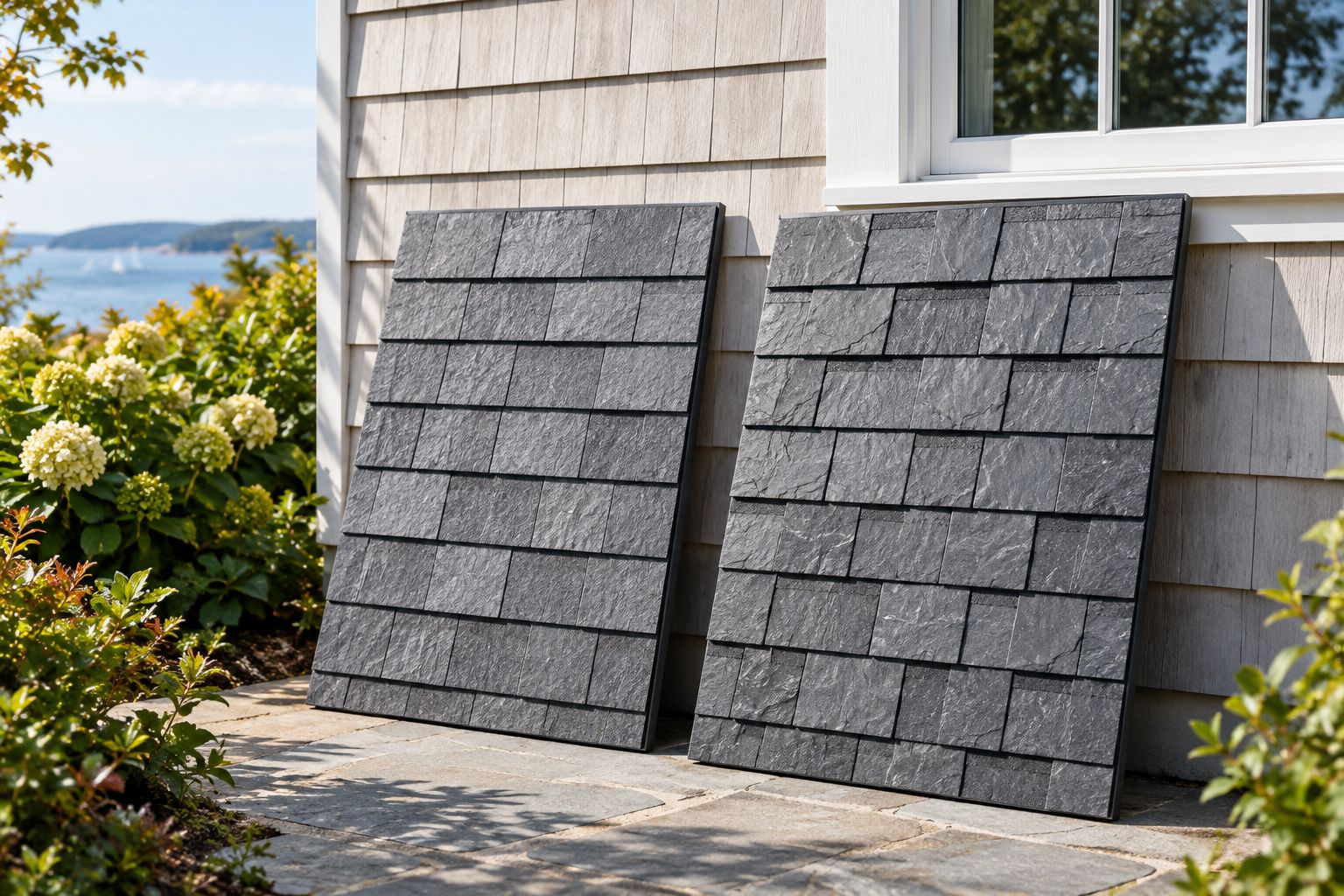
Then review installed-roof photographs showing a similar roof shape. A close-up cannot tell you how a repeating pattern will look across a broad front slope or around several dormers.
Keep historic appearance separate from local roof requirements
On an older home, appearance and installation suitability are separate decisions. Comparisons of roofing options for historic homes raise the architectural question; your Southern New Hampshire replacement still needs an assessment of its own deck, roof geometry, and local requirements.
If your property is subject to historic-district review, confirm the approval requirements before signing for a material. A slate-like appearance is not, by itself, evidence that a replacement is acceptable.
What a slate-look replacement estimate should include
For a 2026 project, compare 3 written estimates using the same requested scope. That is a practical way to expose differences—not a rule that makes the middle proposal correct.
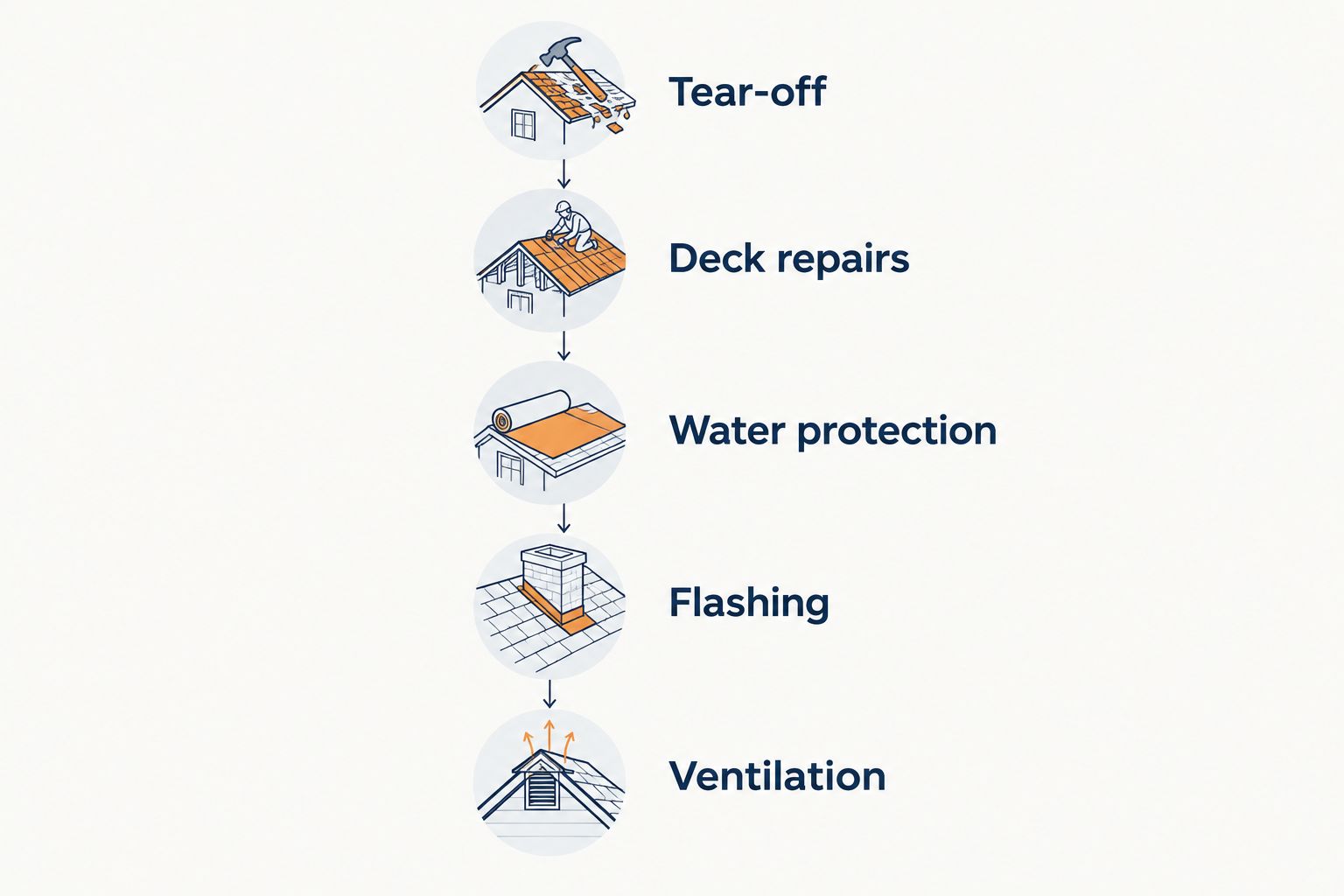
Use these checkpoints to separate an actual replacement plan from a material description:
- Tear-off: State what existing roofing will be removed and how disposal is handled.
- Deck repairs: Explain how concealed deterioration will be documented and how additional work requires approval.
- Water protection: Identify underlayment and the proposed protection at vulnerable roof details.
- Flashing: Define work at walls, chimneys, valleys, and penetrations.
- Ventilation: Explain the proposed intake and exhaust arrangement rather than listing a ridge vent alone.
Step flashing means the individual flashing pieces integrated with shingle courses where a roof meets a wall. Ask whether existing flashing will be replaced, retained, or evaluated during tear-off, and require the proposal to explain that decision.
Underlayment also deserves its own line item. The comparison of synthetic roofing underlayment for cold New England winters addresses a layer beneath the visible shingles; your estimate should identify the actual specified material and its role.
A clear exclusion is better than an unspoken assumption. Ask who handles disturbed siding, chimney masonry, gutters, and other adjacent work when those items fall outside the roofing contract.
Which slate-look roofing should you choose?
Start with CertainTeed Grand Manor if you want layered asphalt slate styling and have not settled on a pattern. Compare Carriage House if shaped tabs matter more, and Slateline if you prefer a restrained appearance. Move DaVinci Multi-Width Slate onto the shortlist when you specifically want composite rather than asphalt.
Prescott Roofing is a fit for Southern New Hampshire homeowners planning a residential roof replacement. Use the inspection discussion to connect your preferred appearance with deck condition, flashing work, and a clearly written estimate—not to skip those decisions.
For a 2026 replacement, settle the scope before committing to the finish. A material choice cannot correct an undefined installation plan.
Request a roof inspection
Discuss your roof replacement scope and material preferences. Confirm scheduling directly.
FAQ
What are the best slate look shingles for New England homes?
CertainTeed Grand Manor is the default shortlist choice for layered asphalt styling. CertainTeed Carriage House suits cut-corner detailing, GAF Slateline offers a more restrained pattern, and DaVinci Multi-Width Slate is a composite alternative.
Are slate-look shingles made from real slate?
The options in this guide are not natural quarried slate. Grand Manor, Carriage House, and Slateline are asphalt shingles; DaVinci Multi-Width Slate is composite roofing.
Is CertainTeed Grand Manor better than Carriage House?
Grand Manor is the stronger appearance match when you want pronounced layering; Carriage House fits a preference for cut-corner detailing. Compare outdoor samples against your home's roof shape rather than treating either style as universally better.
Can I choose slate-look roofing before an inspection?
You can identify preferred styles before an inspection, but confirm roof suitability before committing to a material. The assessment should address deck condition, roof geometry, and the proposed installation.
What should a slate-look roof replacement estimate include?
The estimate should name the roofing material and define tear-off, deck repair procedures, water protection, flashing, ventilation, and cleanup. It should also state exclusions and how additional work receives your approval.
Can slate-look roofing prevent ice dams?
Slate-look styling does not prevent ice dams. Ice-dam risk involves roof temperature and building conditions, so discuss insulation, air leakage, ventilation, and roof-edge protection rather than relying on shingle appearance.
Does requesting a Prescott Roofing inspection book an appointment?
No. Requesting an inspection starts the scheduling conversation; confirm the appointment date and time directly with Prescott Roofing.
One last thing
Ask the contractor to mark where new flashing will go on a photograph of your actual roof. This turns a vague promise about workmanship into a discussion about specific walls, valleys, and penetrations. Choose the contractor who can explain the roof assembly, not just name the shingle.