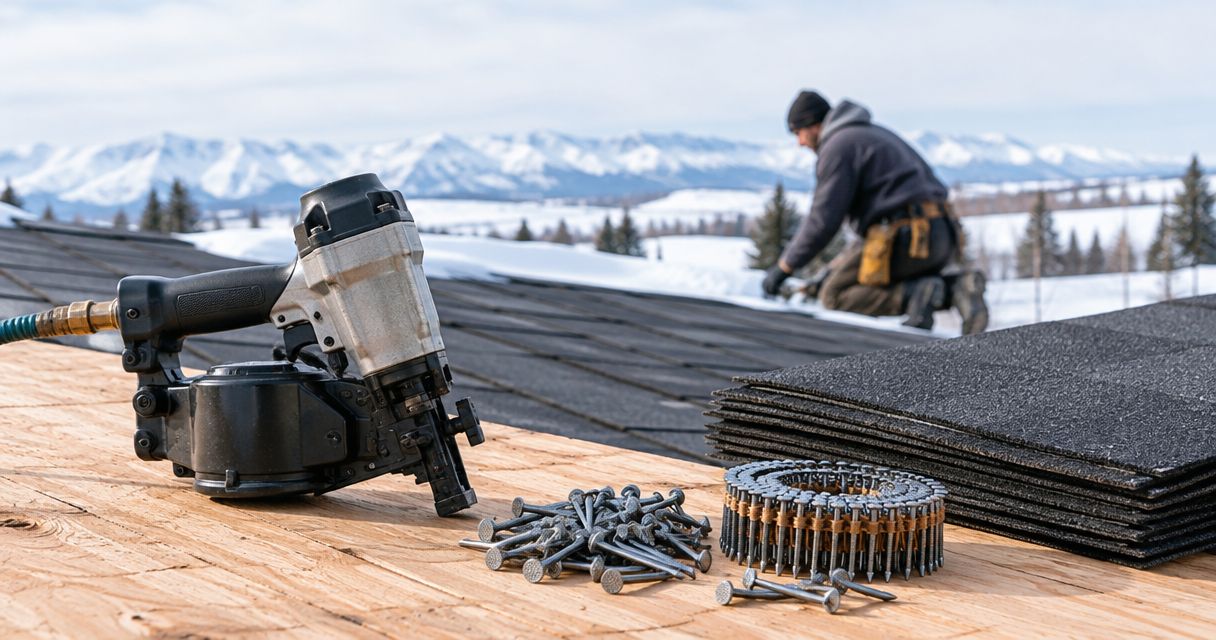
Best overall for inland asphalt roofs: approved hot-dip galvanized roofing nails. Best for coastal exposure: approved stainless steel roofing nails. For Southern New Hampshire homeowners comparing replacement estimates in 2026, the best choice matches the roof covering, deck, and exposure—not just the strongest-sounding fastener.
- Best roofing nails and fasteners cold climate guide: choose by roof assembly, corrosion exposure, and installation requirements.
- Hot-dip galvanized roofing nails are the default recommendation for compatible inland asphalt-shingle assemblies.
- Stainless steel roofing nails suit coastal exposure when the shingle manufacturer approves them.
- Prescott Roofing provides residential roof replacement; ask for fastening details in your written estimate.
Why this matters
A replacement roof depends on connections you cannot see after installation. Shingle nails, underlayment fasteners, deck fasteners, and metal-roof attachments have different jobs. Substituting one for another creates problems that a premium roof covering cannot correct.
Prescott Roofing provides residential roof replacement for homeowners in Southern New Hampshire and Northern Massachusetts. When you compare contractors, ask how each estimate addresses those connections—not simply which shingle appears on the proposal.
For your 2026 roof replacement, choose an approved fastening system before choosing a corrosion-resistance upgrade. A suitable nail driven incorrectly is still an installation defect.
What makes the best cold-climate roofing fasteners?
Use these criteria to evaluate the specification before comparing materials:
- Manufacturer approval: The fastener must meet the roof covering’s current installation instructions. Material, dimensions, placement, and attachment pattern all matter.
- Corrosion resistance: Match the metal and protective coating to moisture exposure, nearby salt exposure, and adjoining materials.
- Deck engagement: Fasteners need the required penetration into sound decking. Extra length does not repair deteriorated wood.
- Installation control: Nails should sit correctly without cutting the shingle or leaving a raised head beneath another course.
- Assembly compatibility: Underlayment, decking, shingles, and metal panels require their own approved attachment methods.
Cold weather adds another installation concern: asphalt shingles can be harder to handle, and their sealant strips depend on suitable conditions to bond. Better nails do not replace the manufacturer’s cold-weather handling and sealing instructions.
Cold-climate roofing fasteners at a glance
These are ranked by their usefulness in a homeowner-paid replacement project, not as interchangeable substitutes. Each recommendation has a separate job.
| Rank and option | Best for | Standout feature | Key limitation |
|---|---|---|---|
| 1. Hot-dip galvanized roofing nails | Compatible inland asphalt-shingle roofs | Zinc coating protects the steel beneath it | Coating alone does not establish compliance |
| 2. Stainless steel roofing nails | Compatible asphalt roofs with coastal exposure | Corrosion resistance without a sacrificial zinc coating | Stainless grade and adjoining materials still matter |
| 3. Plastic-cap roofing nails | Underlayment where specified | Cap spreads holding pressure across the sheet | Not a substitute for shingle nails |
| 4. Approved ring-shank decking nails | Replacement roof sheathing | Deformed shank resists withdrawal from wood | Requires a structural fastening schedule |
| 5. System-specified clips and screws | Standing-seam metal replacement roofs | Attachment designed around the panel assembly | Components cannot be mixed casually between systems |
1. Hot-dip galvanized nails: best for inland asphalt roofs
Hot-dip galvanized roofing nails are steel nails protected by a zinc coating. For an inland asphalt-shingle replacement, they are the first option to discuss when they satisfy the shingle manufacturer’s instructions and applicable code.
The words galvanized roofing nails are not a complete specification. Ask the contractor to identify the corrosion protection, dimensions, and intended application rather than relying on a generic description.
Hot-dip galvanized roofing nail pros:
- Provide corrosion protection for the underlying steel.
- Suit asphalt-shingle assemblies that permit them.
- Offer a straightforward specification to check against installation instructions.
Hot-dip galvanized roofing nail cons:
- Zinc protection does not eliminate the need to assess exposure.
- An approved coating cannot compensate for incorrect length or placement.
Best for: Homeowners replacing an inland asphalt-shingle roof with an assembly that approves hot-dip galvanized nails.
For a 2026 estimate, request the nail specification alongside the shingle selection. “Install architectural shingles” leaves the attachment details unresolved.
Verdict: Buy as part of an approved asphalt-shingle assembly, not by coating name alone.
2. Stainless steel nails: best for coastal asphalt roofs
Stainless steel roofing nails deserve consideration where salt exposure makes corrosion resistance a priority. They still need to meet the shingle manufacturer’s requirements, and the specification should identify the stainless material rather than stopping at the word stainless.
This is an exposure-based choice, not an automatic upgrade for every house. A homeowner in Manchester should not assume the same specification is necessary as a homeowner near the coast.
Stainless steel roofing nail pros:
- Resist corrosion through the properties of the alloy.
- Provide an option where compatible assemblies call for greater corrosion resistance.
- Avoid dependence on a zinc coating for their corrosion protection.
Stainless steel roofing nail cons:
- Different stainless grades have different corrosion resistance.
- Compatibility with nearby metals and the roof covering still requires confirmation.
Best for: Homeowners with coastal exposure whose selected asphalt-shingle assembly permits the specified stainless nail.
Ask the roofer to explain why stainless belongs on your roof. A useful answer connects the exposure, material specification, and installation requirements.
Verdict: Buy when exposure and the approved roof assembly justify stainless steel.
3. Plastic-cap nails: best for specified underlayment attachment
Plastic-cap nails hold underlayment with a broad cap rather than a small nail head alone. The cap spreads pressure across the sheet, helping the attachment resist pulling through the material.
Use the underlayment manufacturer’s instructions to determine the permitted fastener and spacing. Some self-adhered membranes use a different attachment method, so cap nails are not a universal requirement beneath every roof covering.
Plastic-cap nail pros:
- Spread holding pressure over a larger area of underlayment.
- Provide a distinct attachment method for sheets that require capped fasteners.
- Make underlayment fastening a separate, checkable scope item.
Plastic-cap nail cons:
- Do not replace the nails specified for asphalt shingles.
- Cannot be assumed suitable for every membrane or exposure condition.
Best for: Mechanically attached underlayment that specifically permits or requires plastic-cap nails.
Your estimate should identify the underlayment and its installation method. “Synthetic underlayment included” names a material category without explaining how it will be secured.
Verdict: Buy where the selected underlayment instructions require or permit them.
4. Ring-shank decking nails: best for replacement sheathing
Ring-shank nails have ridges along the shank that increase resistance to withdrawal from wood. In roof replacement work, approved ring-shank decking nails belong in the discussion when damaged or unsuitable sheathing must be replaced.
Deck fastening is structural work. Nail diameter, length, spacing, panel thickness, framing engagement, and the required fastening schedule must work together; ring shanks alone do not establish an adequate connection.
Ring-shank decking nail pros:
- Resist withdrawal through their deformed shank.
- Provide an attachment option for sheathing when the schedule permits them.
- Address the deck connection separately from the shingle connection.
Ring-shank decking nail cons:
- Do not restore the holding strength of deteriorated wood.
- Require a specified fastening schedule rather than installer guesswork.
Best for: Replacement roof sheathing installed under an applicable structural fastening schedule.
Ask how the contractor will document concealed deck damage and authorize additional work. This keeps an unknown condition from becoming an undefined agreement.
Verdict: Buy only as specified for the replacement sheathing and framing connection.
5. System-specified clips and screws: best for standing seam
Standing-seam metal roofs use attachment details designed for the selected panel system. Depending on that system, clips or fastening flanges secure the panels while accommodating movement as metal expands and contracts.
Do not choose these components from a general-purpose fastener list. The panel manufacturer’s requirements govern the attachment, including compatible screws, substrate, clip configuration, and installation details.
Standing-seam attachment pros:
- Match attachment to the panel assembly rather than treating it like shingles.
- Allow movement where the specified system is designed to do so.
- Keep material compatibility within a defined installation specification.
Standing-seam attachment cons:
- Clips and screws are not automatically interchangeable between systems.
- Incorrect attachment can restrict movement or compromise the assembly.
Best for: Homeowners selecting a standing-seam metal replacement roof.
For a 2026 metal-roof proposal, request the panel system and attachment specification together. A panel name without installation details is not enough to compare scopes.
Verdict: Buy the specified attachment system; skip generic substitutions.
What proper shingle nailing actually requires
For asphalt shingles, material choice is only the starting point. The International Residential Code’s asphalt-shingle fastener provisions provide familiar dimensional baselines: a minimum 12-gauge shank, a minimum 3/8-inch head, and at least 3/4-inch penetration into roof sheathing. Where sheathing is less than 3/4 inch thick, the fastener must penetrate through it.
Those are reference requirements, not a substitute for checking the locally adopted code and the selected shingle instructions. Nail length must also account for the layers between the nail head and the deck.
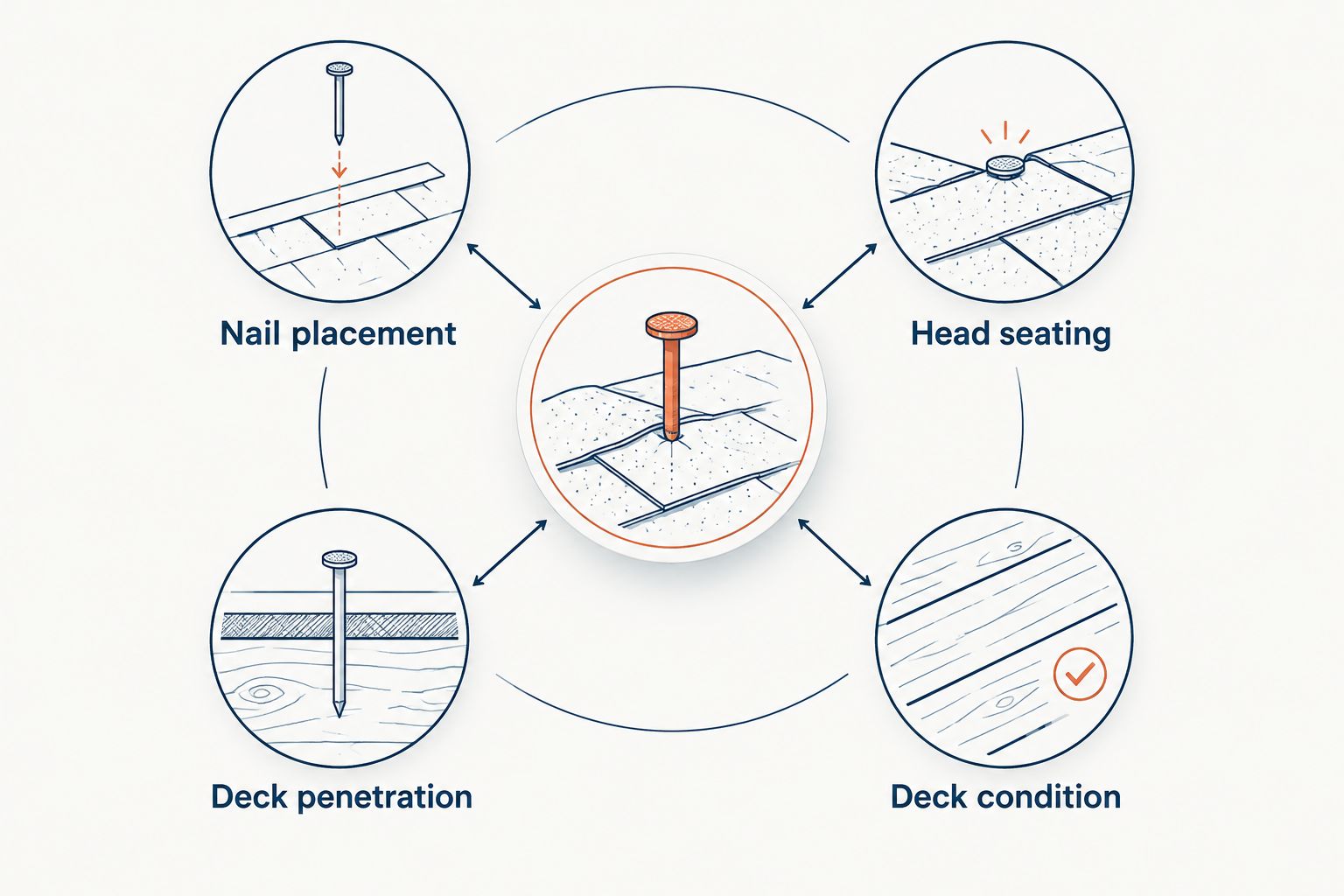
Ask your roofer to explain these four installation checks:
- Nail placement: Fasten within the shingle manufacturer’s designated nailing area.
- Head seating: Seat heads as instructed without cutting into the shingle or leaving them raised.
- Deck penetration: Select length for the actual roof assembly and sheathing.
- Deck condition: Replace unsuitable material rather than fastening into a weak substrate.
A nail gun is not the problem by itself, and hand nailing is not proof of better workmanship. The result matters: correct fasteners, correct placement, and consistent seating as deck conditions change.
What your replacement estimate should spell out
A useful 2026 estimate separates the known installation scope from concealed conditions. You should understand what the contractor includes before tear-off and how additional deck work receives your approval.
Look for these details:
- Tear-off scope: Which existing roof layers will be removed and what disposal includes.
- Deck assessment: How exposed sheathing will be evaluated before covering it.
- Deck repair procedure: How the contractor documents damage and obtains authorization.
- Attachment specification: Which fasteners apply to shingles, underlayment, and replacement sheathing.
- Flashing scope: Whether metal details at walls, chimneys, and roof intersections will be replaced or retained.
- Cold-weather procedure: How installation will follow the selected materials’ temperature and sealing instructions.
Step flashing—the overlapping metal pieces where a sloped roof meets a wall—also needs a clear scope. New nails do not correct an incomplete flashing detail.
For a Prescott Roofing roof replacement, request these details with your estimate. You do not need to specify every component yourself; you need a contractor who explains the assembly clearly.
Request a roof replacement inspection
Discuss your existing roof, replacement scope, and questions about fastening and decking.
An inspection request is not a booked appointment. Confirm the inspection date and access arrangements directly before making plans around the visit.
How we ranked these fasteners
The ranking starts with the most relevant attachment for a conventional asphalt-shingle replacement, then separates exposure-specific and assembly-specific choices. Manufacturer approval, corrosion resistance, deck engagement, installation control, and compatibility determine each recommendation.
This is a specification guide, not a claim that one metal wins every application. No nail category earns a recommendation outside its intended assembly.
Which roofing fasteners should you choose?
For an inland asphalt-shingle replacement, start with approved hot-dip galvanized roofing nails and insist on correct installation. Consider approved stainless nails when exposure warrants them; specify underlayment, decking, and metal-roof attachments separately.
Prescott Roofing serves homeowners planning residential roof replacement in Southern New Hampshire and Northern Massachusetts. Bring the fastening checklist to your inspection so the estimate addresses workmanship as well as materials.
FAQ
What's the best roofing nail for a cold-climate asphalt roof?
An approved hot-dip galvanized roofing nail is the default recommendation for compatible inland asphalt-shingle roofs. Match its dimensions, placement, and penetration to the selected shingle instructions and applicable code.
Are stainless steel roofing nails better than galvanized nails?
Stainless steel roofing nails are an exposure-specific choice, not an automatic upgrade for every roof. Consider them for coastal exposure when the selected material and roof assembly permit them.
Do ring-shank nails solve loose roof decking?
Ring-shank nails do not repair deteriorated decking. Sound replacement sheathing still needs an approved fastening schedule and adequate attachment to the framing.
Can a roofer use plastic-cap nails to install shingles?
Plastic-cap underlayment nails are not substitutes for specified asphalt-shingle nails. Underlayment and shingles have separate fastening requirements.
How long should roofing nails be?
Roofing nails must be long enough to meet the required penetration through the actual assembly. Check the shingle instructions, sheathing thickness, and applicable code rather than choosing length from shingle thickness alone.
Is hand nailing better than using a roofing nail gun?
Neither method guarantees correct installation. Evaluate nail placement, head seating, penetration, and compliance with the shingle manufacturer's instructions.
Can a roof be replaced during cold weather?
Cold-weather replacement must follow the selected materials' handling, installation, and sealing requirements. Ask the contractor how conditions affect the work before confirming the installation schedule.
One last thing
Ask for photographs of the exposed deck and fastening work before the next layer covers it. Finished-roof photos show appearance; in-progress photos help document details you cannot inspect afterward. For your 2026 replacement, make that request before work begins.