To verify a roofing contractor is licensed and insured in 2026, check the credentials required where your home is located, confirm insurance directly with the issuing agent, and match the business name across the paperwork. New Hampshire does not issue a statewide general roofing contractor license, so an advertised license number is not enough. For a homeowner-paid roof replacement, verify local requirements, liability coverage, workers’ compensation arrangements, and who will actually perform the work before signing.
- To verify roofing contractor licensed and insured claims, check official records and confirm insurance directly with the issuing agent.
- New Hampshire does not issue a statewide general roofing contractor license; local permit requirements still matter.
- General liability and workers’ compensation address different risks. Verify both rather than accepting an insurance badge.
- Prescott Roofing serves Southern New Hampshire homeowners considering residential roof replacement; apply the same document checks to every contractor.
How do you verify a roofing contractor is licensed and insured?
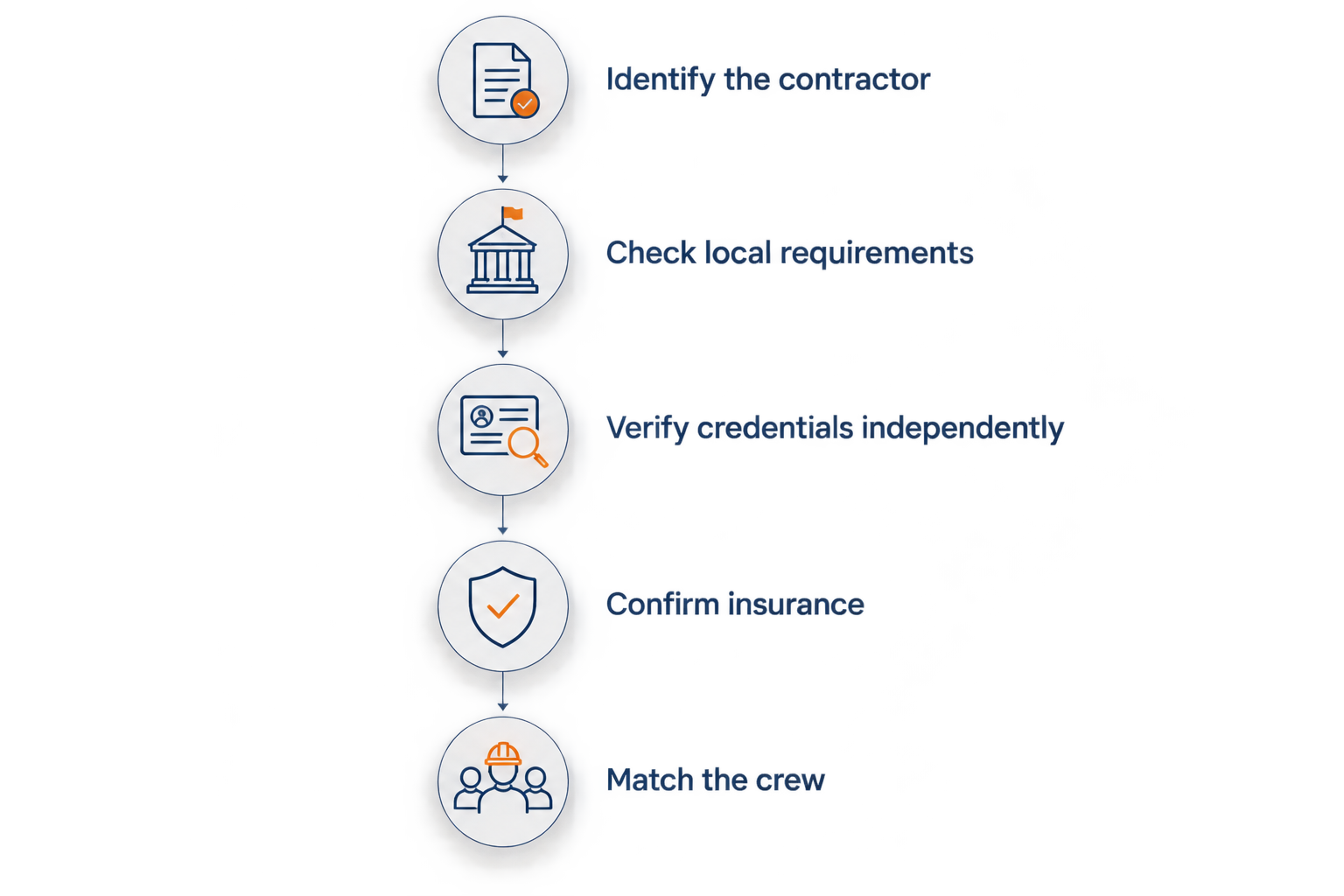
Use these 5 checks before you approve a residential roof replacement. Keep the results with your estimate rather than relying on what a salesperson says at the kitchen table.
- Identify the contractor. Get the legal business name, any trade name, business address, and the name that will appear on your contract.
- Check local requirements. Ask your municipal building department what credentials and permits apply to your roof replacement. Review whether a roof replacement requires a permit in NH before comparing contractors’ answers.
- Verify credentials independently. Search the applicable official records yourself. Match the credential holder, status, classification, and expiration date to the proposed work.
- Confirm insurance with the agent. Request current evidence of general liability and workers’ compensation coverage, then verify the details through an independently checked contact.
- Match the crew and contract. Establish whether employees or subcontractors will install the roof and how their coverage will be verified before work begins.
A complete file should explain who you are hiring, what authorization the job requires, and what insurance applies. A business registration, permit, and insurance certificate answer different questions; none replaces the others.
Why this matters before a roof replacement
Credential checks belong before the deposit and contract, not after materials arrive. You need time to resolve a mismatched business name, an expired document, or an unclear subcontracting arrangement without a tear-off already underway.
For a 2026 roof replacement in Manchester, Nashua, or Bedford, start with your own building department rather than assuming a neighboring town follows the same process. A contractor should explain who handles the permit and where that responsibility appears in the estimate.
Verification also has limits. Proper paperwork does not prove careful flashing installation or a complete replacement scope; you still need a clear estimate and a contractor who answers specific questions.
What does “licensed” mean for a New Hampshire roofer?
New Hampshire does not issue a statewide general roofing contractor license. The New Hampshire Office of Professional Licensure and Certification is the state authority for regulated professional licensing, but business registration is a separate matter.
If a roofer advertises a license, ask which authority issued it and what work it authorizes. The number might refer to an out-of-state credential, a different trade, or another registration. Verify the actual record rather than accepting the label.
For your 2026 project, separate these records:
| Record | What it helps establish | What it does not establish |
|---|---|---|
| Business registration | The registered business identity and recorded status | Roofing skill, insurance coverage, or permission for your specific project |
| Applicable license or registration | Whether the named holder has the listed credential | That every advertised service falls within its scope |
| Municipal permit | Authorization for the work described in that permit | That the contractor carries appropriate insurance |
| Insurance certificate | A summary of the listed policies and dates | Every policy condition, exclusion, or guarantee of payment |
| Manufacturer credential | Participation in the manufacturer’s stated program | Government authorization or current liability coverage |
Ask the town whether your particular scope needs a permit and who must obtain it. Replacing shingles, changing roof structure, and altering other building components are not interchangeable descriptions of work.
What if the contractor also works in Massachusetts?
Verify credentials for the state where your home is located. Massachusetts has a Home Improvement Contractor registration system and Construction Supervisor License requirements that apply according to the work and applicable exemptions.
Use the Massachusetts Office of Consumer Affairs and Business Regulation for Home Improvement Contractor records and the state’s official Construction Supervisor License lookup for that credential. Neither a Massachusetts credential nor a New Hampshire business registration replaces checking your municipality’s requirements.
How do you verify a roofer’s insurance?
Request evidence of 2 coverage types: general liability and workers’ compensation. They address different risks, and a statement that the company is insured does not tell you which policies exist.
General liability: verify the named business and roofing work
General liability insurance generally addresses covered third-party bodily injury and property damage claims, subject to policy terms. It is not a blanket promise that every roof defect, leak, or workmanship dispute will be paid.
Ask the contractor’s agent to send a current certificate directly to you. Independently check the agency’s contact details rather than relying only on the phone number printed on a forwarded attachment.
Then ask the agent to confirm:
- Named insured: Does the policy cover the legal business named in your contract?
- Policy dates: Will coverage be in effect during the planned work?
- Roofing operations: Does the policy cover the residential roofing work being proposed, subject to its terms?
- Relevant restrictions: Are there exclusions or limitations affecting this project or subcontracted work?
An agent needs the actual work description to answer meaningfully. Explain that the project involves residential roof replacement, including tear-off if that is part of the estimate, rather than describing it only as home improvement.
Workers’ compensation: verify the people doing the work
Workers’ compensation generally addresses covered work-related employee injuries. It is different from general liability, so do not accept the liability certificate as the answer to both questions.
Ask whether the installation crew consists of employees, subcontractors, or both. For New Hampshire questions about employer coverage obligations or claimed exemptions, use the New Hampshire Department of Labor’s current guidance.
If the owner says the company has no employees, ask who will perform your replacement. A statement about the owner’s status does not establish coverage for everyone who will arrive at your property.
A certificate is useful, but it is not the policy
An insurance certificate summarizes information. It does not itself change the insurance contract or prove that every possible loss is covered.
Being listed as a certificate holder is also not the same as being an additional insured. Ask the agent to explain the distinction if either term appears in your paperwork; do not treat the wording as a substitute for understanding the actual coverage.
Why verification requirements vary
The verification process depends on the project and the people performing it. These 5 factors explain why the same paperwork does not answer every homeowner’s questions:
- Property location: State rules and municipal permit requirements depend on where the home is located, not where the contractor advertises.
- Work scope: A shingle replacement and structural alterations require different questions about authorization and qualifications.
- Business identity: A trade name can differ from the legal entity signing the contract; establish the connection in writing.
- Crew structure: Employee crews and subcontracted crews require different follow-up about who employs and covers the workers.
- Project timing: A document valid during estimating does not establish that coverage will remain active when installation begins.
For a replacement scheduled later in 2026, recheck documents that expire before the proposed start. If the schedule changes, confirm the new work dates with the contractor and agent rather than relying on the original certificate.
What should match across the estimate and paperwork?
Start with 1 legal business name. That identity should connect the signed contract, insurance documents, applicable credentials, and payment instructions, even when the company also uses a trade name.
An explainable difference is not automatically a problem. An unexplained difference is a reason to pause: ask which entity is responsible for performing the work and correcting problems under the agreement.
Next, check that the estimate describes the work you discussed. A replacement scope should address tear-off, disposal, underlayment, flashing, ventilation, cleanup, and how concealed roof-deck damage will be handled. Decking is the wood surface beneath the roofing materials; its full condition is not always visible before removal.
Ask whether step flashing—the overlapping metal pieces where a sloped roof meets a wall—will be replaced or reused. This question does not verify licensing, but it tests whether the contractor can explain the proposed work beyond naming a shingle.
Do not let clean paperwork distract you from an incomplete estimate. Authorization, insurance, and workmanship planning are separate checks, and your decision needs all of them.
What are the warning signs before you sign?
Pause when the contractor will not provide the legal business name, sends documents for an unrelated company without explanation, or refuses direct confirmation with the insurance agent. A website badge or a photograph of a certificate is a starting point, not completed verification.
Also question requests to put the permit in your name without explaining why. Ask your building department what responsibilities you would take on before agreeing to act as the permit applicant.
Treat these situations as unresolved questions rather than guessing at the explanation. Some discrepancies are administrative; others change who is responsible for your roof. Require a written answer before authorizing work.
Is a registered roofing business the same as a licensed roofer?
Business registration is not a roofing license. Registration helps establish the company’s recorded identity, while a professional or contractor credential concerns authorization under the issuing authority’s rules. In New Hampshire, neither replaces checking local project requirements.
Can you verify a roofer from an insurance certificate alone?
An insurance certificate alone does not complete verification. Confirm its information with the issuing agent, ask about the proposed roofing operations, and separately establish who will employ the installation crew.
Should you check credentials before requesting an inspection?
Check the business identity before inviting a contractor, then complete verification before signing. You can request an inspection while gathering documents, but a request is not a confirmed appointment or an agreement to replace the roof.
Prescott Roofing is a residential roof replacement option for homeowners in Southern New Hampshire. When contacting Prescott Roofing, describe the roof concerns you want inspected and ask what the replacement estimate will include; apply the same credential and insurance checks you use for every contractor.
You can request an inspection and provide your property details. Confirm the appointment separately before making arrangements to be home.
FAQ
Does a roofing contractor need a license in New Hampshire?
New Hampshire does not issue a statewide general roofing contractor license. Ask your municipal building department which permits and other requirements apply to your specific roof replacement, and verify any separately advertised credential with its issuer.
How do I check whether a roofer’s insurance is real?
Contact the issuing insurance agent through independently checked contact details and request confirmation of current coverage. Match the named business, policy dates, and proposed residential roofing operations to your project.
What insurance should I ask a roofing contractor about?
Ask about general liability and workers’ compensation. They address different risks, and you also need to establish whether employees or subcontractors will perform the replacement.
Is a business registration enough to hire a roofer?
Business registration alone is not enough to verify a roofer. Check local requirements, insurance, crew arrangements, and the written replacement scope before signing.
What if the roofing contractor uses subcontractors?
Ask who employs the subcontracted workers, who supervises them, and how applicable insurance coverage will be verified. Do not assume the hiring contractor’s certificate answers every question about a separate business.
Should the insurance business name match my roof contract?
The insured business should match the contracting entity or have a clearly documented connection that the agent confirms. Resolve unexplained differences before making a payment or authorizing work.
Do I need to check insurance again if my roof replacement is delayed?
Recheck coverage when a delay moves installation beyond the dates shown on your documents. For a 2026 replacement, confirm that the coverage information applies to the actual work period, not just the estimate date.
One last thing
A valid credential does not tell you what is excluded from your roof estimate. Before signing, ask the contractor to explain what happens when tear-off exposes damaged decking and how you approve additional work.
For your Prescott Roofing roof replacement inquiry, bring both sets of questions: who is responsible for the work, and exactly what work is included. Clear answers should come before your decision, not after your old shingles are removed.